Australian B2b PC Retailers Ride AI Notebook Boom, Dell Loses Ground
 David Richards
18 Jul 2025
David Richards
18 Jul 2025

PC retailers serving B2B customers in Australia are experiencing a surge in notebook sales, driven by rising demand for AI-enabled devices. Brands such as ASUS and Lenovo, have each delivered 15% growth, while Dell appears to be losing market share.
According to preliminary data from Counterpoint Research, global PC shipments rose 8.4% year-over-year in Q2 2025. The uptick is attributed to growing commercial demand, the adoption of AI-powered PCs, and Microsoft’s decision to end support for certain Windows operating systems.
Lenovo, Apple, and ASUS each posted double-digit shipment growth, further solidifying their positions in the global market. Retailers are also seeing improved margins from selling premium notebooks equipped with new AI capabilities.
This marks the strongest year-over-year growth since 2022, when pandemic-related demand boosted the sector, Counterpoint noted.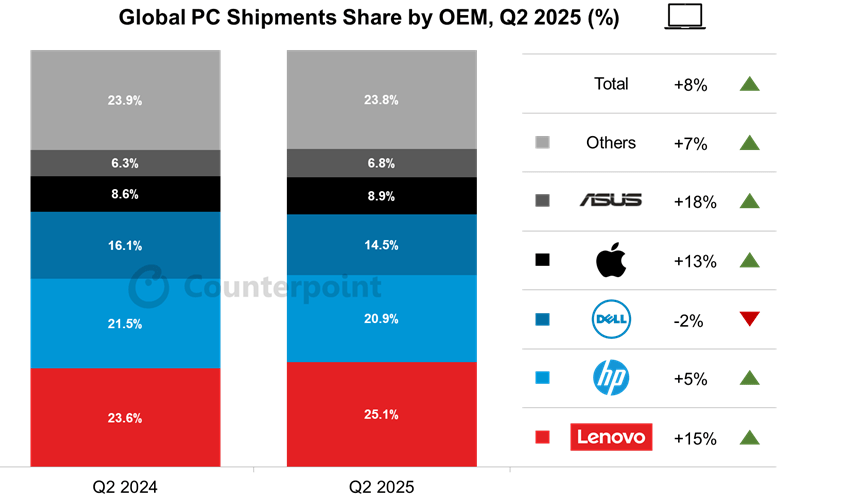
Tariff Uncertainty Clouds Outlook
Despite the positive momentum, uncertainty surrounding U.S. tariff policy has prompted many OEMs to adopt a cautious stance. Manufacturers are reassessing their production strategies and relocating operations to mitigate potential tariff risks.
The commercial segment was the primary growth driver in Q2, as large enterprises, educational institutions, and public sector organizations accelerated device upgrades ahead of the Windows 10 end-of-support deadline in late 2025.
In the consumer market, mid-range notebooks saw moderate growth, although demand for premium ultrathin models in mature regions like Australia fell short of expectations.
Market Leaders and Shifting Dynamics
Lenovo retained its leadership position, accounting for approximately 25% of global shipments during the quarter. The Windows 10 replacement cycle also contributed to gains, with ASUS expanding its footprint in both B2B and education sectors.
HP reported steady enterprise demand but is facing competitive pressure from smaller OEMs offering aggressive pricing. Apple continued to see strong MacBook sales, supported by its refreshed M4 series, although its growth was more tempered compared to previous quarters.
Senior Counterpoint Analyst Minsoo Kang warned that U.S. tariff-related uncertainty could dampen PC shipments in the second half of 2025. However, he expects AI laptops to become a major growth driver in 2026, projecting that more than half of all laptops shipped from that year onward will feature AI capabilities.