Has Apple Finally Cracked? Desperate Lawsuit Against OpenAI Exposes A Company Fighting To Protect Its Past Rather Than Build Its Future
 David Richards
15 Jul 2026
David Richards
15 Jul 2026
Apple’s blockbuster lawsuit against OpenAI may have been intended to protect its intellectual property, but it has also exposed what could be the company’s biggest crisis since Steve Jobs reinvented Apple with the iPhone.
Instead of unveiling the next breakthrough product capable of changing the technology industry, Apple has marched into court accusing OpenAI and former employees of stealing trade secrets, a move many observers see as highlighting a far deeper problem.
Apple is losing talent.
It is losing momentum.
It’s also lost a lot of court cases during the past five years including here in Australia.
Even Samsung may have already spoilt their foldable ambitions with what they are about to launch into the foldable market.
And increasingly, it is losing the confidence of investors who are questioning whether the world’s most valuable consumer technology company still knows how to innovate.
The irony is impossible to ignore.
The company now sitting in Apple’s legal crosshairs has become one of the biggest employers of former Apple engineers.
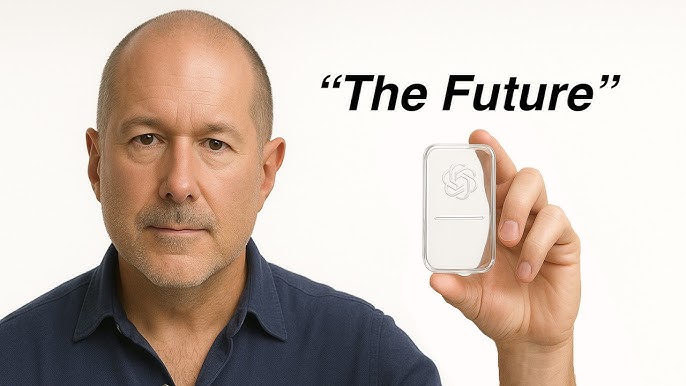
Jony Ive with Open AI
More than 400 former Apple employees are now reported to be working at OpenAI, including senior executives, hardware architects and engineers who once helped build Apple’s most successful products.
Among those helping shape OpenAI’s hardware future is Sir Jony Ive, the legendary designer who transformed Apple from a struggling computer maker into the world’s most admired consumer electronics company.
Without Ive’s vision and Steve Jobs’ leadership, many analysts argue Apple would never have become the company it is today.
Now the man who helped define Apple’s golden era is working on what could become its biggest competitive threat.
That reality appears to have rattled Cupertino.
Rather than dominating headlines with a revolutionary AI device or game-changing hardware platform, Apple is instead attempting to stop a rival through the courts.
Apple has sued OpenAI and two former Apple employees, alleging trade secret theft and accusing the AI company of systematically harvesting confidential Apple information through recruitment interviews.
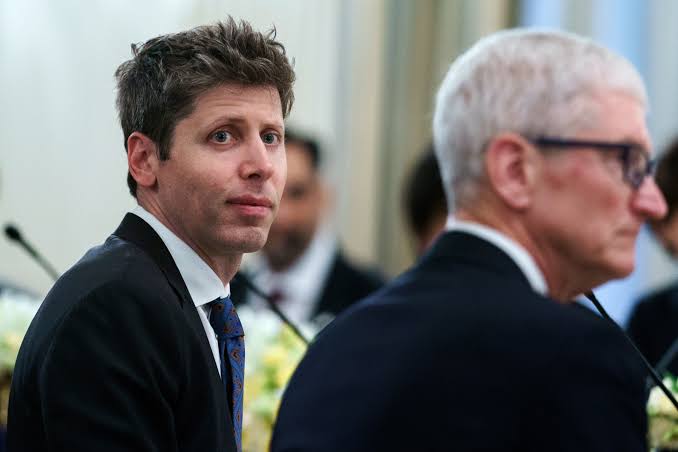
Sam Altman Open AI CEO seen with Apple CEO Tim Cook during a recent tour to China
The lawsuit also targets io Products, the hardware startup founded by Ive and later acquired by OpenAI, alleging it participated in what Apple describes as “a coordinated pattern of misconduct at an institutional level.”
OpenAI has flatly rejected the allegations.
“We’re not aware of any evidence that this complaint has merit,” the company said.
“We believe in fair competition and allowing people the freedom to work wherever they choose, and we’re focused on building innovative technology that empowers people everywhere.”
According to Apple’s complaint, former iPhone executive Tang Yew Tan questioned prospective recruits about confidential Apple projects and allegedly encouraged candidates to bring unreleased hardware, including batteries and logic boards, to interviews.
Apple also alleges another former engineer copied confidential engineering presentations before leaving for OpenAI.
The accusations are serious.
Whether Apple can prove them remains another matter.
What is equally significant is what the lawsuit reveals about Apple’s growing anxiety over OpenAI’s hardware ambitions.
News Corp publications, including The Wall Street Journal and The Australian, have suggested the case may also provide Apple with an opportunity to use the legal discovery process to uncover exactly how advanced OpenAI’s hardware development has become.
In other words, the courtroom could become Apple’s intelligence gathering operation.
The timing could hardly be worse.
Apple’s AI strategy has been widely criticised as late, fragmented and lacking the bold vision that once defined the company.
While rivals including Microsoft, Nvidia, Meta and OpenAI race ahead, Apple continues to struggle to convince investors it has a compelling answer to the AI revolution.
Bloomberg data shows fewer than 60% of analysts currently rate Apple a Buy.
By comparison, roughly 90% of analysts covering Microsoft, Amazon, Meta and Nvidia recommend buying those companies.
That is an extraordinary shift for a company that once set the pace for the entire technology industry.
Legal experts believe the battle also underlines where the next technology war will be fought.
“The next frontier is going to be AI hardware, more than just chips,” said Charlyn Ho, CEO of Rikka Law Group.
“Robotics and other types of physical AI are the next areas ripe for disruption.”
She said OpenAI’s recruitment of experienced Apple hardware engineers makes commercial sense if it intends to accelerate development.
The lawsuit also throws fresh attention onto Apple’s own lengthy legal history.
Apple has spent decades aggressively pursuing competitors through the courts while simultaneously defending itself against allegations of patent infringement, anti-competitive conduct and intellectual property breaches.
Over the past five years alone, the company has suffered a string of costly legal defeats and settlements.
These include a US$634 million patent infringement verdict in favour of Masimo, a US$502.8 million judgment in the VirnetX patent case, a US$250 million Siri privacy settlement and multiple iPhone battery throttling settlements across several countries worth hundreds of millions of dollars.
Apple was also found in contempt during the Epic Games legal battle after violating a court injunction governing App Store payment rules, a ruling with potentially multi-billion-dollar implications for its services business.
Collectively, those legal defeats and settlements amount to well over A$2.5 billion before legal fees, interest and ongoing royalty obligations are included.
Apple has also previously faced allegations from battery manufacturer A123 Systems that it poached engineers and misappropriated battery technology. That dispute settled before trial, and there was no judicial finding that Apple stole trade secrets.
Whether Apple’s latest lawsuit succeeds will ultimately be decided in court.
But one uncomfortable question already hangs over Cupertino.
Is Apple genuinely protecting valuable intellectual property, or has one of the world’s richest companies resorted to litigation because it can no longer stop its most dangerous competitors through innovation alone?
For a company that built its reputation on changing the future, the optics are difficult to ignore.
Apple no longer appears to be leading the AI race.
It increasingly looks like it is chasing it.