Meta Takes Privacy Concerns Head-On With New Camera-Free AI Glasses
 Dominic Bayley
24 Sep 2026
Dominic Bayley
24 Sep 2026

Meta is expanding its push into wearable technology, unveiling a new range of AI-powered glasses and a lightweight mixed-reality headset at its annual Connect conference.
The company introduced several new wearable devices, including an audio-only version of its smart glasses that removes the camera entirely. The move comes as concerns continue to grow around privacy and the potential misuse of camera-equipped wearables, particularly when people are recorded without their knowledge or consent.
Meta CEO Mark Zuckerberg announced the new lineup at the company’s headquarters in Menlo Park, California, while also highlighting Muse, the company’s new personal artificial intelligence assistant.
Zuckerberg said almost two billion people around the world already wear glasses, arguing that many of those glasses could eventually be upgraded with AI capabilities.
Meta’s new audio-only glasses will launch in the US on October 13, starting at US$349. Unlike the company’s existing smart glasses, they don’t include cameras for taking photographs or recording video.
The new model is being introduced alongside dozens of other smart-glasses variants that retain camera functionality. Meta says its glasses can be used for listening to music, making calls, translating text, taking photos and videos, and interacting with an AI assistant.
Privacy has become an increasingly important issue as these devices become smaller and more discreet. Meta’s glasses include a recording indicator light designed to make it clear when the camera is being used.
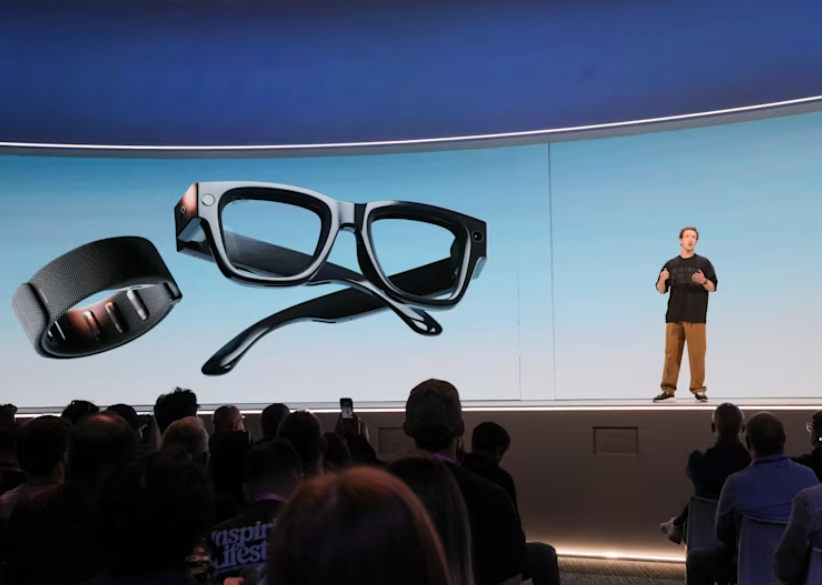
Vishal Shah, Meta’s vice president of AI products, said the company believes making the recording indicator highly visible is an important part of addressing privacy concerns.
Meta first introduced its smart glasses in 2021 and has continued expanding the range through its partnership with eyewear giant EssilorLuxottica, which produces Ray-Ban and Oakley models featuring Meta’s technology.
Meta also announced additional versions of its flagship Meta Ray-Ban smart glasses.
The company’s display-equipped glasses, which start at US$799, will soon expand into additional markets including the UK, France, Italy, Germany and Canada.
These glasses combine traditional eyewear with cameras, speakers and AI features, while the display models can project information directly into the wearer’s field of view.
Meta also showed off a new generation of mixed-reality glasses designed to be significantly lighter than its previous Quest VR headsets.
Called Meta VR Glasses, the headset uses an external battery and memory pack connected by a cable. Moving those components away from the headset itself allows Meta to reduce its weight.
Zuckerberg compared the weight of the glasses to roughly that of a deck of playing cards.
The headset doesn’t feature conventional external controls. Instead, users interact with it through hand gestures and voice commands.
Meta plans to launch the VR Glasses in the US in spring 2027, with a starting price of US$1,299.
With billions of people already using Meta’s social platforms every month, the company is clearly betting that glasses and other wearables could become a major gateway to its AI technology. The latest devices show just how far Meta is pushing that strategy – from camera-free audio glasses to AI-equipped eyewear and increasingly lightweight mixed-reality hardware.
Australian release dates and pricing is yet to be announced.