Inside Story On LG’s Shocking Dead Last Failure Of Their 5G OLED TV
 David Richards
31 Jul 2025
David Richards
31 Jul 2025

Serious questions are now being asked about the quality and performance capability of LG OLED TVs especially their G5 OLED model that finished a shocking dead set last in a major shootout run by experts and professional industry reviewers.
Nilay Patel is editor-in-chief of The Verge, host of the Decoder podcast, and co-host of The Vergecast, was recently a judge in the recent Value Electronics 2025 shootout in New York, that saw LG’s top of the range G5 OLED TV come in dead last after Patel and a top team of judges were asked to assess some of the best OLED TVs on sale today at retailers.
In an in-depth analysis of why LG’s top of the range TV failed so badly up against premium models from Sony, LG, Panasonic, and Samsung, he has revealed some concerning issues around LG’s OLED offering.
The judges were asked to objectively evaluate how closely the images on each set matched a pair of $43,000 Sony BVM-HX3110 professional reference monitors across a number of categories in a very dark room, using both test patterns and real content delivered from a Panasonic Blu-ray player, a Kaleidescape streaming box, and an Apple TV, all switched by an AVPro Edge 8×8 HDMI matrix and delivered over Bullet Train optical HDMI cables.
Patel claims that the shocker result of the 20 year old shootout event was the dismal showing by the LG G5 especially as it featured the South Koreans Companies latest tandem OLED panel.
“There’s no other way to say it: the G5 basically failed several of the tests, showing the wrong colours on some of the linearity test patterns, big posterization artifacts in dark scenes, a slight green cast that kept reappearing, and an overall tendency to push colour and brightness in dark scenes in ways that did not require display nerds to see. The LG made Sansa Stark look like she had a blocky red rash during a particularly dim Game of Thrones scene that the Sony and Samsung handled nearly perfectly” he said.
“There are lots of problems with the LG TV this year,” said judge Cecil Meade.
I heard other judges say, “Have you seen what the LG is doing?” more than once. Indeed, the G5 was so far off on some of the test patterns that Dwayne reminded the judges that the lowest possible score was 1, not 0. This is generally a bad sign.
He said that if he had to explain why the LG did so poorly while other TVs did so well use the same panel, I’d put it down to confidence, bordering on cockiness.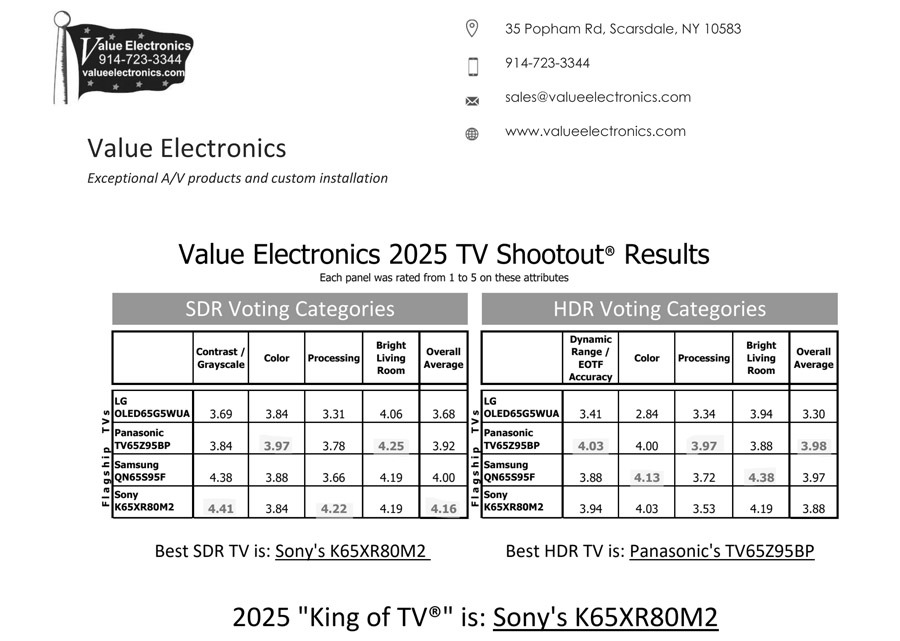
The massive failure also raises questions about the performance capability of LG’s Alpha 11 A1 Gen 2 processor.
Listen to LG and they will tell you that the LG G5 OLED TV is powered by the Alpha 11 AI Processor Gen 2 which is being described as the next-generation processor that was supposed to enhances picture and sound quality through AI.
This included including features like AI Picture Pro and AI Super Upscaling.
They claim it supports functionalities like OLED Dynamic Tone Mapping and up mixing, along with features like “Recognise You”, “Customise to You”, and “Care Around You”.
All the TV’s used in the shootout were shipped stock models.
See original story here and how Sony came out on top.
Other judges at the shootout included:
- Ilya Akiyoshi, a cinematographer who’s worked on The White Lotus and Captain America: Civil War
- Todd Anderson, a certified THX calibrator and host of the Home Theatre News Review podcast
- Chris Boylan, an ISF-certified calibrator and editor-at-large of eCoustics
- Jason Dustal, an ISF calibration instructor and co-chair of the CEDIA standards committee
- Jeffrey Hagerman, a cinematographer and colourist
- Cecil Meade, an ISF-certified calibrator known as ClassyTech on the AV forums
- John Reformato, an ISF-certified calibrator
- Mike Renna, an ISF-certified calibrator
- Richard Drutman, a filmmaker
- David Mackenzie, CEO of Fidelity in Motion, a compression and mastering company