Global Smartphone Shipments Rise 3% as Emerging Markets Drive Recovery
 Isabella Alexiou
30 Oct 2025
Isabella Alexiou
30 Oct 2025

The global smartphone market shipped 320.1 million units in Q3 2025, representing a 3% year-on-year increase and signalling recovery from flat first-half performance, according to Omdia research.
The first half of 2025 faced challenges including U.S. tariff policy uncertainty, supply chain restructuring, cautious channel sentiment from slow retail traffic, and vendor inventory adjustments.
After inventory corrections in Q3, vendors seized channel opportunities and brought forward product launches to align with back-to-school and festive periods.
Samsung, Apple, Transsion, and Lenovo each shipped over two million additional units year-on-year, driving market growth.

Samsung remained the world’s leading vendor, shipping 60.6 million units (+6% YoY).
Growth came from premium Galaxy Z Fold7/Flip7 models alongside Galaxy A07 and A17 in the mid-to-low-end segment, with strong Galaxy A series sales in Asia-Pacific and the Middle East.
Apple shipped 56.5 million units (+4% YoY) as the brand prepared for the festive Q4.
The base iPhone 17 outperformed launch expectations due to improved value proposition with higher storage capacity without price increase.
The iPhone 17 Pro and Pro Max drew strong global demand, with rising demand from emerging markets including India expected to support full-year growth.

Xiaomi maintained 1% growth with 43.4 million units.
While Chinese shipments declined after subsidy programs ended, Asia-Pacific and other regions offset the decline.
Transsion rose to fourth place with shipments up 12% YoY following inventory adjustment completion.
Vivo remained strong in India, overtook Huawei in Chinese market share, and grew across Asia-Pacific, Africa, and Latin America.
North America and Greater China declined year-on-year, while Asia-Pacific, the Middle East, and Africa recorded strong growth driving overall global expansion.
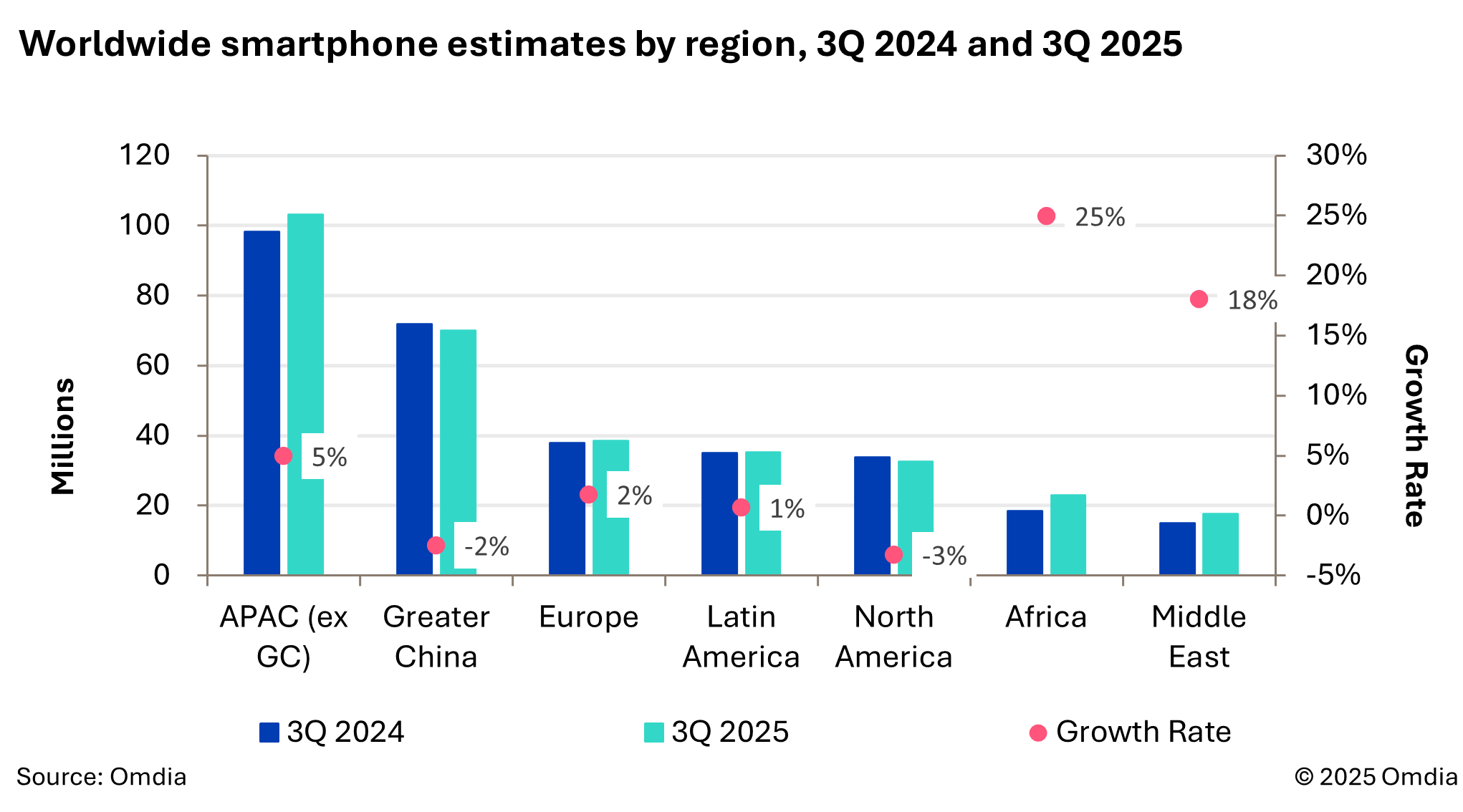
Africa surged 25% YoY as Transsion ramped up activity following earlier inventory adjustments.
Asia-Pacific increased 5% YoY, the highest quarterly volume since Q4 2021.
North American shipments dropped after early pull-in triggered by tariff uncertainties concluded, while China recorded its second consecutive quarterly decline following government subsidy expiration.
The market shows polarised growth with expansion in ultra-low-end (below USD $100, approximately A$150) and high-end (above USD $700, approximately A$1,050) segments, while mid-range remains weak.
Recent component shortages and rising costs have emerged as industry challenges, with effects expected to result in higher new product pricing short-term and hinder low-end segment demand growth.
“Vendors may adopt different strategies to tackle this common challenge, securing channel funding early, prioritising high-margin models, keeping mid- and low-end devices on a defensive stance, and leveraging scaling to strengthen supply chain bargaining power. Regardless, maintaining profitability remains their shared top priority,” said Jusy Hong, Senior Research Manager at Omdia.