CES 2026: Audio Now A Serious Part Of Samsung’s Consumer Business As New Range Revealed
 David Richards
30 Dec 2025
David Richards
30 Dec 2025
Samsung, following its recent acquisition of Masimo’s Consumer Audio business through its Harman subsidiary, is preparing to make a major statement at CES 2026. With iconic brands such as Bowers & Wilkins, Denon, and Marantz now under its control, Samsung enters 2026 with access to some of the world’s most respected audio engineers—and a clear ambition to become a dominant force in the global audio market.
At CES 2026, Samsung will unveil an all-new lineup of soundbars and wireless speakers for the year ahead, alongside its next generation of televisions. Audio is no longer an accessory to Samsung’s display business—it is now a strategic pillar. With Harman’s deep portfolio of processors, DSP technology, and proprietary audio software, Samsung is positioning sound as a defining part of its consumer electronics ecosystem.
Hun Lee, Executive Vice President of Visual Display Business at Samsung Electronics, has made the company’s intent clear.
“For more than a decade, Samsung has shaped the evolution of home audio through advanced acoustics, intelligent features, and thoughtful design,” Lee said. “We’re continuing that legacy with next-generation sound devices designed to deliver rich, expressive performance for any space and moment.”
As consumers increasingly prioritize premium sound to match premium displays, Samsung is expanding and refining its Q-Series soundbars for 2026. The new range offers greater scale flexibility and advanced AI-driven audio processing that can analyze room size, layout, and even the number of people present. These AI enhancements are designed to deliver a more immersive experience without the cost or complexity of a traditional home-theater build-out.
For those seeking dedicated high-end audio solutions, Samsung now owns an unparalleled stable of premium brands, including Bowers & Wilkins, Harman Kardon, AKG, Infinity, Lexicon, Mark Levinson, Arcam, Revel, and MartinLogan. The portfolio also includes Denon, Marantz, Polk Audio, Definitive Technology, Classe, and HEOS software—giving Samsung unmatched coverage from lifestyle audio to reference-grade performance.
At the top of Samsung’s 2026 soundbar lineup sits the new flagship HW-Q990H, replacing the 2025 HW-Q990F. Both models feature an 11.1.4-channel configuration, combining a 7.0.2 main bar, 4.0.2 rear speakers, and a compact active subwoofer with dual 8-inch drivers engineered to deliver powerful low-end performance without overwhelming living spaces.
The defining difference for 2026 is AI enhancement. All 2026 Samsung audio models will carry an “H” suffix, replacing the “F” designation used in 2025. The upgraded AI software improves vertical sound elevation and better anchors dialogue to the center of the screen, eliminating the sensation of audio floating below the picture. Auto volume control has also been refined to maintain consistent levels across sources and scenes, reducing abrupt jumps between dialogue and effects without sacrificing impact.
Samsung is also introducing a new all-in-one soundbar, the HW-Q990H, designed for users who want premium sound without modular complexity. The QS90H features a self-contained 7.1.2-channel design with 13 drivers, including nine wide-range speakers, and eliminates the need for separate surrounds or a dedicated subwoofer. Its Quad Bass Woofer system delivers meaningful low-frequency performance from a single enclosure.
A Convertible Fit design allows for both wall-mounted and tabletop installation, while an integrated gyro sensor automatically adjusts channel mapping based on orientation—ensuring optimal sound regardless of placement.
Beyond soundbars, Samsung is expanding its wireless speaker portfolio with two new Wi-Fi models for 2026: the Music Studio 7 and Music Studio 5. Designed to integrate seamlessly across Samsung’s broader audio ecosystem, the Music Studio series emphasizes refined, room-friendly sound rather than sheer volume.
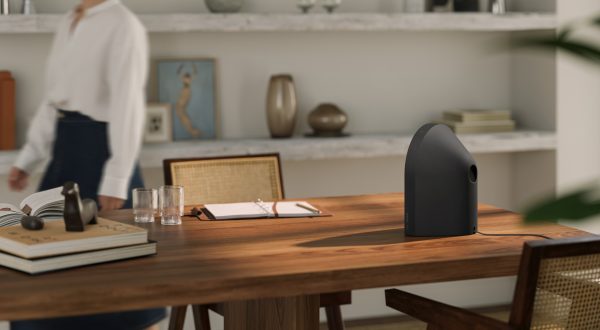
Both speakers feature a distinctive “dot” design created by renowned designer Erwan Bouroullec, drawing inspiration from universal visual language while remaining consistent with Samsung’s industrial design ethos. The result is audio hardware that blends naturally into living spaces rather than demanding attention.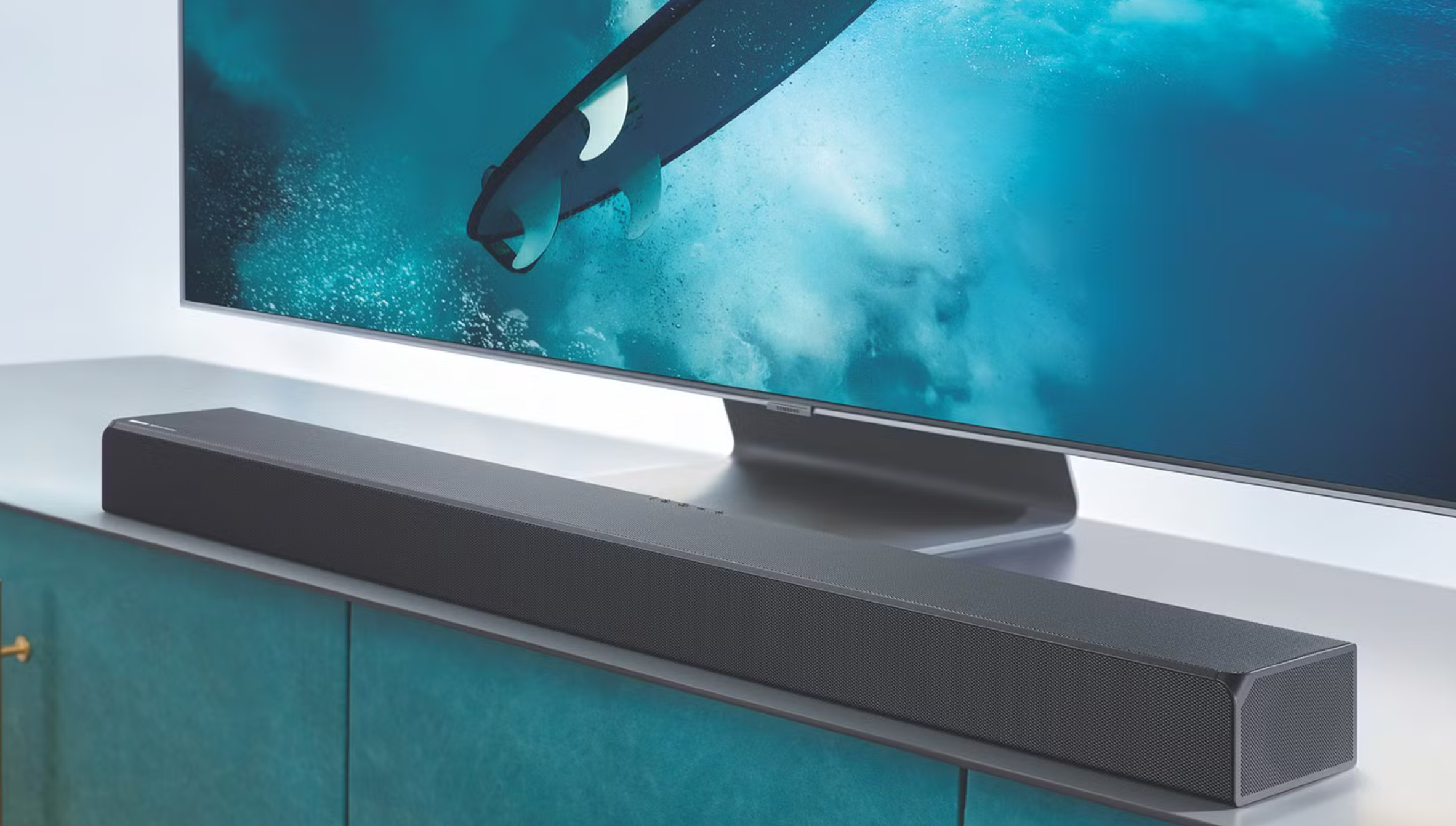
The Music Studio 7 (LS70H) is the most advanced of the two, offering a 3.1.1-channel spatial audio configuration with left, center, right, and top-firing drivers to create immersive sound from a single enclosure. Core technologies include Audio Lab Pattern Control, which manages sound distribution to reduce congestion and improve clarity, and AI Dynamic Bass Control, which delivers deep, controlled low frequencies with minimal distortion while supporting high-resolution audio up to 24-bit/96kHz.
Finished in black, the Music Studio 7 can operate as a standalone speaker or integrate with compatible Samsung soundbars, TVs, and Wi-Fi speakers via Q-Symphony for expanded stereo or surround configurations.
The more compact Music Studio 5 (LS50H) takes a décor-friendly approach without sacrificing performance. Tuned by the Samsung Audio Lab in Valencia, it features a 4-inch woofer and dual tweeters, delivering balanced bass, clarity, and everyday usability. It supports Wi-Fi casting, streaming services, voice control, and Bluetooth, making it an understated but versatile addition to modern homes.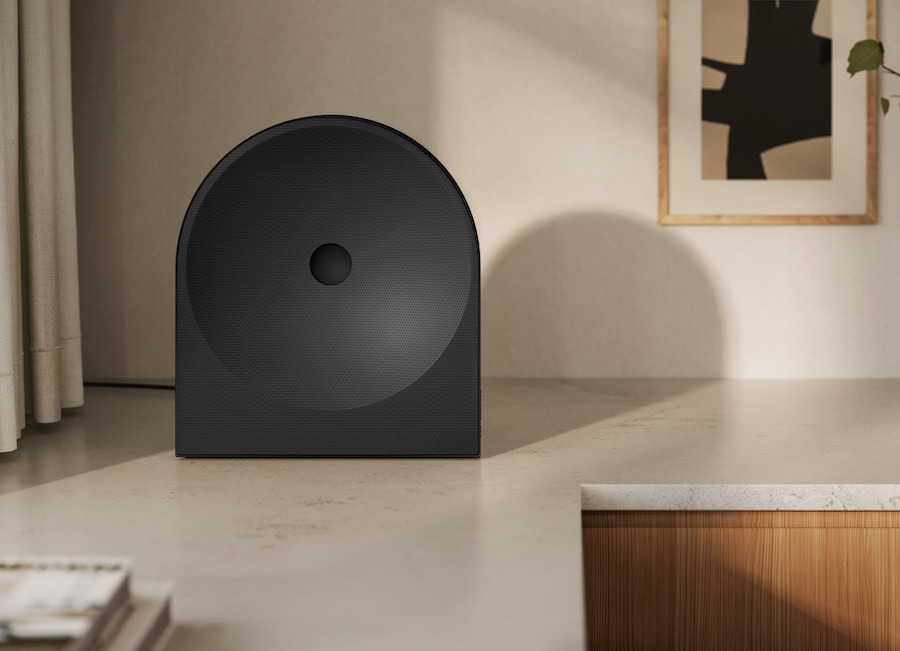
Q-Symphony itself has evolved into a more flexible and intelligent platform for 2026. The system now supports up to five audio devices connected to a single Samsung TV, allowing for wider soundstages and immersive layouts without the complexity of traditional AV receivers. The system also dynamically calibrates output based on room conditions rather than relying on static presets.
Further strengthening the ecosystem is an expanded SmartThings platform, which will act as the central gateway for voice assistant integration and system control, enabling hands-free adjustment of playback, volume, and system behavior.
As rival LG Electronics continues to invest heavily in celebrity endorsements and partnerships with struggling audio brands, Samsung is quietly assembling one of the most formidable audio portfolios in the industry. Best known for its TVs and monitors, Samsung is now a genuine heavyweight in audio.
Ownership of Harman gives Samsung access to elite acoustic engineering, advanced DSP development, and real-world audio tuning expertise that few consumer electronics companies can match. That advantage is clearly reflected in the direction of Samsung’s 2026 lineup—and signals a company intent on reshaping the audio landscape from the ground up.