CES 2026:Hisense To Push Into Premium ‘Water Cooled’ Laser Projector Market
 David Richards
24 Dec 2025
David Richards
24 Dec 2025

Hisense is preparing to make a significant move into the professional laser projector market in Australia with the launch of its new XR10 Water Cooled’ Laser projector.
The Melbourne based Company appears to be preparing to make a significant move into the professional laser projector market in Australia with the launch of its new water cooled XR10 Laser projector.
boasting some truly spectacular specifications including image sizes up to 300 inches, I suspect that Hisense could soon be shopping for customer installers or distributors in the Pr market to sell this new top end model.
It also claims that it’s TriChroma triple laser optical system is capable of outputting a massive 6,000 ANSI Lumens of brightness – the sort of figure that was once the exclusive reserve of only the ultra high end semi-pro projector world.
There’s even an industry-first liquid water cooling system built into the projector’s chassis to save you from the noisy fans you’d otherwise likely have to put up with to keep a 6,000 ANSI Lumens projector cool.
The rapidly expanding Chinese electronics brand which continues to gain share in the Australian TV market, believes its upcoming XR10 and PX4-PRO projectors will deliver technology rarely seen in most premium models.
Both products will be unveiled publicly for the first time at CES 2026.
These latest additions form part of Hisense’s long-term strategy to focus on large-format displays, advanced colour reproduction, and more flexible management solutions designed to simplify projector setup for optimal large-screen viewing.
ChannelNews readers may recall that Hisense introduced its first laser projector at CES in 2014. More than a decade later, the company claims its latest offerings represent a major leap forward in performance and capability.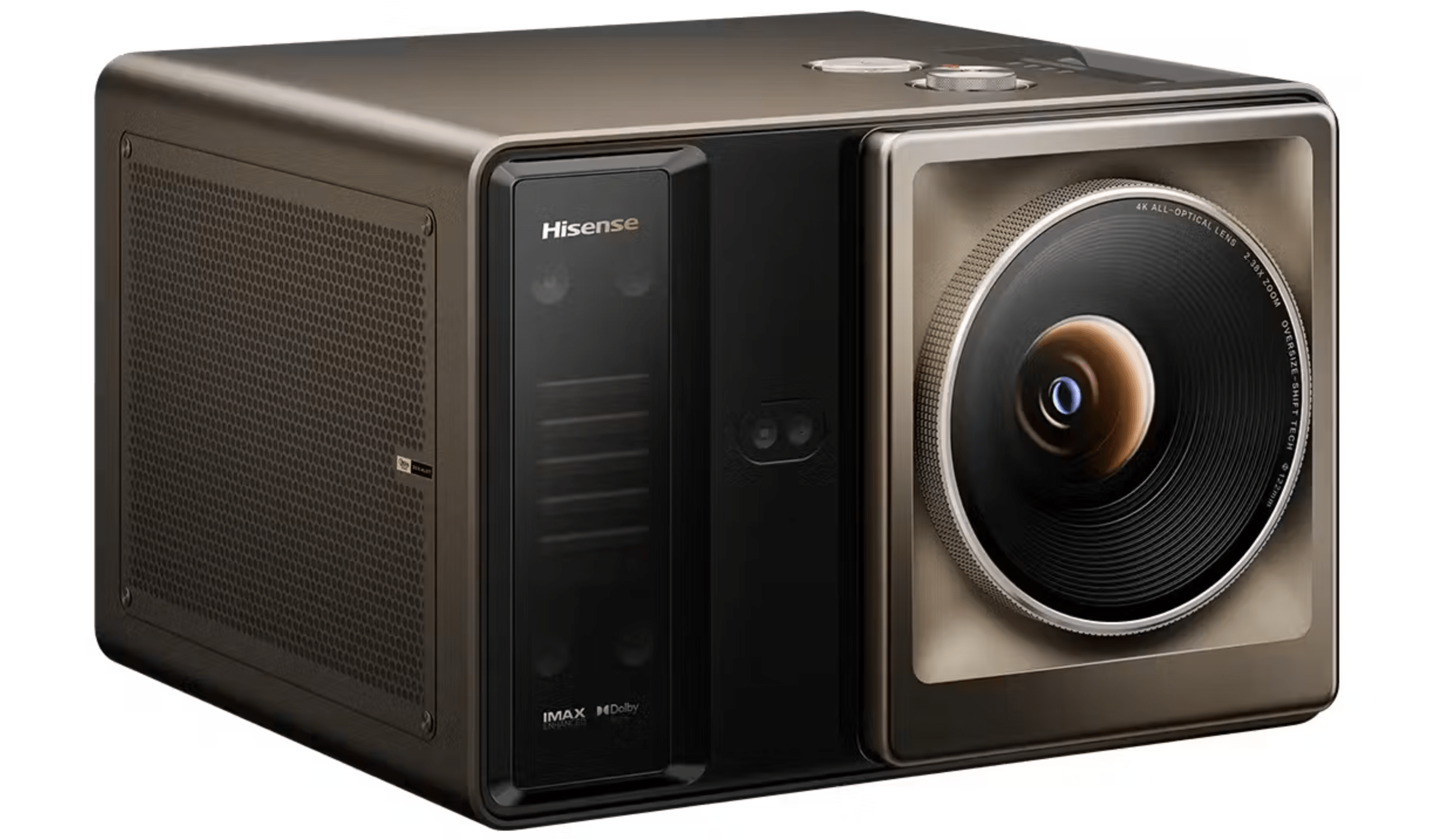
One of the key highlights at CES 2026 is the continued expansion of Hisense’s TriChroma laser technology, first introduced in 2019. The company’s emphasis on multi-primary colour and wide colour gamut performance has helped it stand out, and this year Hisense builds on that foundation with the introduction of two new models: the XR10 and PX4-PRO. Both projectors are designed to support a wide range of screen sizes—from 65 to 300 inches—and suit a variety of installation environments.
The XR10 is positioned as a premium laser projector aimed at users seeking a cinema-like experience without the need for a fixed home theatre installation. Despite its compact size, the XR10 features a pure RGB triple-laser light source, an upgraded chipset, and Hisense’s LPU 3.0 Digital Laser Engine. According to the company, this configuration allows the projector to perform effectively in brighter rooms, delivering up to 6,000 ANSI lumens of brightness.
The optical system incorporates 16 all-glass lenses to improve thermal stability and light transmission, along with a new dynamic IRIS system that adjusts exposure and aperture in response to changing lighting conditions. Together, these technologies are designed to deliver contrast levels of up to 6,000:1 while preserving detail in both dark and bright scenes.
Thermal management is handled by a fully sealed microchannel liquid-cooling system, which improves heat dissipation and helps maintain long-term performance. Hisense has also focused on enhancing colour accuracy, offering increased BT.2020 colour coverage and reduced laser speckle for a cleaner, more uniform image. Installation flexibility is further supported through a wide optical zoom range, intelligent image correction using multiple cameras and sensors, and both vertical and horizontal lens shift.
Alongside the XR10, Hisense also introduced the PX4-PRO, an ultra-short-throw laser projector designed for more casual home theatre environments. Building on the PX3-PRO, the new model delivers 4K resolution, a maximum contrast ratio of 6,000:1, brightness of 3,500 ANSI lumens, and support for screen sizes up to 200 inches. Its compact, space-efficient design makes it well suited to living rooms, while features such as TriChroma laser technology, IMAX Enhanced certification, and low input latency target both movie enthusiasts and gamers.