Smartphone Shipments Crash 20% to 14-Year Low as Memory Shortages Bite
 Emma Wheaton
13 Oct 2026
Emma Wheaton
13 Oct 2026

Global smartphone shipments have fallen to their lowest level in 14 years, declining 20% year-on-year as memory supply constraints continue to affect availability, according to market research firm Counterpoint Research.
Counterpoint’s research highlighted the growing pressure on the global smartphone market, with memory shortages emerging as a key factor behind the sharp contraction. The downturn points out the vulnerability of smartphone production to disruptions in components supply.
The mounting pressure from rising DRAM and NAND memory prices have inflated manufacturing costs and forced smartphone makers to rethink pricing, production and product strategies.
Global smartphone retail prices have risen 20% so far this year, according to Counterpoint, putting additional pressure on consumers already facing affordability challenges.
The downturn is widening the gap between premium handsets and more affordable devices, with buyers seeking to hold on to their phones for longer, consider refurbished models and increasingly prioritising value when upgrading.
Samsung retained its position as the world’s largest smartphone supplier in Q3, with a 23% market share despite shipments falling 3% year-on-year.
The South Korean manufacturer recorded the largest market-share gain among major brands, benefiting from its premium product mix, strong early demand for its Galaxy Z foldable range and relatively stable component supplies for its Galaxy A-series devices in emerging markets.
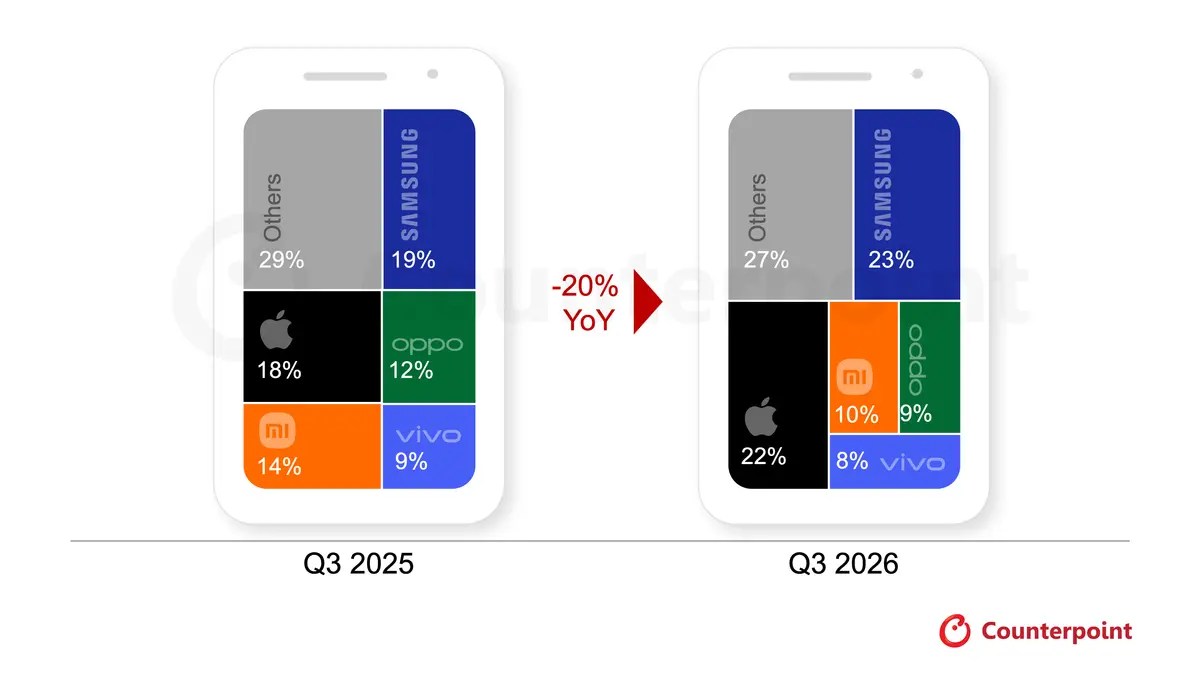
Source: Counterpoint Research’s preliminary Market Monitor report, Q3 2026 (based on sell-in) Note: OPPO includes OnePlus and realme. Percentage totals may not add up to 100% due to rounding.
Apple also strengthened its position, capturing 22% of the global market, notably the first time its share has exceeded 20% in a third quarter.
Despite this, Apple’s shipments still declined year-on-year, likely due to launch timings. Counterpoint attributed much of the fall to the absence of a base iPhone 18 during the quarter. This meant there was a smaller initial distribution of new devices compares to last year’s iPhone 17 launch cycle.
The iPhone 18 Pro models reportedly enjoyed a stronger launch than their predecessors, particularly in China and India, while continued demand for the iPhone 17 range helped cushion the decline.
Chinese manufacturers faced a tougher environment.
Xiaomi recorded a shipment decline of more than 30%, with its market share falling to 10%. The company reduced its exposure to lower-priced devices and less profitable overseas markets but raised its average selling prices and tightened shipment plans.
OPPO and vivo also had shipment declines exceeding 20%, with market shares falling to 9% and 8%, respectively. Both increased prices across entry-level and mid-range portfolios as memory costs increased.
 OPPO is consolidating operations across its OPPO, realme and OnePlus brands to reduce duplication and improve cost efficiency. Vivo, meanwhile, is concentrating on core markets including India and China and continues to develop its premium X, V and S series.
For consumers, budget and mid-range phones are expected to be exposed to price increases in line with higher component costs. There is also expected to be limited availability as supply issues hit.
Counterpoint expects manufacturers to continue prioritising profitability over shipment volumes, with smaller product portfolios and more focus on premium devices.
Smartphone makers continue to face a tricky balancing act of securing components, controlling costs and sustaining consumer demand. Until memory costs and supply conditions improve, this is unlikely to improve