Oh Dear Optus CEO Believes They Have Fixed Their Problems, Maybe Someone Should Tell Him
 David Richards
15 May 2026
David Richards
15 May 2026

Optus is once again attempting to rebuild trust in a brand now synonymous with crisis, dysfunction and corporate failure, launching a multimillion-dollar national advertising blitz at the very moment customers are still battling some of the most basic service failures imaginable.
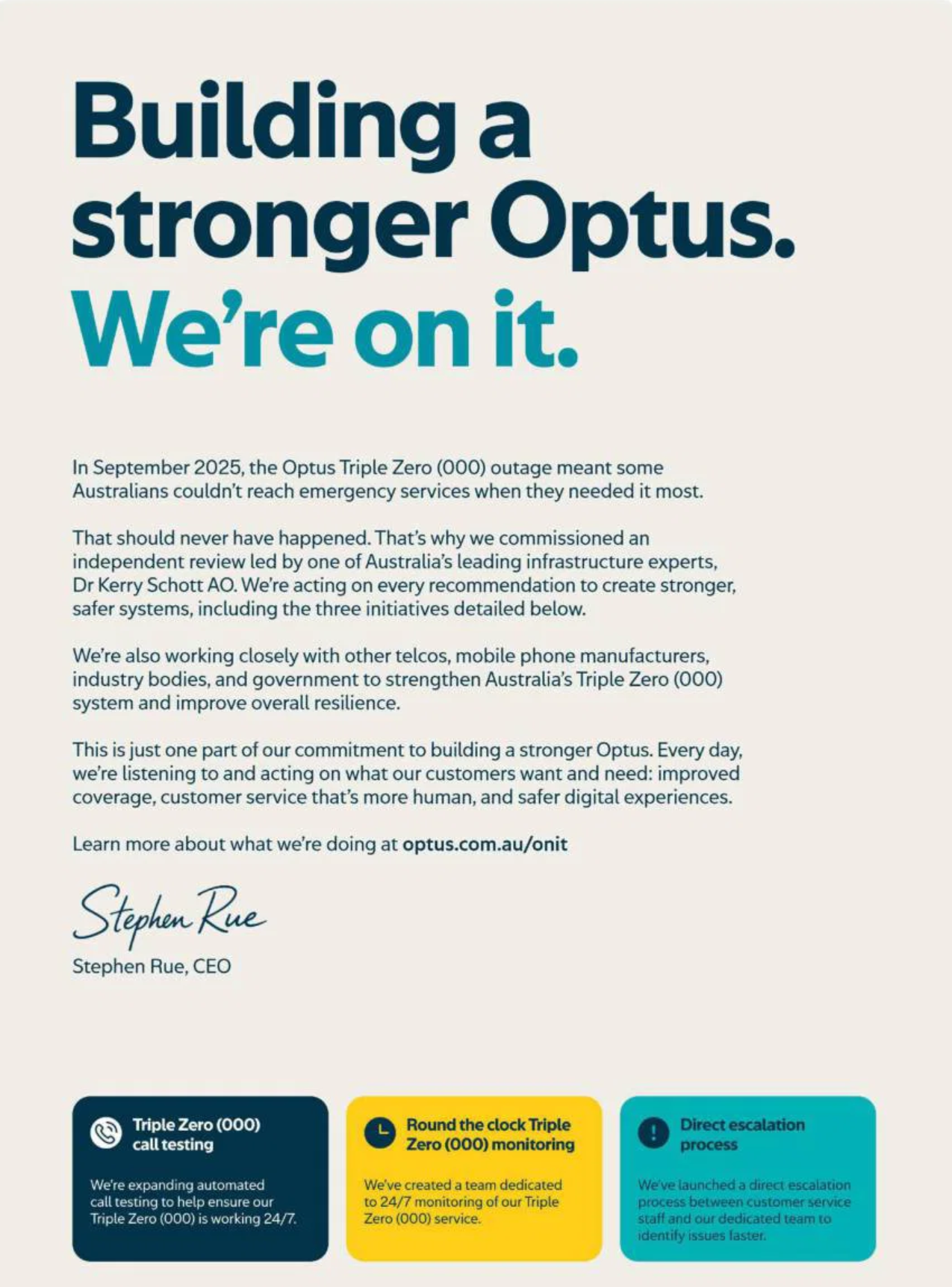
In full-page newspaper advertisements across Australia, Optus CEO Stephen Rue declared that the telco’s catastrophic nationwide outage “should never have happened”, while promising the company had strengthened its network and improved customer experience.
The glossy apology campaign, signed personally by Rue, is designed to convince Australians that Optus has changed. It will be backed by radio, digital, social media and outdoor advertising in what insiders describe as one of the company’s biggest reputation-repair exercises in years.
But behind the carefully crafted marketing spin, customers are continuing to encounter a company that appears incapable of consistently delivering even fundamental operational competence.
This week, ChannelNews was confronted with yet another example of what critics increasingly describe as systemic dysfunction inside Optus — a broken NBN payment system unable to process perfectly valid debit cards, despite multiple cards being tried.
For many consumers, the incident was not an isolated technical hiccup. It reinforced a growing perception that Optus is no longer suffering from occasional mistakes, but from a deeply embedded culture of operational breakdowns, poor governance and chronic underinvestment in systems and customer support.
The question now being openly asked is brutal: does Optus management genuinely understand the scale of the collapse occurring inside the organisation, or have the company’s systems, outsourcing strategies and script-driven offshore call centres become so dysfunctional that no amount of CEO apologies or expensive advertising can restore public confidence?
Once viewed as a stable telecommunications giant and a reliable earnings engine for Singapore parent Singtel, Optus is now increasingly being seen by investors as a high-risk operational liability weighed down by relentless reputational damage.
Analysts have started referring to an “Optus discount” — a persistent drag on investor sentiment caused by repeated crises that continue to undermine confidence in the company’s leadership and infrastructure.
What makes the situation particularly damaging is the sheer scale and frequency of the failures.
First came the devastating 2022 cyberattack that exposed the personal information of almost 10 million Australians, triggering national outrage and years of legal, regulatory and reputational fallout.

CEO Stephen Rue, someone needs to tell him about his billing system.
Then came the disastrous 2023 nationwide outage that paralysed communications across the country, crippling businesses, transport systems and emergency services.
By 2025, the crisis deepened further when a Triple Zero emergency outage was linked to fatalities, igniting Senate hearings, regulatory scrutiny, pending court action and the looming threat of massive penalties and compensation payouts.
At that point, what may once have been dismissed as bad luck started to look far more serious — a pattern of systemic governance failure inside one of Australia’s largest telecommunications companies.
Now, in 2026, customers are still encountering failures so basic that Optus systems reportedly cannot reliably process legitimate card payments.
Critics argue the company’s problems stem from years of prioritising efficiency, outsourcing and cost cutting over resilience, infrastructure integrity and customer service capability.
And yet, in a paradox that continues to frustrate both critics and investors, Optus’ underlying financial performance remains relatively solid.
The company’s FY26 first-half results showed EBITDA up 7.2 per cent, EBIT rising 27 per cent, revenue increasing 1.7 per cent, continued mobile subscriber growth and stronger enterprise and network-sharing revenue.
Those results surprised many observers because the public narrative surrounding Optus has become overwhelmingly toxic.
Few major Australian brands have suffered such a sustained collapse in public trust. Roy Morgan rankings recently placed Optus among the nation’s most distrusted companies, at one stage ranking it the single most distrusted brand in Australia.
Despite this, Optus is now attempting to engineer one of the country’s largest corporate rehabilitation campaigns under the slogan “We’re On It” — a message supposedly built from “raw and direct feedback” from frustrated customers.
The problem for Optus is that trust is not rebuilt through advertising copy, carefully staged apologies or expensive media campaigns.
It is rebuilt through competence.
And right now, many Australians increasingly believe competence is exactly what Optus no longer has.