JB Hi-Fi Steps Up Supply Chain War As Amazon Ramps Up Australian Logistics Assault
 David Richards
13 Jul 2026
David Richards
13 Jul 2026

JB Hi-Fi has quietly stepped up its battle against Amazon, moving to strengthen its supply chain and home delivery network as the online retail giant pours capital into expanding its Australian logistics operation.
The retailer is now recruiting a Home Delivery Centre (HDC) Network Planner, a move that highlights the growing importance of distribution and fulfilment as the next battleground between Australia’s largest consumer electronics retailer and Amazon.
While JB Hi-Fi executives have publicly downplayed Amazon as their biggest competitive threat, the company’s investment strategy tells a very different story.
Behind the scenes, JB Hi-Fi is investing heavily in faster delivery, advanced logistics, warehouse automation and fulfilment technology in a bid to protect market share as Amazon expands its ability to deliver products directly to Australian consumers.
The timing is significant.
JB Hi-Fi is coming off one of its strongest financial performances, with first-half FY26 sales rising 7.3% to $6.1 billion, EBIT climbing 8.1% to $454 million and net profit increasing 7.1% to $305.8 million.
Online remains the fastest-growing part of the business.
JB Hi-Fi Australia’s online sales jumped 11.2% to $759 million, accounting for 18.4% of total sales, up from 17.6% a year earlier. The group’s websites now attract more than 20 million monthly visits, significantly ahead of Harvey Norman’s estimated 5.5 million monthly visitors.
Despite those numbers, management continues to insist Amazon is not the primary competitive threat.
During the HY26 results briefing, Group CEO Nick Wells argued that JB Hi-Fi competes mainly against traditional omnichannel retailers, saying the company’s focus remained on delivering competitive pricing, service and delivery.
However, industry observers believe the retailer’s investment priorities suggest Amazon is driving many of its strategic decisions.
Instead of attempting to match Amazon warehouse for warehouse, JB Hi-Fi is leveraging one advantage Amazon cannot easily replicate, its nationwide network of physical stores.
The retailer is increasingly transforming stores into local fulfilment hubs capable of supporting click-and-collect, ship-from-store operations, real-time inventory management and faster last-mile delivery.
At the same time, suppliers say JB Hi-Fi is investing heavily in upgraded digital commerce platforms, customer data analytics, recommendation engines and mobile shopping technology designed to improve customer engagement and increase online conversion.
The Good Guys is also understood to be preparing a significant marketplace expansion that could introduce new brands and product categories as it seeks to broaden its online offering.
Management has identified three key growth priorities: improving online fulfilment efficiency, extracting greater productivity from consolidated distribution centres and expanding its B2B commercial business, a market estimated to be worth around $500 million.
Those investments are already flowing through to the company’s operating costs, with selling and administrative expenses continuing to rise as JB Hi-Fi spends heavily on new stores, logistics capability and digital infrastructure.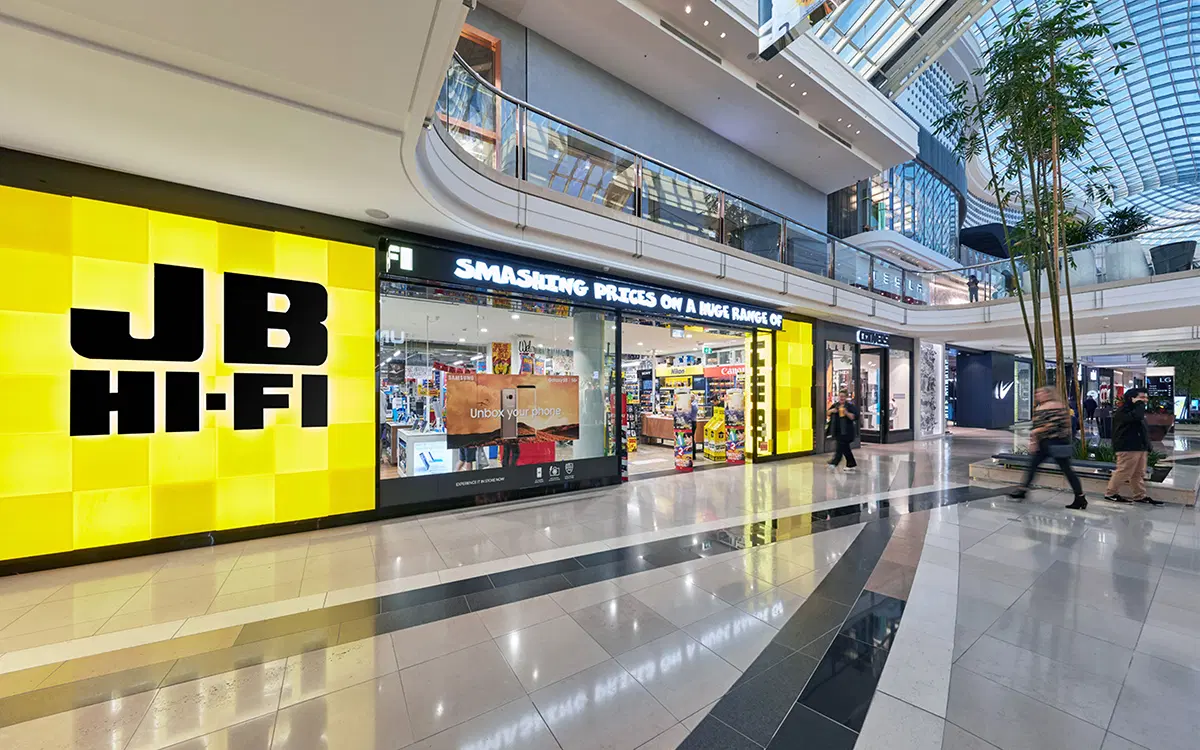
Meanwhile, Amazon is showing no signs of slowing down.
Earlier this year the US retail giant committed $750 million to build a massive 150,000 square metre robotics fulfilment centre in Australia, adding to its existing network of six local fulfilment centres.
The scale of that investment dwarfs anything currently being undertaken by JB Hi-Fi and underscores Amazon’s long-term commitment to dominating Australian online retail.
Investment analysts believe JB Hi-Fi’s omnichannel strategy provides an effective defence against Amazon, but may also limit future earnings growth.
RBC Capital Markets recently highlighted increasing competitive pressure from Amazon while noting that the replacement cycle for consumer electronics may not receive the AI-driven boost many investors had expected.
The broker continues to rate JB Hi-Fi as one of Australia’s highest-quality retailers, supported by an industry-leading cost base and disciplined execution, but believes investors are increasingly viewing the business as a mature retailer rather than a high-growth technology retailer.
That shift in sentiment has been reflected in the share price.
JB Hi-Fi shares have fallen approximately 25% over the past 12 months, significantly underperforming the broader ASX 200, which has gained around 4% over the same period.
The recruitment of a specialist Home Delivery Centre Network Planner provides another indication that JB Hi-Fi believes the next phase of the retail war will not be won on price alone.
It will be won by whoever can place the right product in the customer’s hands the fastest.
For JB Hi-Fi, that increasingly means building a supply chain capable of standing up to the biggest online retailer in the world.