Gerry Harvey Buys More Shares As Harvey Norman Stock Plunges 40%, Retail Downturn Deepens
 David Richards
12 Oct 2026
David Richards
12 Oct 2026

Gerry Harvey is putting his own money behind Harvey Norman shares at a time when the veteran retailer is warning of deteriorating trading conditions, falling store traffic and mounting pressure on Australian consumers ahead of the critical Black Friday and Christmas trading periods.
The Harvey Norman chairman has again been buying shares in the company he founded, despite its market value falling sharply over the past 12 months and analysts warning that Australia’s consumer electronics and appliance market could be entering a prolonged downturn.
The latest reported purchase came on 18 September 2026, when Harvey acquired another 463,000 shares for approximately A$1.9 million.
It was a significant vote of confidence from the billionaire retailer, but it also raises a question for investors: is Gerry Harvey buying into an undervalued business, or attempting to capitalise on a share price collapse at a time when the retail market is becoming increasingly difficult?
Harvey Norman shares have fallen from approximately A$7.23 in October 2025 to A$4.15 at the latest quoted trading session, a decline of more than 42%.
That represents A$3.08 wiped from the value of each share in just 12 months.
The collapse is particularly striking because Harvey Norman has continued to report higher annual sales and underlying profits, highlighting a growing disconnect between the company’s financial performance and what investors believe lies ahead.
For Harvey, who has experienced numerous retail downturns during his career, the warning signs are becoming increasingly difficult to ignore.
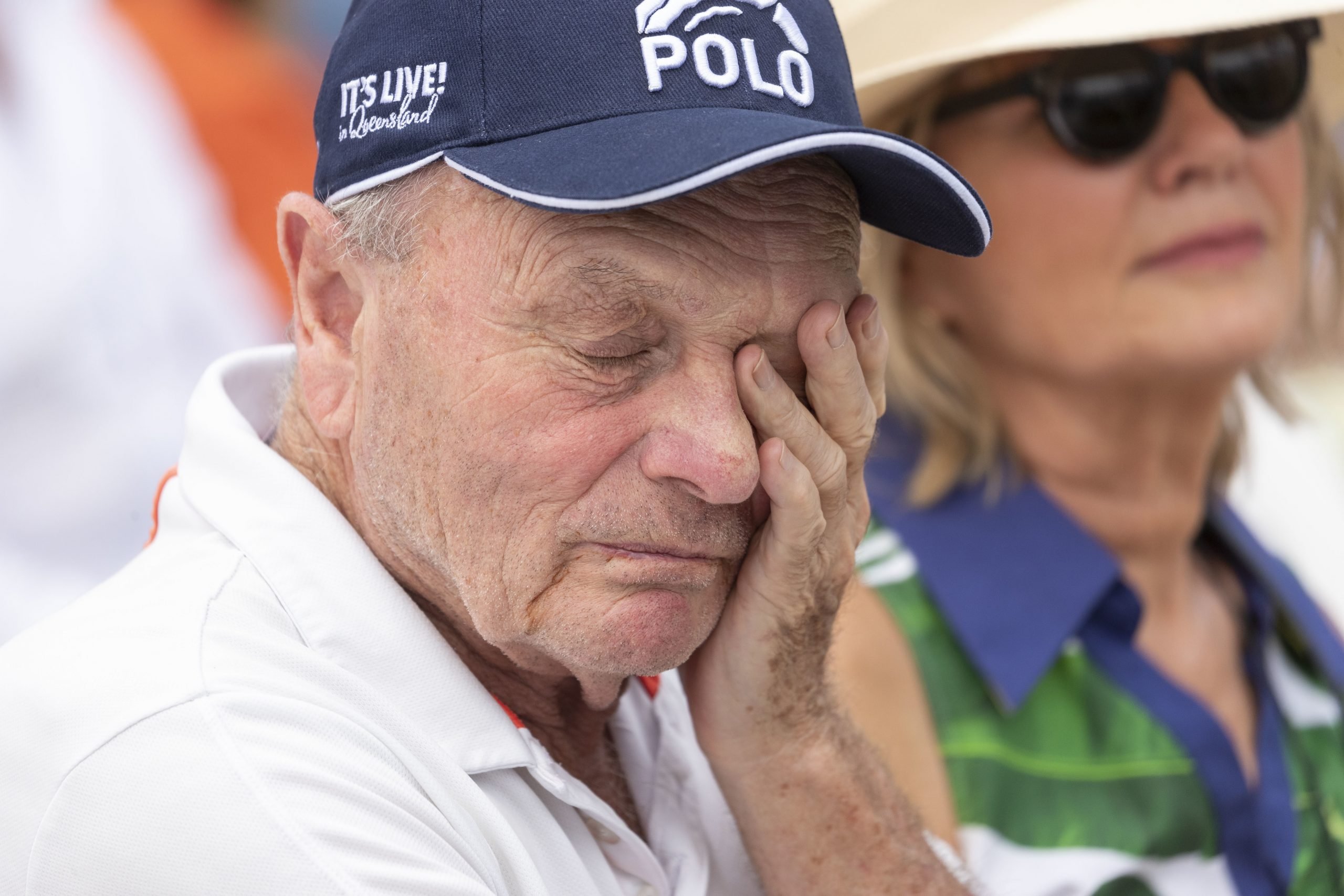
Gerry Harvey at the 2020 Magic Millions barrier draw at Surfers Paradise Foreshore on the Gold Coast, Tuesday, January 7, 2020. (AAP Image/Glenn Hunt) NO ARCHIVING
Store Traffic Falling As Consumers Retreat
Harvey has warned that Australian retail conditions are deteriorating, with declining store traffic, rising household costs and increasingly cautious consumers putting pressure on discretionary spending.
The concern extends well beyond Harvey Norman.
Retailers selling televisions, computers, smartphones, whitegoods and other household products are confronting consumers who are increasingly prepared to postpone purchases, shop around for discounts or simply stop spending.
The competitive challenge is also evident online.
In September 2026, Harvey Norman’s website attracted an estimated 5.5 million visits compared with approximately 20.45 million for JB Hi-Fi, according to the traffic figures supplied.
That gives JB Hi-Fi almost four times the online traffic of Harvey Norman, although website visits alone do not establish sales conversion rates or total retail market share.
For Harvey Norman, the problem is compounded by reports of weakening physical store traffic.
The retailer is also facing increasingly aggressive competition from JB Hi-Fi, The Good Guys, Officeworks and online operators prepared to sacrifice margins to win sales.
And with Black Friday approaching, the concern is that retailers could be forced into increasingly aggressive discounting to stimulate demand.
That may help clear inventory, but it could come at the expense of already pressured margins.

Harvey Norman is one business unworried by the AI revolution
Interest Rates Deliver Another Blow
The deteriorating retail environment has been made worse by renewed pressure on household finances.
On 29 September, the Reserve Bank of Australia lifted the official cash rate to 4.60%, adding to the financial pressure facing mortgage holders and consumers already struggling with higher living costs.
The RBA cited persistent inflation, higher energy prices and technology-related inflationary pressures.
It also pointed to easing consumer spending growth, falling house prices across most capital cities and declining new housing lending.
For Harvey Norman, these are particularly troubling developments.
The retailer has historically benefited from Australians buying homes, renovating properties and upgrading televisions, furniture, bedding and appliances.
When housing activity slows, the flow-on effects can be significant.
Consumers who are paying more for mortgages, electricity, fuel and groceries have less money available for discretionary purchases.
Even when an appliance needs replacing, shoppers may trade down to cheaper models rather than purchase the premium products that traditionally deliver stronger margins.
Harvey Norman management has also linked weaker consumer confidence following the May Federal Budget to more cautious spending.
The company’s own trading commentary suggests that the relatively strong conditions experienced during the first half of FY26 gave way to a much more challenging second half.
Financial Results Mask A More Difficult Retail Market
The contradiction facing Harvey Norman is that its latest annual accounts do not portray a company in financial distress.
For FY26, the group reported underlying profit before tax of A$654.69 million, an increase of 10.9%, excluding specified lease accounting effects, property revaluations and the impact of a regulatory penalty.
Operating cash flow reached A$537.22 million, while net assets stood at approximately A$4.94 billion.
Those figures demonstrate that Harvey Norman remains a substantial, profitable and asset-rich retailer.
However, investors are increasingly concerned about what happens next.
Australian franchisee sales grew 4.8% during the first half, but that momentum weakened as the year progressed.
By July, comparable sales had turned negative.
The deterioration is significant because it suggests that the growth recorded earlier in the year may not be sustainable under current economic conditions.
There are also questions about the financial support provided to franchisees and the extent to which funding arrangements could become more important if trading conditions worsen.
Any assessment of that risk needs to distinguish ordinary franchise financing arrangements from evidence of actual financial distress.
For investors, the more important issue is whether weaker sales will eventually translate into lower franchisee profitability, reduced returns and greater pressure on Harvey Norman’s own earnings.
Harvey Points To Samsung Launch Timing
Management has cautioned against treating July’s weaker sales as evidence of a wholesale collapse in consumer demand.
One explanation offered was the timing of Samsung’s latest Galaxy Fold launch, which moved from July in the previous year to August 2026.
That shift distorted year-on-year comparisons, particularly in higher-value mobile devices.
Harvey Norman also reported that Australian comparable written sales increased 3.8% between 1 August and 24 August.
This suggests demand had not disappeared.
However, written sales represent customer orders that may not yet have been delivered, and therefore do not necessarily translate immediately into completed transactions or recognised revenue.
Nor does the improvement establish that physical store traffic has recovered.
The real test will be whether the August improvement continues through October, November and the all-important Christmas trading period.
Analysts Warn Harvey Norman Could Be At The Start Of A Downturn
External analysts are becoming increasingly cautious about the outlook.
Retail Mosaic’s September assessment described Harvey Norman as being “At the start of a downturn”, pointing to slowing sales, weaker second-half franchise earnings and the possibility that greater promotional support could squeeze profitability.
That is an analyst assessment rather than an established forecast outcome, but it reflects growing concern about the direction of the business.
Morningstar has taken a more measured view.
Its July analysis highlighted the distinction between Harvey’s warnings about the retail market and the company’s actual financial performance.
Australian household goods sales had been holding up better than consumer confidence indicators might suggest, despite the substantial decline in Harvey Norman’s share price.
That distinction is important.
Harvey Norman is not a retailer facing an immediate financial crisis.
It is a profitable business operating in a market where investors are increasingly questioning future earnings growth.
The share price decline suggests the market is placing less value on the company’s ability to sustain its previous performance.
UK Losses And Regulatory Penalty Add To Pressure
The company’s problems are not confined to Australian trading conditions.
Harvey Norman’s expansion into the United Kingdom continues to weigh on earnings, with reported losses of approximately A$31.2 million.
International expansion requires considerable capital, and losses become harder to justify when investors are already questioning the outlook for the core Australian operation.
There is also the financial and reputational impact of the Federal Court’s A$35 million penalty imposed in July 2026 in proceedings brought by ASIC concerning misleading consumer credit representations.
While the penalty is not large enough to threaten Harvey Norman’s financial stability, it represents another unwanted cost at a time when management is attempting to defend profitability and restore investor confidence.
Together, these issues add to the challenges facing a retailer whose shares have already suffered a substantial decline.
Black Friday Could Become A Margin Battleground
The next major test for Harvey Norman and its competitors will be Black Friday.
Traditionally, the promotional event has delivered a significant lift in consumer electronics and appliance sales.
This year, however, retailers face a different set of circumstances.
Consumers are under pressure, suppliers are confronting higher freight, energy and component costs, and retailers are increasingly concerned about inventory levels and promotional profitability.
The danger is that a weaker market will force retailers to discount more aggressively to generate the same sales volumes.
For companies such as Harvey Norman, JB Hi-Fi and The Good Guys, the challenge will be balancing transaction volumes against gross margins.
Selling more products at lower margins does not necessarily translate into higher profits.
There is also the risk that consumers will increasingly delay purchases until major promotional events, further weakening trading conditions during ordinary retail periods.
Other retailers have reported similar concerns about tightening conditions since Harvey Norman released its full-year results.
If those concerns are borne out in upcoming trading updates, the sector could face a difficult final quarter.
Why Is Gerry Harvey Buying More Shares?
Against this background, Harvey’s decision to continue buying shares is particularly interesting.
The September acquisition of 463,000 shares for approximately A$1.9 million indicates that he is prepared to commit additional personal capital despite the company’s falling market valuation.
Insider buying is often interpreted positively because directors generally have a detailed understanding of their businesses.
However, it does not guarantee that a share price has reached its bottom.
Harvey’s purchases could reflect his confidence in the company’s long-term asset value, property portfolio and ability to survive a difficult retail cycle.
They could also indicate that he believes investors have become excessively pessimistic about the company’s future earnings.
What the purchases cannot establish is when trading conditions will improve.
The distinction matters because Harvey Norman’s considerable property assets and cash-generating capacity provide a level of protection that smaller retailers may not enjoy.
The group can potentially withstand a prolonged period of weak discretionary spending while competitors with weaker balance sheets struggle to maintain profitability.
But that financial strength does not make Harvey Norman immune to declining sales, margin pressure or further share price weakness.
The Bigger Problem For Australia’s Retailers
The real significance of Harvey’s warnings is what they suggest about the broader Australian retail market.
Harvey Norman is one of the country’s largest electrical, appliance and furniture retailers.
Its management has direct exposure to consumer purchasing patterns across multiple discretionary categories.
When Harvey warns about falling traffic and weakening demand, those observations warrant attention.
However, there remains a difference between deteriorating market conditions and an outright collapse in consumer spending.
Harvey Norman’s annual results demonstrate that consumers continued spending throughout FY26, even as the economic outlook became more difficult.
The improvement in August written orders also suggests that demand remains responsive to new products and promotional activity.
The question is whether that demand can be sustained without increasingly aggressive discounting.
For smaller retailers, the consequences could be considerably more severe.
Unlike Harvey Norman, many independent appliance and electronics retailers do not have substantial property portfolios or the financial resources to absorb prolonged periods of weak sales.
They also face competition from larger operators with greater buying power, marketing budgets and access to supplier-funded promotions.
If consumers continue retreating from discretionary spending, the pressure on those smaller businesses could intensify.
Comment: Harvey’s Share Buying Is A Bet On The Future, Not Evidence Of A Recovery
Gerry Harvey has spent decades building a retail empire that has survived recessions, technology disruption, changing consumer behaviour and increasingly aggressive competition.
His latest share purchases suggest he believes Harvey Norman remains worth substantially more than its current market valuation.
But investors are clearly less convinced.
A share price decline of more than 40% in 12 months is difficult to dismiss, particularly when it coincides with warnings from the chairman about weaker store traffic and deteriorating consumer demand.
Harvey Norman’s A$4.94 billion net asset position and substantial operating cash flow provide considerable financial protection.
What they do not provide is certainty about future retail sales.
The company now faces a critical period in which the performance of its Australian franchisees, promotional margins and consumer demand will determine whether the share price decline represents an overreaction or an early warning of weaker earnings ahead.
There is also a broader question about how long Australian retailers can continue relying on major discount events to stimulate spending when household finances are under increasing pressure.
For Harvey Norman shareholders, the contradiction is becoming impossible to ignore: Gerry Harvey is buying more shares while warning that the market in which his company operates is getting tougher.
The chairman is betting on the longer-term resilience of the business.
Investors, judging by the share price, are increasingly focused on the risks immediately ahead.
Black Friday and Christmas trading could go a long way towards determining which assessment proves more accurate.