WH Smith Profits Crash 30%, Australian Store Network Faces Review As Retail Giant Slashes Costs
 David Richards
16 Nov 2026

British retail giant WH Smith, which operates an extensive network of stores across Australian airports, hospitals and educational institutions, is facing a major restructuring after profits plunged almost a third, with questions now being raised about the future of its 66 Australian retail locations.
The troubled retailer, which competes directly with JB Hi-Fi for sales of headphones, mobile accessories and travel technology at major Australian airports, has warned that years of aggressive expansion have left the business saddled with excessive costs, a complex management structure and too many loss-making stores.
Now its new executive chairman, Leo Quinn, is pushing through what he describes as a “fundamental reset” of the business, with Australia emerging as one of just three international markets the company intends to prioritise outside its core US operations.
What remains unclear is whether that commitment will protect Australian stores from closures, job losses and cost-cutting measures as management attempts to restore profitability.
WH Smith’s Australian operation currently lists 66 retail locations, including outlets at major airports in Sydney, Melbourne, Brisbane, Perth, Adelaide, Canberra and the Gold Coast.
The company also operates in hospitals, railway stations and educational institutions, giving it a significant presence in the Australian convenience and travel retail market.
At airports, WH Smith competes for spending by travellers purchasing headphones, charging cables, power banks and other technology accessories, putting it in direct competition with JB Hi-Fi’s airport retail operations.
Any rationalisation of its Australian network could potentially create opportunities for rival retailers and airport concession operators.

WHSmith.
The group’s latest financial results reveal the scale of the problems confronting management.
Underlying pre-tax profits slumped 30% to approximately A$134 million for the financial year ending August 31, despite like-for-like revenue increasing 2%.
On a statutory basis, WH Smith swung to a pre-tax loss of approximately A$141 million, compared with a small profit the previous year, after being hit by substantial impairments, write-downs and restructuring costs.
The result follows a disastrous period for the British retailer, which has seen its share price fall approximately 41% this year.
The company was also forced to raise approximately A$200 million in fresh equity in June to strengthen its balance sheet and fund its turnaround strategy.
The latest restructuring comes after a major accounting error in its US division triggered a series of profit warnings, a sharp sell-off in its shares and an investigation by Britain’s Financial Conduct Authority.
Quinn, who took control in April, has delivered a damning assessment of the group’s previous expansion strategy.
“Over the last few months, we have undertaken a detailed analysis of the group’s strategy and recent historical performance,” he said.
“It is clear from this that forced growth delivered a complex and siloed group structure without scalable benefits.”
He said the strategy had resulted in “increased costs, too many loss-making stores, acquisitions not integrated effectively and high organisational complexity.”
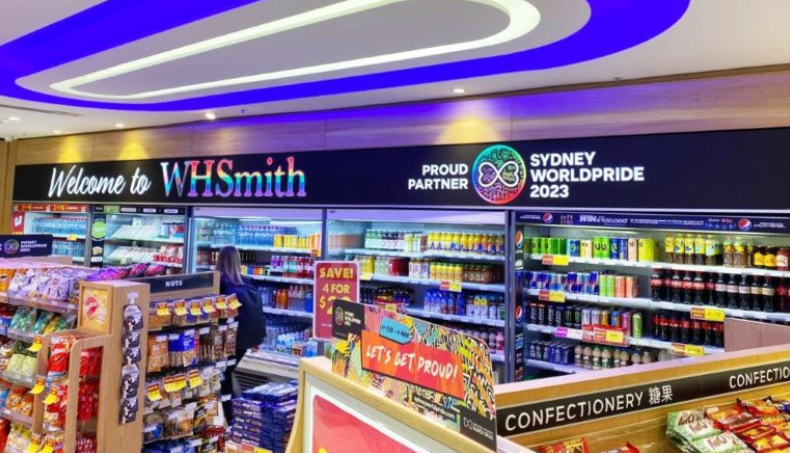
WHSmith.
The admission raises questions about how WH Smith’s Australian expansion has performed, particularly given the high operating costs associated with airport retailing, where rents, staffing expenses and concession agreements can place significant pressure on margins.
Australian airport operators have increasingly expanded their retail offerings, attracting specialist technology retailers, convenience operators and international brands competing for passenger spending.
WH Smith has not disclosed the profitability of its individual Australian stores or identified which locations, if any, could be affected by the restructuring.
Nor has the company provided details of potential Australian job losses.
The group has already incurred approximately A$72 million in turnaround costs during the past financial year as it moves to overhaul its US store network and reduce its exposure to less attractive international markets.
Management has identified Australia, Ireland and Spain as its three priority international markets.
That decision suggests Australia remains strategically important to WH Smith, although it does not necessarily mean the existing store network will remain intact.
The company has also failed to quantify the annual savings expected from its restructuring program, leaving investors uncertain about how quickly the turnaround will improve profitability.
For the 2026-27 financial year, WH Smith is forecasting underlying pre-tax profits of approximately A$130 million to A$155 million, while warning that trading conditions remain uncertain.
Management said it “continues to plan cautiously given the ongoing macroeconomic uncertainty”.
For the Australian operation, the immediate issue is whether WH Smith can maintain its current retail footprint while reducing costs and improving returns.
The company has yet to reveal whether Australian airport outlets, hospital stores or educational institution locations will be subject to the same profitability reviews being undertaken elsewhere in the group.
With its share price under pressure, investors demanding improved returns and management openly acknowledging that the business operates too many loss-making stores, WH Smith’s Australian operation is likely to face increased scrutiny.
The key question now is whether Australia will emerge as a growth market for the restructured retailer or whether local stores will become casualties of a global cost-cutting exercise.