US Makes It Easy To Exit Subscription Maze. Will Australia Follow?
 Peter Holmes
25 Oct 2024
Peter Holmes
25 Oct 2024

It’s known to many as the Hotel California Technique, and it’s something that drives Australians batty.
The clue is in the final lyric – “Relax,” said the night man, “We are programmed to receive / You can check out any time you like, but you can never leave”.
In this instance it refers to the often maddening hoops you have to jump through to extract yourself from free trials and paid subscriptions you’ve signed up for online.
In the US, the government is doing something about it. Well, it’s trying to. However, the companies that benefit from people signing up have got the hump and are trying to forestall measures that make it easier for people to unhitch themselves.
Australia is lagging behind. In August the Consumer Policy Research Centre (CPRC) in Australia released its “Let Me Out: Subscription Trap Practices” report.
It said its research found 75 per cent of Australians surveyed had experienced “some form of negative experience when trying to cancel a subscription”.
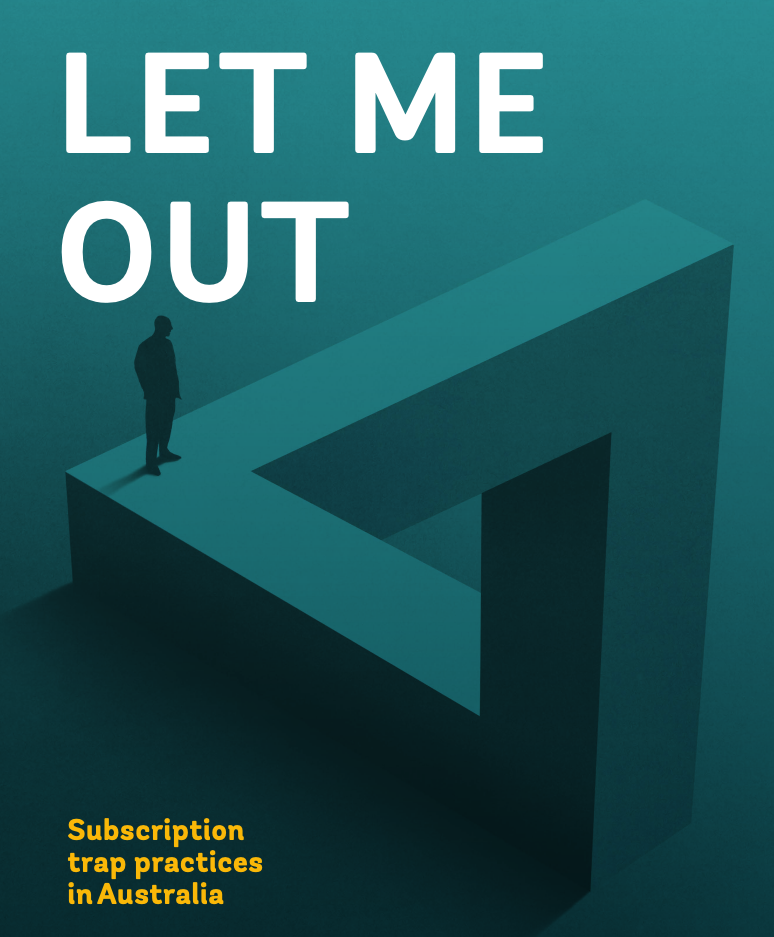
CPRC 2024 report into making it easier to unsubscribe.
“This can include feeling pressured to keep a subscription or giving up and continuing to pay for a service you no longer need. Many survey respondents found the practice annoying or deceptive.
“While different dark patterns can vary in their harm, being unable to unsubscribe from unwanted paid services has a direct and harmful impact on consumers, costing them time, money and ultimately affecting their wellbeing.”
The CPRC noted that subscribing is easy, but unsubscribing less so.
“Frictionless processes mean that consumers can easily sign-up to streaming services, marketplace loyalty programs, health and fitness regimes. When a consumer no longer needs nor wants that subscription service however, the experience is often the inverse.”
It said dark patterns, also known as deceptive and manipulative designs, were “website features or business processes built to influence consumer choice and behaviour that are often not in the consumer’s best interest. When businesses purposefully make it difficult to unsubscribe or cancel a service, this is a dark pattern.”

CPRC graphic on how businesses can change how they operate.
The process is known as forced continuity and a subscription trap. Or the Hotel California Technique.
On Wednesday in the US lawyers representing NCTA – The Internet & Television Association, The Electronic Security Association and the Interactive Advertising Bureau, sued in New Orleans to block new US Federal Trade Commission (FTC) laws that make it easier to unsubscribe.
They claimed the new rules “oversteps the FTC’s authority and was not supported by evidence”.
NCTA represents major cable and internet providers including Charter Communications, Comcast Corp and Cox Communications, and media companies such as Disney Entertainment and Warner Bros. Discovery.
Per Reuters: “The rule requires businesses to get consumers’ consent for subscriptions, auto-renewals and free trials that convert to paid memberships. The cancellation method must be ‘at least as easy to use’ as the sign up process.
“It also prohibits requiring consumers who signed up through an app or a website to go through a chatbot or agent to cancel. For in-person signups, companies must provide means to cancel by phone or online.”

CRPC Report.
The CPRC says moves by governments in Europe, India and the US to ensure the exit door to Hotel California is in good working order should be emulated in Australia.
“Subscription traps … are unfair but not illegal. Unlike a growing number of countries, Australia doesn’t yet have broad laws to stop unfair practices or targeted laws to stop subscription traps. The Australian Government has a real opportunity to take inspiration from other jurisdictions and domestic sectors to introduce measures that mitigate harm caused by subscription traps.
“This is best achieved by introducing an unfair trading prohibition into the Australian Consumer Law. An unfair trading prohibition could explicitly or through a broad principle require that businesses make opting-out of a service as easy as opting-in.”