US Data Centre Bottleneck Could Send AI Overflow To Australia: Morgan Stanley
 David Richards
24 Sep 2026
David Richards
24 Sep 2026
Morgan Stanley analysts believe Australia is well placed to absorb some of the AI data centre demand the US can’t build fast enough to meet the requirements of global retailers such as Amazon and the likes of Instagram and large global manufacturers who are sucking up bandwidth and processing capability.
They point to Australia’s data sovereignty requirements, renewables-backed power and its existing scale which local residents in some cities are objecting to.
They also point to a widening gap in energy costs between the two markets.
The bottleneck in the US is severe.
Morgan Stanley’s Stephen Byrd has flagged US data centre power demand of up to 74 gigawatts by 2028, leaving a shortfall of roughly 49 gigawatts.
Ordering a large power transformer now can mean a two- to three-year wait for delivery.
US thematic strategist Michelle Weaver said last month that power, political and labour bottlenecks will keep a check on supply for the next few years with Australia seen as an alternative market.
Morgan Stanley analyst highlights AI adoption challenges amid computing bottlenecks.
Local opposition is now a major factor.
Morgan Stanley’s Head of Public Policy Research, Ariana Salvatore, said an estimated $156 billion of US projects were cancelled or delayed in 2025, and almost the same amount again in the first quarter of 2026 alone.
What’s not been considered is a similar move to curtail the roll out of data centres in Australia. In an August report, the bank argued that the constraint is not US federal policy but the accumulation of local decisions Washington cannot reach.
In Texas, Governor Greg Abbott has ordered an audit of all data centre projects in the interconnection queue, citing more than 474 gigawatts of pending requests, about 90% of them tied to data centres.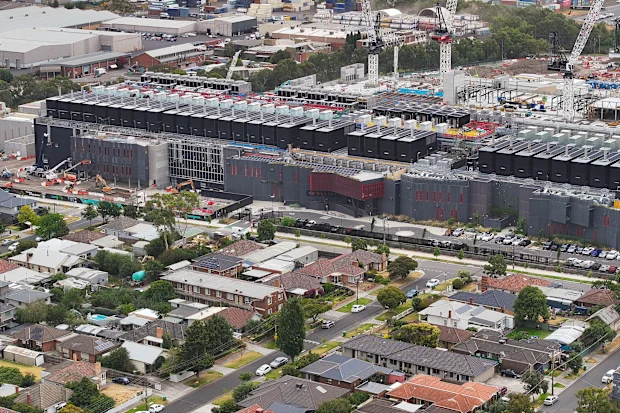
Australia’s position looks strong by comparison.
Morgan Stanley has previously noted that Australia has the world’s 50th largest population but ranks in the top five for data centre capacity.
The energy argument is backed by the market data.
AEMO’s June quarter figures showed NEM-wide average wholesale spot prices down 47% to $74/MWh, the lowest June quarter average since 2020.
Batteries have become the main price-setter in the grid.
They set the price in 36% of dispatch intervals, up from 17% a year earlier, and in 46% of evening-peak intervals.
The AER reports that quarterly base futures prices for 2026 to Q2 2028 fell across all regions except Q4 2027 in South Australia, with significant decreases in Queensland and NSW.
Australia is now the world’s third-largest utility-scale battery market, behind only the US and China.
NEM battery price spreads fall 85% in a year as Australia’s grid-scale BESS fleet passes 9,000MW +3
Capital is already flowing in.
NextDC is building a $7 billion hyperscale AI facility in Western Sydney of around 550 megawatts, with OpenAI as the first major customer.
Amazon plans to spend $20 billion expanding its Australian footprint, and Blackstone paid $24 billion for AirTrunk.
On 9 September, Nvidia named eight Australian operators, including Firmus, IREN, CDC, NextDC and AirTrunk, targeting up to 2 gigawatts of AI capacity by 2027.
That compares with around 1.5 GW across Australia’s 162 existing data centres.
The caveats
The picture isn’t all positive. AEMO’s projections show data centre electricity use rising from about 5 terawatt-hours to roughly 34 terawatt-hours over the next decade, taking the sector from about 3% to 13% of operational demand. The same report found more than 40% of 225 known projects had dropped out or gone backwards in the connection queue since 2025.
The pricing gains are also uneven.
In WA, average wholesale prices rose 30% year-on-year to $118/MWh as reliance on gas increased. South Australia was hit by a cluster of price-cap events in late June.
Policy is still unsettled.
At the 26 August National Cabinet, Queensland won the right to power its data centres with gas or coal, despite the PM’s earlier push for renewables.
The laws are to be introduced by early 2027. Industry has also warned about uncertainty. NextDC CEO Craig Scroggie cautioned that expectations shaping approvals without defined thresholds create uncertainty that global investors will notice. Australia is competing with Singapore and Malaysia for the same hyperscaler capital.