Samsung’s OLED Surge Leaves LG Reeling as Display War Escalates
 David Richards
13 Feb 2026
David Richards
13 Feb 2026

LG Electronics’ once-dominant OLED television business is under mounting pressure, squeezed at both the consumer and manufacturing ends as rival Samsung accelerates a rapid and aggressive expansion that is reshaping the global premium TV market.
Losses are building inside LG Display, the group’s panel manufacturing arm, while market share is being eroded in key regions — most notably North America — where Samsung has seized the momentum.
Samsung’s Rapid Rise
In 2024, Samsung sold 1.44 million OLED TVs, capturing approximately 27.3 percent of the global OLED TV market — a staggering 42 percent increase in unit sales for a company that barely registered as a major OLED player four years earlier.
By 2025, Samsung Display had climbed to the top of the OLED panel market, commanding about 38 percent of global shipments and approximately 48 percent of revenue. The surge has translated into dominance at the brand level.
Samsung overtook LG as the leading OLED TV brand in North America in early 2025. According to the latest research, Samsung captured 50.3 percent of OLED TV revenue and led shipments with roughly 45.2 percent market share, surpassing LG’s 42 percent.
For LG Display, the impact is direct and painful: fewer orders, rising competitive pressure, and shrinking influence in markets it once controlled.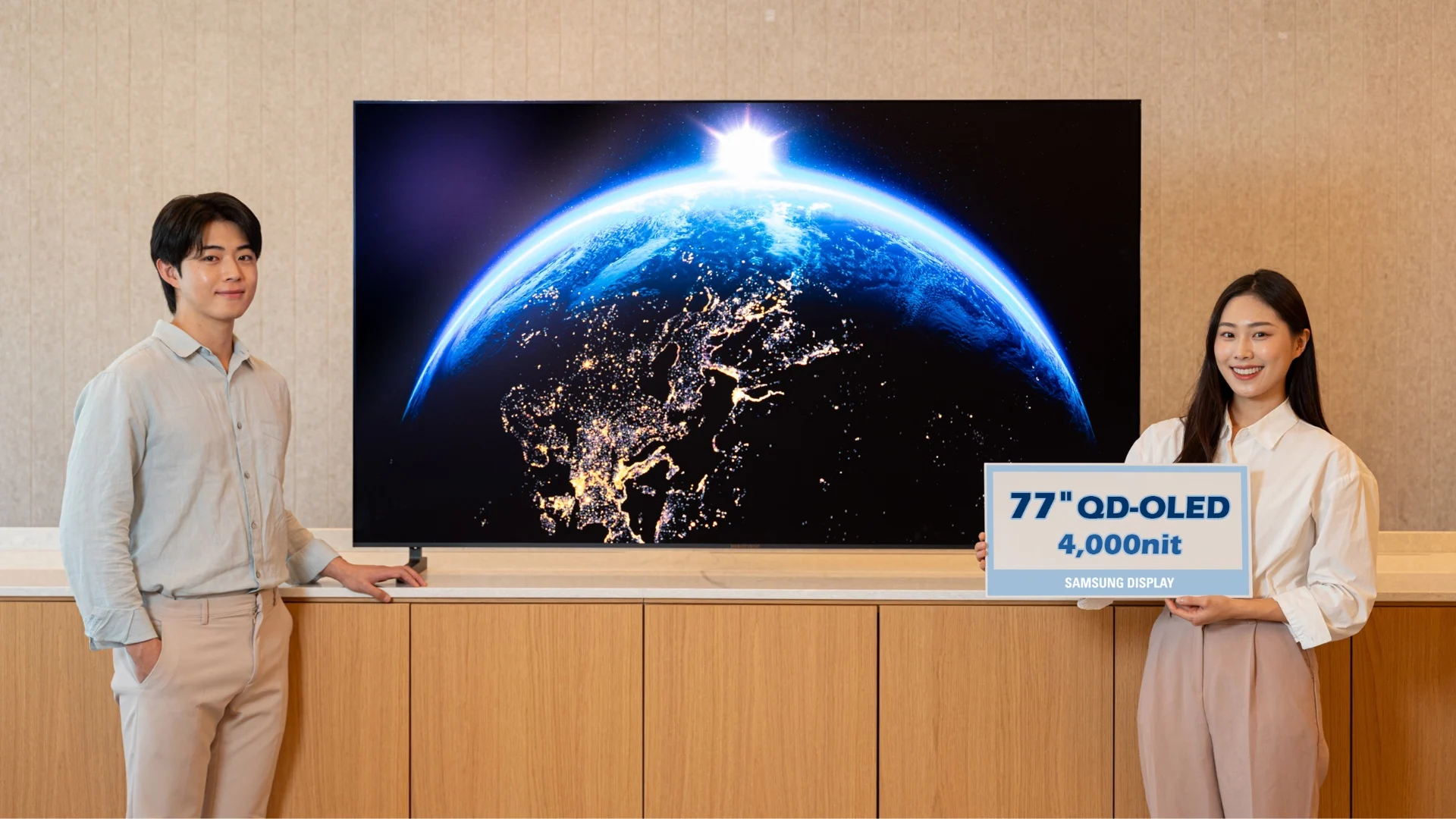
The Technology Arms Race
The battle is no longer just about market share — it is about technology branding and panel architecture.
Late yesterday in South Korea, Samsung Display unveiled its latest offensive: a new premium panel branded “QD-OLED Penta Tandem.”
The company described the display as being built on a proprietary five-layer organic light-emitting structure — a core innovation unique to its QD-OLED panels. “Penta,” Latin for five, refers to five stacked blue/green OLED layers operating in tandem — up from four in the previous generation.
Samsung has already begun deploying the QD-OLED Penta Tandem branding across its monitor lineup, including last year’s 27-inch 4K panel and this year’s 32-inch 4K and 34-inch WQHD models. A 49-inch 5120×1440 ultra-wide panel is also confirmed.
In televisions, the new five-layer structure will underpin upcoming 55-inch, 65-inch, and 77-inch QD-OLED panels.
More significantly, Samsung Display plans to expand the Penta Tandem architecture across its full panel range this year — and make the technology available to external brands, including companies that historically sourced panels from LG Display.
That move directly targets LG’s OEM customer base.
Pressure Mounting on LG
Samsung’s push extends well beyond televisions. In the fast-growing monitor market — particularly in Australia — major brands including Asus, Dell, Gigabyte, MSI, and Sony already rely on Samsung’s QD-OLED panels.
Meanwhile, LG remains a global leader in OLED TV shipments overall, supported by relatively stronger demand in Europe. But in the United States — the world’s most lucrative premium TV market — the company is losing ground.
The broader panel market tells the same story. In 2025, Samsung Display led in both shipment and revenue share. While LG Display has made some gains in revenue percentage, it is struggling to secure new orders at the pace required to counter Samsung’s advance.
A Strategic Turning Point
For years, LG’s WOLED and Tandem OLED technologies defined the premium TV category. Now Samsung is challenging that dominance not just with marketing muscle, but with rapid innovation, aggressive expansion, and a willingness to court LG’s traditional customers.
The OLED market, once effectively LG’s stronghold, has become a full-scale battleground.
If current trends continue, 2025 may be remembered not simply as another competitive year — but as the turning point when Samsung decisively reshaped the OLED hierarchy.
The data came from Omedia and South Korean research Company UBI