Samsung Storms Back In TV Market, As Sony Price Gouges LG Wobbles & Hisense RGB LED Sales Tank
 David Richards
28 Aug 2026
David Richards
28 Aug 2026
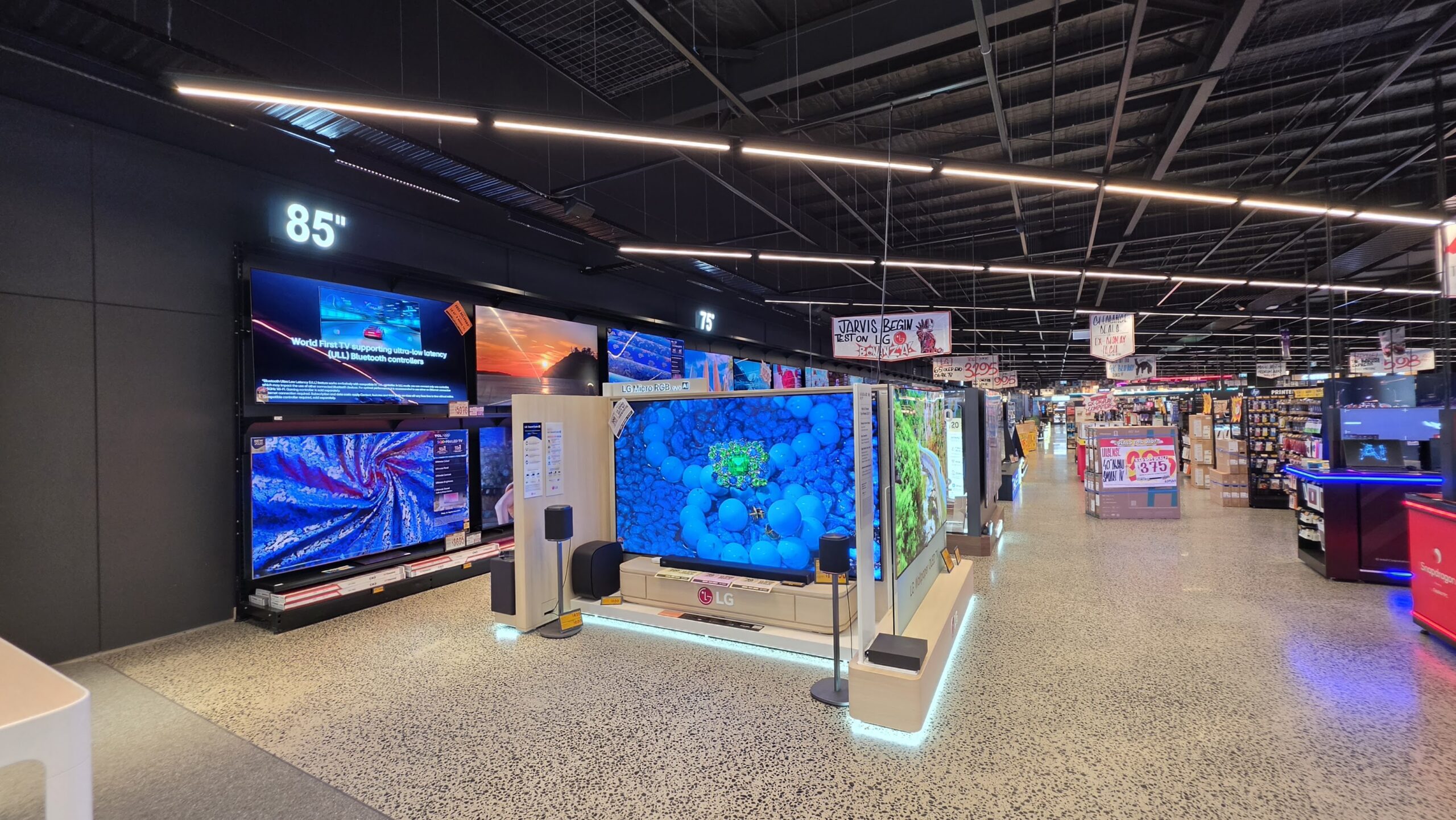
\Australia’s television battleground has flipped on its head. Samsung, once lagging in the local market, is now tearing a bloody big chunk out of LG Electronics, stripping away OLED sales and aggressively growing its large-screen LCD business in a retail war that is forcing one rival to retreat.
Sources confirm LG Electronics, pivoting hard to the B2B sector, is now expected to kill off select consumer models of its TCL-manufactured LCD TVs in Australia.
The reason? A two-front pincer movement from Samsung and a surging wave of Chinese brands like Hisense and TCL, which are flooding the market with cheaper, larger panels.
The numbers paint a picture of a market that has suddenly found new life for big branded TVs.
According to Counterpoint Research, shipments of LCD TVs 70 inches and above are projected to explode by 80% this year compared to 2022 – leaping from 16.74 million units globally to 30.11 million.
In Australia, the 70-inch class is now the sweet spot, while 80-inch shipments are forecast to triple, and monster 98-inch screens are set to skyrocket 12-fold.
But behind this giant-screen gold rush lies a brutal economic truth: rising memory prices and falling retail costs are reshaping the entire industry.
“Panel makers have increased production of ultra-large panels to maintain factory utilization rates while trimming prices,” said Yoshio Tamura from Counterpoint Research. The result? 75-inch LCD panels are projected to fall 70% from a decade ago, while 85-inch panels drop 60%.
Manufacturers are now chasing profit margins as consumers increasingly watch videos on smartphones, spending less time in front of TVs. The big screens offer fatter margins, and they’re fighting tooth and nail for every inch.
Mini LED Chaos
The Mini LED arena has turned into a full-blown brawl.
In early 2026, TCL commanded a stranglehold with 30.2% of global shipments. But by the second quarter, Samsung had stormed from third place to become the market leader with a crushing 28.2% share, as both Samsung and LG slashed entry price points to undercut their Chinese rivals.
Prices on Australian retail floors tell the story.
A 98-inch Samsung Mini LED currently retails for $7,961. A TCL equivalent? Just $3,495. Sony, whose sets are manufactured by TCL, is desperately trying to hold the high ground with their $12,995 price sticker for a 98″ TV at JB Hi Fi very hard to justify as the market drowns in competitive firepower.
Meanwhile, the RGB LED market – once a Hisense monopoly – is being torn apart.
Hisense held a staggering 77.2% of shipments at the start of the year, but by Q2 2026, that dominance had collapsed to just 42.9%, as Samsung and other brands savaged their market share.
Global RGB LED shipments hit 295,000 units in the quarter, with China representing nearly 90% of early sales – but that stranglehold is over.
“Prominent promotion of RGB LED TVs during the World Cup has undoubtedly helped increase consumer awareness,” said Matthew Rubin, Research Manager at Omdia. “As adoption grows, RGB LED will increasingly compete with OLED in the premium segment. Consumer preferences are likely to be shaped by pricing – and by how clearly consumers can evaluate the differences.”
Memory Prices
The real wildcard is semiconductor memory. Soaring DRAM prices, driven by a production shift toward AI data center servers – are forcing manufacturers to think bigger.
For a 32-inch TV, the main circuit board now accounts for a staggering 37% of total component costs, up 24 percentage points year-on-year. For a 75-inch TV? That figure rose only 12 points to 20%.
“Large-screen sets can absorb higher memory costs more easily,” said Omdia principal analyst Nick Jiang. “Rising memory prices will reinforce the trend toward larger TVs.”
In other words, small TVs are becoming economic poison. Big screens are the only life raft.
Australian Retailers
Australian retailers including Harvey Norman, JB Hi-Fi, and The Good Guys are now flooded with older inventory as brands push older product lines to clear low-cost memory stock.
But with memory supply constraints expected to tighten further, retail TV prices face inevitable upward pressure later this year.
For now, the Australian consumer is the winner – walking out of stores with behemoth 98-inch screens for as little as $3,495 while Samsung, LG, TCL, Hisense, and Sony tear each other apart for market dominance.
But make no mistake: this is a war of attrition. LG is retreating. Samsung is surging. The Chinese giants are circling. And the only certainty is that the TV market will never look the same again.