Samsung Faces 18-day Strike Threat As Supply Risks Loom
 David Richards
08 May 2026
David Richards
08 May 2026
Tens of thousands of workers at Samsung’s South Korean chip plants are set to walk off the job on May 21 — threatening to disrupt supply chains across the Asia-Pacific at a moment when the tech giant is already battling falling consumer sales, rising costs, and a strategic retreat from key markets.
The move is seen as being an advantage for Chinese consumer brands including the likes of TCL and Hisense who are looking to strip share across multiple categories where Samsung operates in various markets around the world.
As a result subsidiaries such as Samsung Electronics are having to work around an 18-day general strike set to begin May 21, with tens of thousands of workers at its Pyeongtaek chip plant ready to walk out in what analysts are warning could become one of the most damaging industrial actions in South Korean corporate history — and the consequences could be felt in Australia and New Zealand.
For Australian retailers and distributors already managing thin margins under persistent inflationary pressure and RBA rate rises, the threat of a prolonged production shutdown at Samsung could translate directly into product shortages, longer lead times, and further price increases on everything from televisions and PCs to audio systems and home appliances.
In March 2026, a ballot of Samsung workers saw 93% vote in favour of industrial action, citing wages significantly below those paid by rival SK Hynix — a company that has paid record-breaking compensation in recent years. Three major unions, which formed a coalition in November 2025, are demanding the removal of performance bonus caps and an allocation equal to 15% of annual operating profit.
Management has so far rejected those demands.
If Samsung were to accept — raising base salaries by 5% and allocating 10–15% of operating profit to bonus pools — analysts estimate the company would face billions in additional labour costs, representing a 7% to 12% downside risk to 2026 operating profit.
Samsung’s board chairman Shin Je-yoon and the head of the device experience (DX) division issued an internal message urging both sides to resolve the dispute before the strike date, warning that production disruptions could cost the company its market leadership and send shockwaves through the broader South Korean economy.
The Australian impact
The timing is particularly punishing for Samsung’s Australian and New Zealand operations. The local consumer business has been navigating a difficult environment — cost-of-living pressures, successive RBA interest rate rises, and softening demand for big-ticket electronics have all weighed on sales.
An 18-day stoppage at the company’s primary semiconductor facility would compound these pressures by squeezing already-stretched supply pipelines.
JB Hi-Fi has already flagged that rising memory costs — driven by surging global AI and server demand — are pushing up the retail price of televisions, PCs, and audio equipment. A supply shock from strike action would likely accelerate that trend.
Distributors who spoke to ChannelNews are already moving to front-load stock ahead of any disruption — a sign that the trade is taking the risk seriously.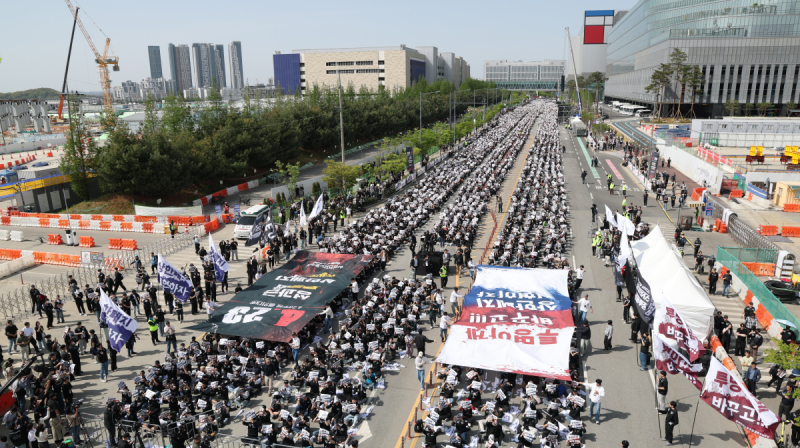
The strike threat lands at what the Seoul Economic Daily has described as a “tale of two companies” moment for Samsung.
Its semiconductor division is posting record profits fuelled by AI-driven demand for server and high-bandwidth memory.
But its consumer-facing businesses — mobile, televisions, and home appliances — are under severe structural pressure.
Samsung recently announced a full withdrawal from the Chinese TV and home appliance market after 34 years, citing a “selection and concentration” strategy.
The retreat comes after TV shipments in China collapsed from a peak of 2.55 million units in 2014 to fewer than 500,000 by 2025, with rivals TCL and Hisense executing what analysts describe as a “sandwich attack” — squeezing Samsung from both the premium and value ends using Mini LED technology and aggressive pricing. The TV and home appliance division posted losses of US$138 million last year.
Globally, Samsung is closing manufacturing plants in Malaysia and Slovakia, losing mobile market share to Apple and emerging challengers including Motorola, and contending with weakened consumer purchasing power as international oil prices surge amid ongoing Middle East tensions.
The 18-day strike, if it proceeds, would threaten the one division keeping Samsung’s financials afloat — its chips business — arriving at the worst possible moment for a company attempting one of the most complex corporate transformations in the technology sector.