Samsung and Apple File Smart Glasses Patents with Very Different Visions
 Joe Gallop
18 Aug 2025
Joe Gallop
18 Aug 2025
The competition in the smart glasses market is heating up, with Samsung and Apple filing patents that reveal contrasting approaches in next-generation wearable technology.
While Apple is emphasising comfort and visual precision, Samsung’s newly published patent focuses on safety and environmental awareness, introducing a system designed to reduce risks for users immersed in augmented reality (AR).
Samsung’s patent outlines smart glasses equipped with multiple microphones that use adaptive beamforming to capture and amplify critical sounds, such as approaching vehicles or alarms – even as the wearer turns their head.
The glasses can detect nearby objects through sensors and cameras, classify risks, and deliver tailored alerts via audio, visual, or haptic feedback.
For example, a fast-approaching car may trigger a louder warning than a pedestrian crossing the street.
To conserve battery life, only the microphones closest to the detected object remain active. Samsung’s design even includes a see-through video mode to give wearers a live camera feed when danger is imminent.

This innovation could help Samsung differentiate itself in the emerging AR glasses market, particularly in urban settings where situational awareness is critical. Analysts suggest the technology could become a benchmark for rival brands, including Apple, Meta and Xreal.
Contrastingly, Apple’s recently granted patent reveals an optical calibration system designed to ensure AR content remains correctly aligned with the user’s vision.
Wear-and-tear or frame deformation can disrupt the user experience, but Apple’s system continuously recalibrates the displays in real time to ensure visual accuracy.
Another Apple patent proposes a more unconventional feature – a removable headband-style strap that can be attached to smart glasses for better fit and comfort.
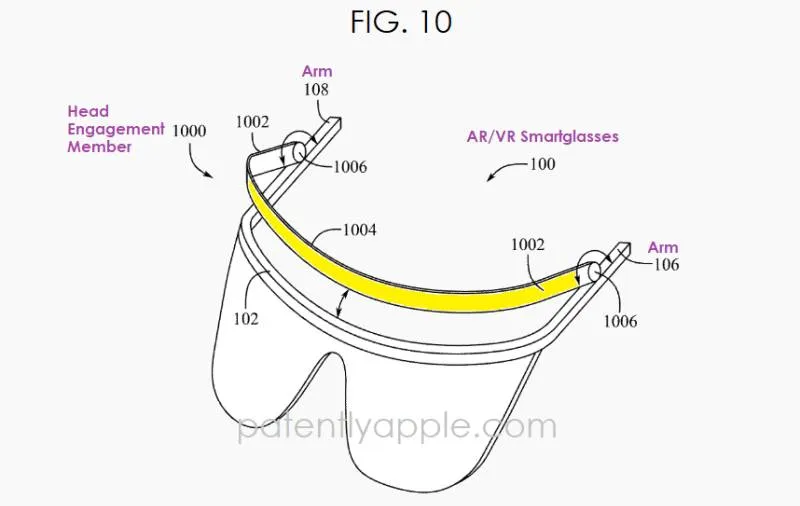
Image credit: Patently Apple
While the design may look unusual, Apple appears to be targeting extended wear sessions for AR applications, where stability and comfort matter more than fashion.
Apple is also exploring modular designs, suggesting its future glasses could be customisable with interchangeable components – a strategy that mirrors how the Apple Watch evolved into both a tech and fashion product.
Taken together, the patents highlight the starkly different strategies of the two tech giants.
Samsung is prioritising safety-first innovation, while Apple is doubling down on user comfort and visual accuracy.
Both approaches suggest that consumers will have plenty of choice in the market when AR glasses finally become mainstream from next year onwards.