OZ Firm Wants To Take On Microsoft & Goole With Canva AI 2.0
 David Richards
17 Apr 2026
David Richards
17 Apr 2026

Australian design software company Canva has unveiled a major expansion of its artificial intelligence capabilities, as it positions itself for its next phase of growth and a potential public listing, with investors closely watching the shift.
The company launched its “Canva AI 2.0” platform at a large-scale investor and customer event in Los Angeles, attended by around 6,000 people, opting to debut the product offshore rather than in Australia.
The move comes as the $60 billion business continues to weigh the timing of a potential initial public offering.
Canva is a private company primarily owned by its co-founders—Melanie Perkins, Cliff Obrecht, and Cameron Adams (seen above) along with early investors like Blackbird Ventures. Founded in 2012 in Perth, Australia, Perkins serves as CEO and maintains significant control, along with Obrecht and Adams, who still hold a large portion of the company.
This is a meaningful shift for Canva—but it’s not automatically a guaranteed win claim observers.
This isn’t just a feature update — it’s a positioning play.
Calling it “Canva AI 2.0” and framing the company as an AI firm is very deliberate with Canva now trying to move up the value chain ahead of a potential float.
The new AI-driven features introduce “connectors” that allow users to integrate data from external platforms including Slack, Gmail and Google Drive. Canva says this will enable its software to transform conversations, emails and files into structured outputs such as summaries, reports and newsletters.
The update also introduces a conversational design workflow powered by artificial intelligence, alongside built-in web research tools and a “Brand Intelligence” feature designed to automatically align content with a company’s tone and visual identity.
Co-founder Cliff Obrecht said the company was repositioning itself beyond its origins as a design platform.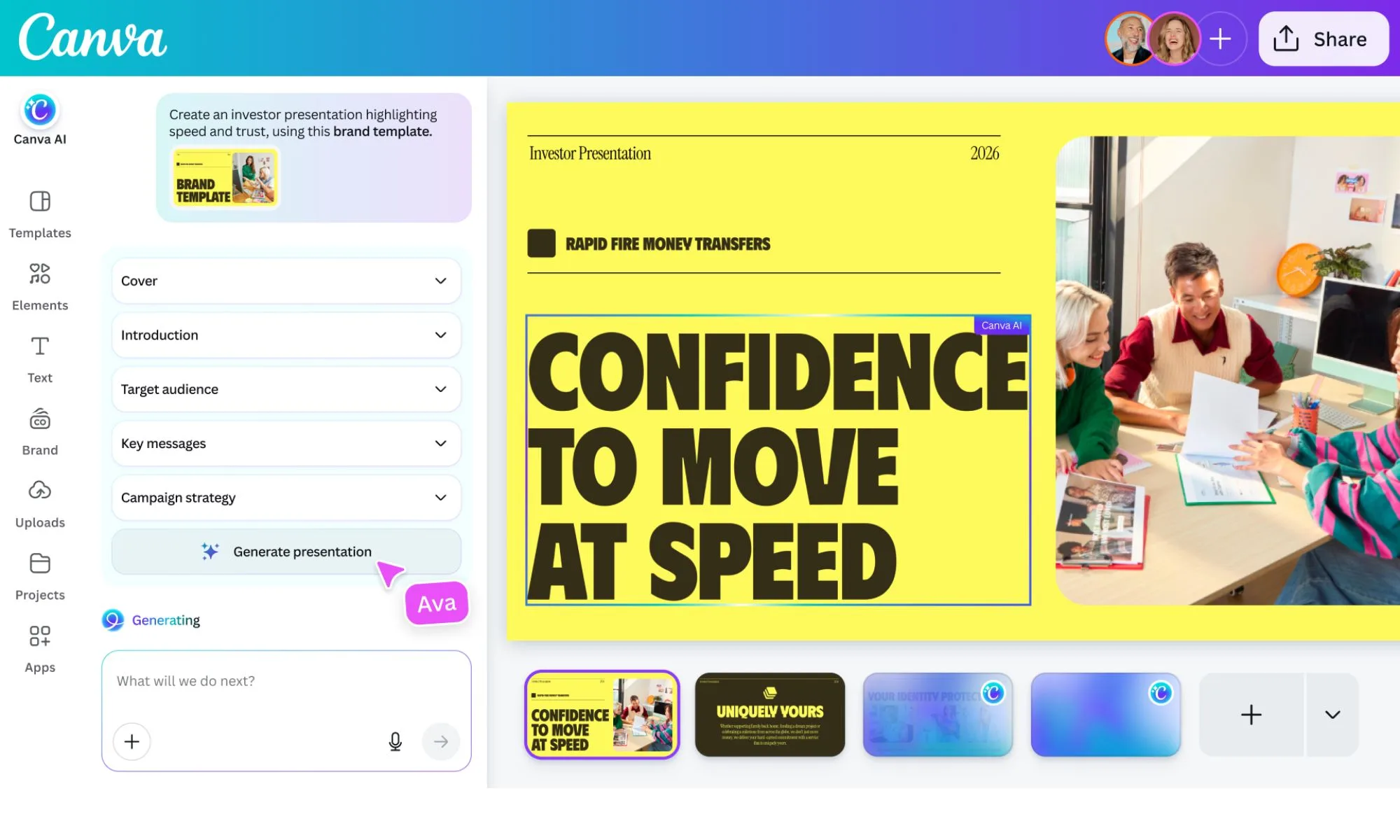
“We’re disrupting ourselves,” Obrecht said. “With any big piece of new technology that launches, the table is flipped… we need to be the best place to create visual content in the world.”
The strategy signals Canva’s ambition to compete more directly with US-based Adobe, whose recent share price weakness has highlighted pressure on incumbent creative software firms. Canva is betting that deeper AI integration and workflow consolidation will help it capture a greater share of enterprise users and expand beyond design into broader productivity tools.
However, analysts note the shift carries significant risks.
The integration of third-party data sources raises concerns around data privacy, security and compliance, particularly for enterprise customers operating under strict regulatory frameworks. By pulling information from emails, internal chats and cloud storage into a single AI system, Canva could face scrutiny over how sensitive data is processed, stored and protected.
There are also questions about reliability and accuracy. AI-generated summaries and documents may introduce errors or misinterpretations, which could have consequences for business decision-making if not properly reviewed by users.
Strategically, Canva’s pivot toward artificial intelligence places it in more direct competition not only with Adobe, but also with major technology companies such as Microsoft and Google, which are embedding similar AI capabilities across their productivity ecosystems. Competing at that level may require substantial ongoing investment in infrastructure and research, potentially impacting profitability.
In addition, the company risks diluting its core identity as a simple, user-friendly design platform. Expanding into a broader AI-powered productivity suite could complicate the user experience and alienate parts of its existing customer base.
Despite these challenges, Canva’s investors have publicly backed the leadership team’s decision to delay an IPO amid volatile market conditions, according to reports from the Australian Financial Review. The success of Canva AI 2.0 is likely to play a key role in determining the company’s valuation and market appetite when it eventually moves toward listing.
The latest update underscores Canva’s intent to redefine itself as an AI-first company, but whether the strategy delivers sustained growth—or introduces new vulnerabilities—will be closely watched in the months ahead.
Old Canva was about design tools and competing with Adobe, and Figma, etc.
As for the new Canva this is all about workflow + intelligence layers and competing with Microsoft Copilot, ChatGPT and Google Workspace AI.
The connectors (Slack, Gmail, Drive) are the key signal. They’re not about design—they’re about owning context, owning workflow and reducing app-switching friction
That’s a much bigger market than design alone claim analysts.