Nvidia Takes Aim At Intel And AMD To ‘Reinvent’ Windows PCs
 Joe Gallop
02 Jun 2026
Joe Gallop
02 Jun 2026
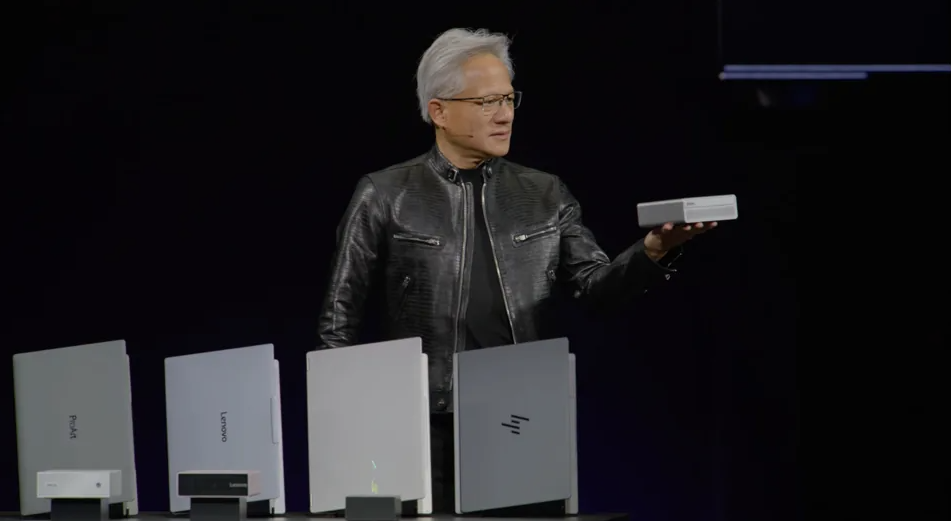
Nvidia has officially entered the consumer PC processor market, unveiling its Arm-based RTX Spark “superchip” for Windows laptops and mini PCs in a direct challenge to Intel, AMD, Qualcomm and Apple.
Following yesterday’s leaks, Nvidia CEO Jensen Huang announced at Computex in Taiwan that RTX Spark is designed to power a new generation of AI PCs capable of running large AI models and autonomous agents locally, rather than relying entirely on cloud services.
“Microsoft and Nvidia are going to reinvent the PC,” Huang said, describing the chip as part of a broader shift towards home AI supercomputers.
The move marks Nvidia’s most serious attempt yet to reshape the PC market, using its dominance in AI and graphics to push Windows-on-Arm machines into territory long controlled by Intel and AMD.

The first RTX Spark laptops are expected to launch later this year, with models from Asus, Dell, HP, Lenovo, MSI and Microsoft’s Surface brand.
Nvidia said the initial rollout will include six premium laptops before expanding to around 30 laptop models and 10 mini PCs.
Built in partnership with Taiwanese chipmaker MediaTek, RTX Spark uses TSMC’s 3nm manufacturing process and combines a 20-core Nvidia Grace CPU with Blackwell graphics featuring 6,144 CUDA cores. The architecture is similar to Nvidia’s GB10 superchip used in its DGX Spark AI mini PC platform, but RTX Spark is aimed at consumers and Windows 11 systems.

The chip supports up to 128GB of LPDDR5X unified memory, allowing the CPU and GPU to share a large pool of RAM. Nvidia claims this will let users run AI models with up to 120 billion parameters locally.
The new laptops will also target creators and gamers, with Nvidia claiming graphics performance comparable to a laptop RTX 5070, while offering better power efficiency. RTX Spark systems will qualify as Microsoft Copilot+ PCs and are expected to support AI-enhanced Windows features.
Pricing has not been confirmed but early systems are expected to sit firmly in the premium category. Devices with high-memory configurations could be expensive, particularly given ongoing memory supply pressures.