Google’s Gemini Intelligence May Be Limited To Elite Android Devices
 April Ossington
18 May 2026
April Ossington
18 May 2026
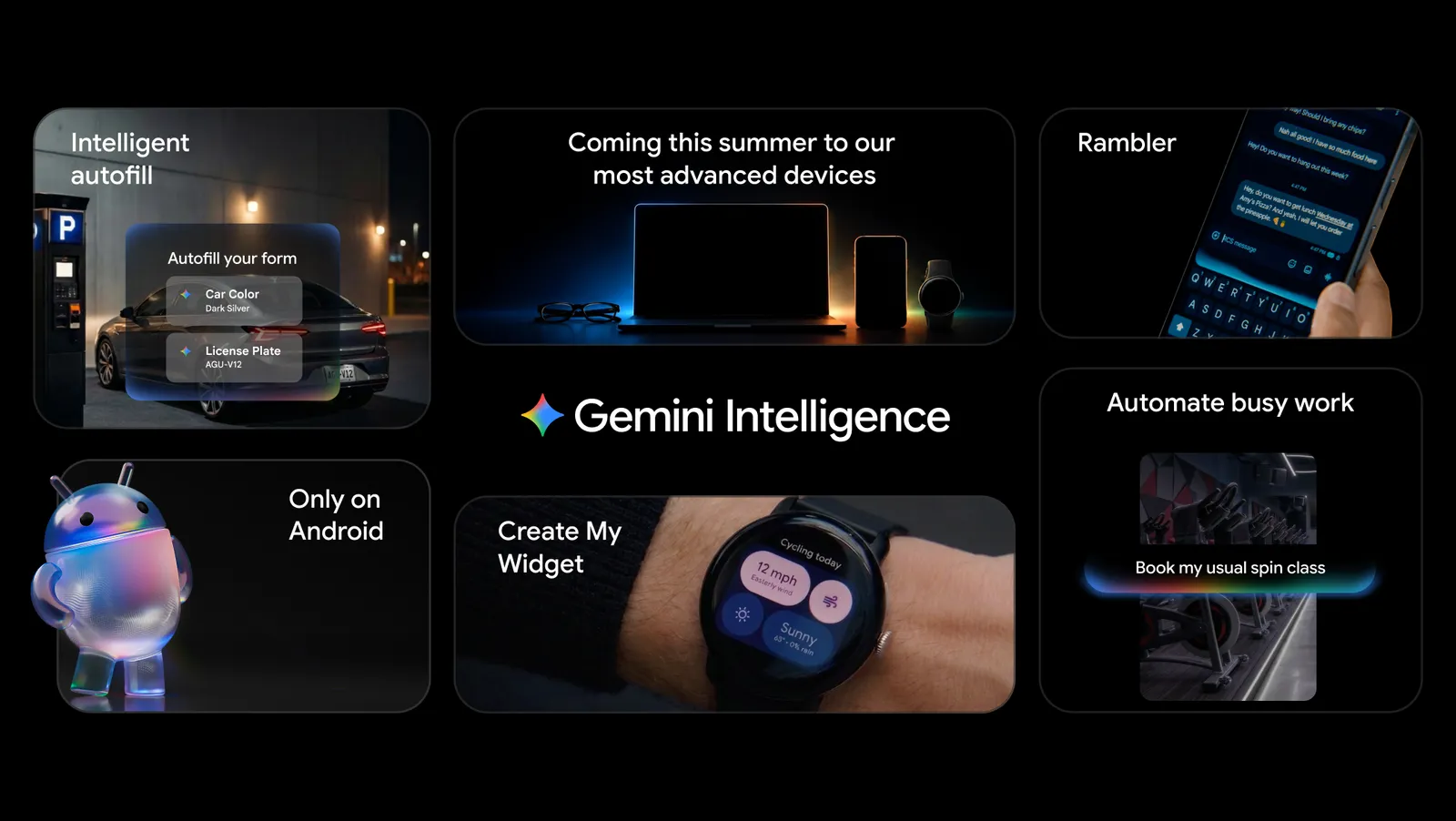
Google’s newly unveiled Gemini Intelligence platform appears set to become one of the most demanding and exclusive AI systems yet introduced on Android, with early requirements suggesting only a small number of flagship devices will be capable of supporting the technology at launch.
The company recently revealed Gemini Intelligence as a major evolution of its Gemini AI ecosystem, introducing advanced capabilities designed to handle complex tasks autonomously in the background without constant user input.
Among the showcased features were tools capable of carrying out multi-step actions independently, including gathering information, transforming content and interacting with apps and websites on behalf of users. Google also previewed a new “Rambler” function for Gboard that can interpret natural conversational speech filled with pauses, filler words and even mixed languages within the same sentence.
While the demonstrations positioned Gemini Intelligence as a major leap for Android AI, access to the platform may initially be restricted to premium hardware.
Current indications suggest the first devices to receive Gemini Intelligence will be Samsung’s upcoming Galaxy Z Fold8 and Galaxy Z Flip8 foldables. Google has also confirmed the software will arrive on the Pixel 10 series and Galaxy S26 lineup later this year.
However, technical details buried within Google’s Android documentation suggest the system has unusually high hardware and software requirements.
According to information published on the official Android website, devices must include at least 12GB of RAM to support Gemini Intelligence. The requirement strongly suggests the AI models powering the system are resource intensive and rely heavily on on-device processing.
Eligible devices must also support AICore, Android’s dedicated system framework that enables apps to access Gemini Nano AI models directly on a handset. Gemini Intelligence specifically requires Gemini Nano v3 or newer, a standard currently supported by only a limited number of devices.
Beyond memory requirements, Google has outlined several additional conditions that effectively narrow compatibility to top-tier flagship phones. Devices must include qualifying premium chipsets, pass launch quality testing for Android 17 and maintain low crash rates during real-world use.
Manufacturers are also expected to commit to at least five major Android operating system upgrades and six years of quarterly security updates. Support for Android Virtualisation Framework and pKVM security technology is also mandatory.
The company’s requirements further mention advanced multimedia and gaming standards including spatial audio, HDR support, low-light performance and ongoing graphics driver updates.
Taken together, the criteria place Gemini Intelligence firmly within the ultra-premium smartphone category for now, potentially excluding many mid-range devices and older flagships from accessing the platform.
The requirements have also raised questions about Google’s own future hardware lineup. Recent leaks surrounding the Pixel 11 family suggested some non-Pro models could launch with only 8GB of RAM, potentially placing them below the stated Gemini Intelligence threshold.
That possibility has fuelled speculation that Google may either revise the requirements later or reserve certain Gemini Intelligence features exclusively for higher-end models within its own smartphone range.
For now, Google has yet to fully explain how the platform will scale across different devices or whether lighter versions of the AI experience may become available on less powerful hardware in the future.