Google Launches ChatGPT Rival
 Nathan Jolly
07 Feb 2023
Nathan Jolly
07 Feb 2023

Google’s parent company has introduced Bard, the search giant’s competitor to the Microsoft-backed Chat GPT chatbot.
“Bard seeks to combine the breadth of the world’s knowledge with the power, intelligence and creativity of our large language models,” explained Sundar Pichai, CEO of Google and Alphabet.
“It draws on information from the web to provide fresh, high-quality responses. Bard can be an outlet for creativity, and a launchpad for curiosity, helping you to explain new discoveries from NASA’s James Webb Space Telescope to a 9-year-old, or learn more about the best strikers in football right now, and then get drills to build your skills.”

This may sounds familiar to those following ChatGPT’s trajectory over the past few months.
As Pichai explains, Bard will be initially released with the company’s “lightweight model version” of LAMDA, Google’s “breakthrough conversional technology”, which was launched in 2021.
LaMDA — short for “Language Model for Dialogue Applications” — can “engage in a free-flowing way about a seemingly endless number of topics”, according to Google.
Pichai explains that LaMDA requires significantly less computing power, enabling the company to scale to more users, allowing for more feedback.
“We’ll combine external feedback with our own internal testing to make sure Bard’s responses meet a high bar for quality, safety and groundedness in real-world information,” Pichai explains.
“We’re excited for this phase of testing to help us continue to learn and improve Bard’s quality and speed.”
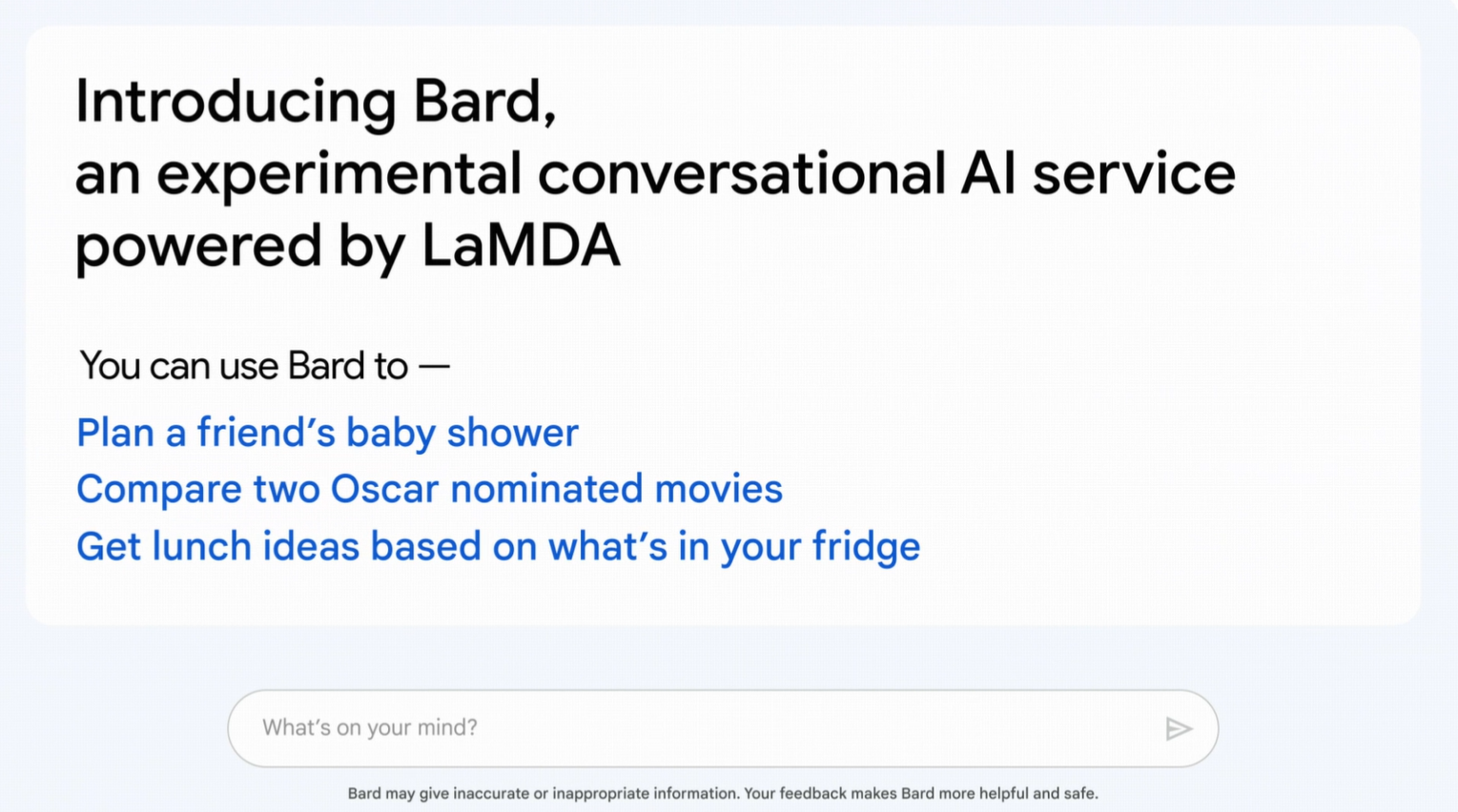
Google is racing Microsoft to implement Bard into its search functionality.
“Increasingly, people are turning to Google for deeper insights and understanding — like, ‘is the piano or guitar easier to learn, and how much practice does each need?’”, notes Pichai.
“Soon, you’ll see AI-powered features in Search that distill complex information and multiple perspectives into easy-to-digest formats, so you can quickly understand the big picture and learn more from the web: whether that’s seeking out additional perspectives, like blogs from people who play both piano and guitar, or going deeper on a related topic, like steps to get started as a beginner.
Google has not confirmed a timeline for this, other than to say it will “begin rolling out on Google Search soon”.