Creepy Stalking Glasses Offer Grim Peek Into Future
 Peter Holmes
04 Oct 2024
Peter Holmes
04 Oct 2024
Readers of a certain vintage will remember the comic books that used to run ads for products such as Sea Monkeys and X-Ray Spex.
The glasses, according to an ad that bent the truth to breaking point, would allow children the world over to see through things – yes, even clothes!

X-Ray Spex.
Of course, they did no such thing, instead using thin pieces of cardboard, a hole and a feather that diffracted light, to create the appearance of two images, with an overlap could be interpreted as seeing bones in your hand.
Things have moved along somewhat, evidenced by two Harvard students who have built a pair of facial recognition glasses that show how easy it is to quickly identify someone, and harvest numerous photos and background information – including home address – about them.
AnhPhu Nguyen and Caine Ardayfio (pictured at top) call the project I-XRAY, and a video posted to X shows how easy it is to scrape information about someone who is standing next to you on the street, or sitting opposite you on a bus.
Facial recognition is not new, but widespread, easy access to it is. And it’s pretty terrifying. Laws in some jurisdictions around the world have banned or severely restricted facial recognition technology.
In July Facebook parent company Meta was ordered to pay US$1.4 billion (A$2 billion) to the state of Texas for using personal biometric data without permission.

Mark Zuckerberg and Ray Bans.
But while big tech is on notice and must tread warily, the students have shown how easy it is to create such a device away from the main game.
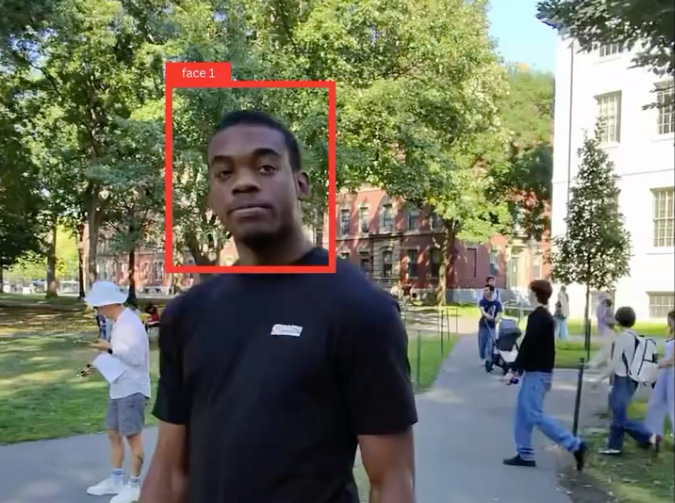
The students’ video shows random people being approached after the students’ glasses have been used to not only identify them, but serve up chunks of information about them.
The two most concerning aspects of the encounters are the easy access to information such as addresses and current activities, and the faux familiarity that can be established within seconds when people are approached by someone using information they have collected just minutes before, to create a bond.
“Initially started as a side project, I-XRAY quickly highlighted significant privacy concerns,” the pair wrote. “The purpose of building this tool is not for misuse, and we are not releasing it.
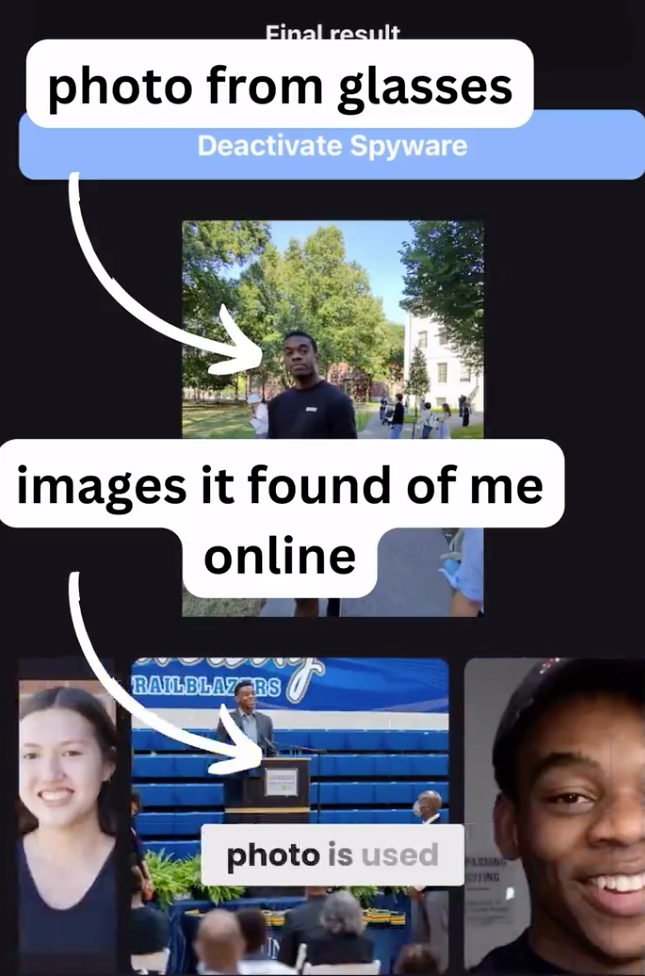
Photos found.
“Our goal is to demonstrate the current capabilities of smart glasses, face search engines, LLMs, and public databases, raising awareness that extracting someone’s home address and other personal details from just their face on the street is possible today.”
The project utilised five technologies. They are:
- Discreet Smart Glass Camera (Released 2023): Smart glasses equipped with a camera capture an image of a person’s face in public. Meta Ray Bans 2 were used, “as they look almost indistinguishable from regular glasses. Note that any hidden camera would achieve the same effect, or a discreet phone picture. If smart glasses didn’t exist, I-XRAY would still be just as dangerous”.
- Reverse Facial Recognition (Released 2017): The image is processed using facial recognition models similar to those used by search engines like PimEyes and FaceCheck.id, which can match the face to publicly available images across the internet and returns the URLs. “In our testing, Pimeyes was the most effective and accurate to a wide range of people,” they said.
- LLM Data Extraction (Released 2022): “Once URLs are found, they are scraped, and a Large Language Model (LLM) is prompted to infer details such as the person’s name, occupation, and other personal details from this unorganised data.”
- Home Address Lookup (Released 2017): FastPeopleSearch is an online tool that allows users to easily find personal information such as home addresses, phone numbers, age and relatives from publicly available records and social media profiles with just someone’s name. “It aggregates this data into searchable profiles, raising privacy concerns due to the ease with which sensitive details can be accessed.”
- Social Security Number Lookup (Released 2023): Cloaked.com takes in phone numbers and returns partial social security numbers (SSNs). “This means that if FastPeopleSearch returns an accurate phone number, we can get the first and last digit of someone’s SSN. Unfortunately, it seems most Americans have their SSN leaked in data dumps from corporation-level hacks.”
The students say what makes I-XRAY unique is that it operates entirely automatically, due to improvements in LLMs.
“The system leverages the ability of LLMs to understand, process, and compile vast amounts of information from diverse sources – inferring relationships between online sources, such as linking a name from one article to another, and logically parsing a person’s identity and personal details through text.
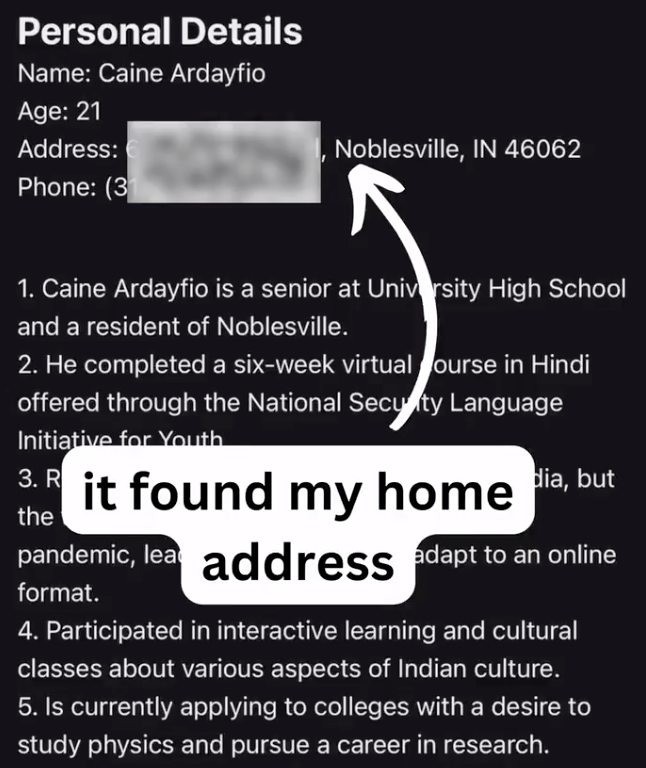
Address found.
“This synergy between LLMs and reverse face search allows for fully automatic and comprehensive data extraction that was previously not possible with traditional methods alone.”
It is possible, they say, to “erase yourself from data sources like Pimeyes and FastPeopleSearch”.
“The major, most accurate reverse face search engines, Pimeyes and Facecheck ID offer free services to remove yourself.”
To remove yourself from People Search Engines opt out links were provided to FastPeopleSearch, CheckThem and Instant Checkmate.