COMMENT: Myer & David Jones Are Losing The Online War, As Supply Chain Chief Quits
 David Richards
13 Jul 2026
David Richards
13 Jul 2026
Australia’s two big department stores are being found out.
As Amazon pours tens of millions of dollars into new Australian distribution centres and uses AI to harvest data on what consumers are buying, Myer and David Jones are struggling to fund the very infrastructure that decides who wins in online retail: logistics and distribution.
The contrast with JB Hi-Fi could not be starker. The consumer electronics giant has the balance sheet and the discipline to invest in taking Amazon on. Myer and David Jones, by comparison, are fighting a capital-intensive war with empty pockets.
The latest casualty is Myer’s chief supply chain officer Darren Wedding, whose resignation was revealed earlier today.
Wedding, who was responsible for Myer’s entire supply chain from supplier to store to customer, is a massive loss for a business that is struggling across its store network and attempting to invest in online despite what insiders describe as “massive operational issues”.
Wirth’s Handpicked Fixer Walks

Myer’s chief supply chain officer Darren Wedding,
Wedding was no ordinary hire. According to the Australian Financial Review, he was handpicked by Myer executive chairwoman Olivia Wirth after joining from Super Retail Group in March 2025, part of a sweeping leadership overhaul designed to modernise Myer’s supply chain through robotics and automation, and to finally deliver the long-delayed national distribution centre at Ravenhall in Melbourne’s west.
Sixteen months later he is gone, with insiders claiming Myer is facing significant cost blowouts and delays at one of the company’s most important transformation projects.
The market has already delivered its verdict on the Wirth era. Since she was appointed executive chairwoman, Myer’s share price has more than halved, and the shares fell a further 2.75 per cent at the opening bell today following revelations that Wedding had quit.
Tellingly, Myer has no plans to appoint another chief supply chain officer. Responsibility for both the distribution centre remediation and the broader supply chain network has instead been handed to chief financial officer Kathy Karabatsas. When the person fixing your warehouse is your CFO, the message is unmistakable: this is now a cost containment exercise, not a growth strategy.
Ravenhall: The $32 Million Robot Warehouse That Doesn’t Work
At the heart of Myer’s online logistics trouble is the National Distribution Centre at Ravenhall. The 40,000 square metre facility was built to hold over 100,000 SKUs with more than 200 autonomous mobile robots, and was billed as the largest implementation of the Geek+ RS8 Shuttle System in the Southern Hemisphere. Up to 70 per cent of online fulfilment was supposed to run through the facility, cutting cost per order.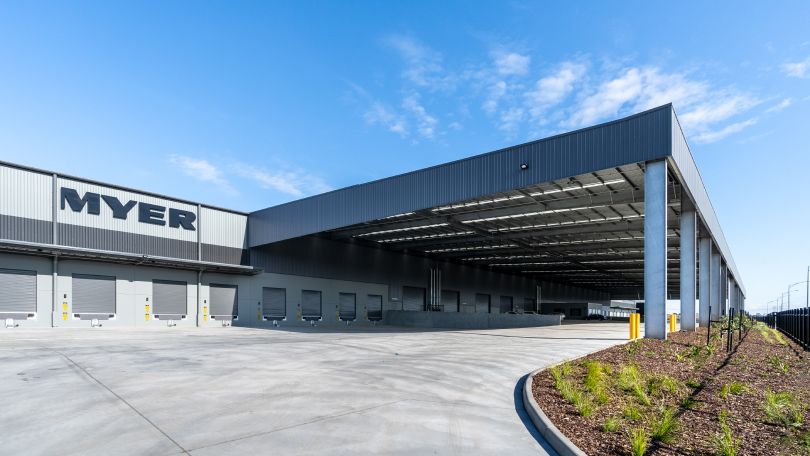
Instead, the highly automated warehouse has been a disaster since going live in August 2024. By Myer’s own admission it was hit with implementation issues and a delayed ramp-up that created stock-flow problems, with media reports indicating the computer system running the warehouse was not communicating properly with the robots transferring stock. Myer Exclusive Brand stock was trapped in the facility during the first quarter of FY25, forcing online fulfilment back to stores.
The first-half FY25 hit was $12 million to EBIT, comprising $7 million in lost Myer Exclusive Brands gross profit from stock trapped in the NDC, $3 million in duplicative costs from keeping the Altona site running during transition, and $2 million in extra online fulfilment costs because stores had to pick orders.
Then the full bill emerged. At the FY25 results Myer revealed it would cost $32 million to overhaul the warehouse, with the work not completed until 2026/27.
The company posted a statutory net loss of $211.2 million, shares fell to a three-year low, shareholders lost their final dividend, and underlying profit of $36.8 million was down 30 per cent, a result Wirth herself conceded would have been flat if not for the NDC issues.
According to sources, operations at the facility struggled to overcome the complexities of its bespoke automation system even after Myer engaged Argon & Co, a management consultancy that specialises in supply chain, to resolve the issues.
A Myer spokesman said the business had a plan to resolve the distribution centre’s problems. “Given the scale and complexity of the project and the challenges under previous management at this site, we’re undertaking more extensive design and testing on our proof of concept to ensure the project’s full potential can be realised,” he said.
Nearly two years after go-live, Myer is still testing a proof of concept.
David Jones: Borrowing To Stand Still
The situation is equally grim at Myer’s arch rival David Jones, which is currently borrowing to pay down debt, with suppliers earlier this year complaining of not being paid.
“Digital and supply chain transformation is exactly the kind of spending that gets starved when a retailer is managing week-to-week liquidity,” one observer at a major retailer claims. “When you’re extending supplier payment terms, cutting inventory and closing stores to preserve cash, discretionary capex is the first casualty.”
Analysts had identified poor digital capability, weak use of customer data and an outdated merchandise mix before Anchorage Capital Partners even acquired the business, and fixing those problems requires significant capital that Anchorage may be struggling to provide, at exactly the moment Amazon is going after David Jones customers while enjoying a buying advantage on many of the same products both department stores sell.
The scale of the data problem was laid bare by David Jones’ own leadership, with the CEO previously acknowledging that the retailer only had meaningful customer data on just 16 per cent of its shoppers. That is a startling figure for a business claiming omnichannel leadership, and it is precisely the kind of gap Amazon’s AI-driven customer intelligence machine is built to exploit.
Squeezing Suppliers Is Killing The Supply Chain
There is a deeper structural problem, and it is self-defeating. The supplier squeeze that has seen consumer electronics and appliance brands place department stores on credit hold in the past directly undermines logistics performance.
Using extended payment terms as working capital effectively makes suppliers the bank, but it degrades the very supply relationships an efficient distribution operation depends on. You cannot run a slick online operation up against Amazon when brands are exiting, and when some Australian retailers are being made to pay for orders before stock is shipped, which is exactly what is now happening.
Supply chain economics have become the decisive battleground in Australian retail, and retailers are having to invest in both stores and distribution simultaneously because of the impact of Amazon. JB Hi-Fi can fund that fight. On the evidence of the past week, Myer and David Jones cannot, and the departure of the one executive charged with fixing Myer’s broken warehouse suggests the people closest to the problem may have reached the same conclusion.