Captions Go Mainstream: Under-35s Lead Australia’s Shift To Subtitled Viewing
 Isabella Alexiou
22 Sep 2025

New Roy Morgan research shows captions have moved from accessibility feature to viewing default for many Australians.
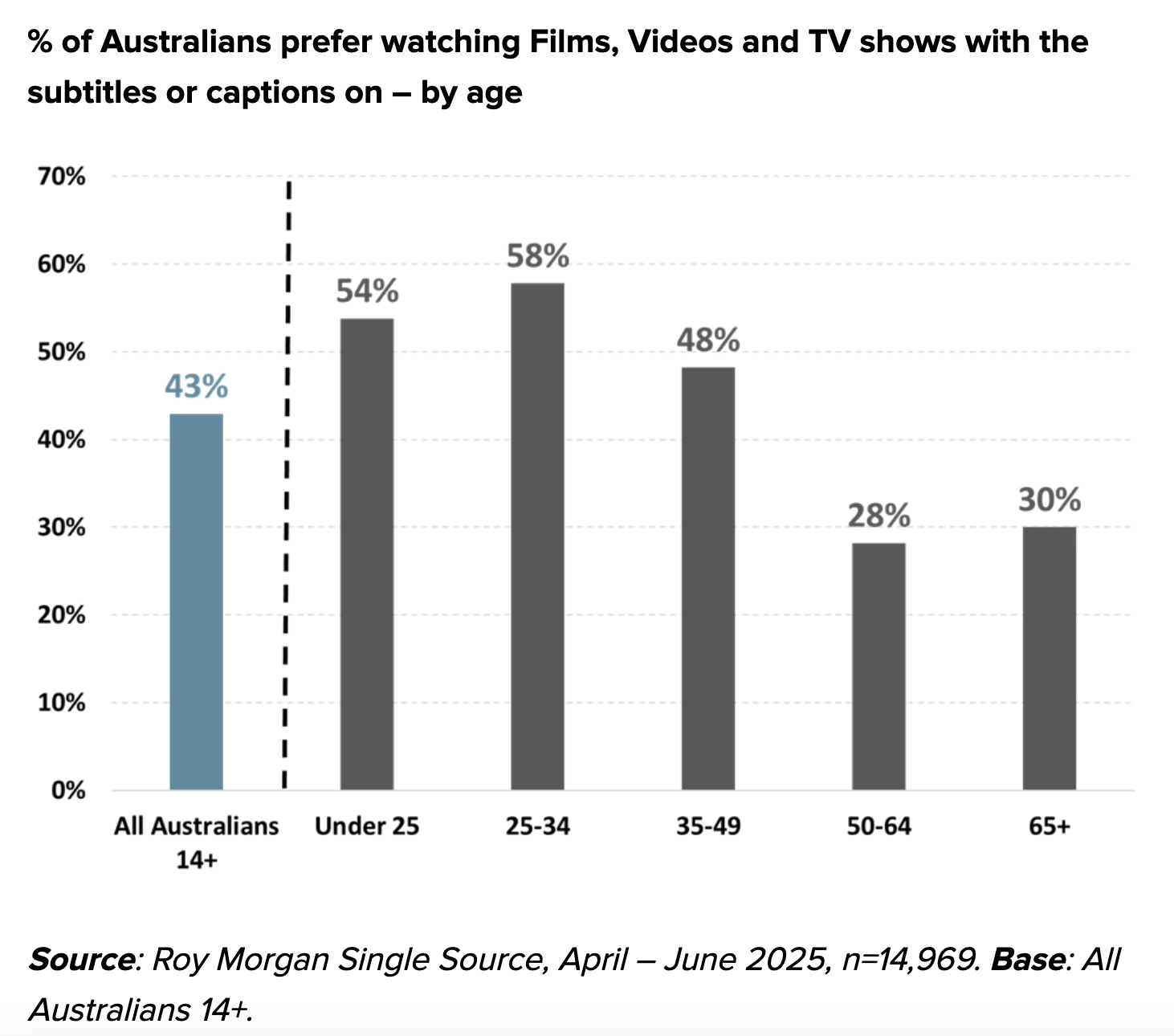
Across a nationally representative sample of 14,969 people aged 14+ surveyed between April and June 2025, 43% said they prefer to watch films, videos and TV with subtitles or captions on.
Among younger viewers, that preference is a majority view, 54% of under-25s and 58% of 25-34s opt in, compared with 48% of 35-49s and only around three in ten among those 50+ (28% of 50-64s, 30% of 65+).
Language and cultural diversity amplify the trend. People who speak a language other than English at home report markedly higher use of captions, 70% for Mandarin speakers, 65% Arabic, 64% Cantonese, 63% Vietnamese and 62% Hindi.
One in eight Australians (13%) now prefer news or entertainment in a language other than English.
That figure rises to 18% for 14–34s and 16% for 35–49s, before dropping to 7% and 5% for the 50–64 and 65+ cohorts respectively.
By country of birth, more than a quarter of those born in Central & South America (38%), India (37%), China (33%) and the Middle East (27%) prefer non-English news/entertainment.
The data comes from Roy Morgan’s expanded “Diversity & Inclusion in Media” program, built with the Media Federation of Australia’s (MFA) DE&I Advisory Council to modernise how the industry measures audiences across culture, language and neurodiversity.
“The MFA is proud to have partnered with Roy Morgan to evolve the Single Source survey, introducing new questions that better reflect the full spectrum of Australia’s population… The first data release already demonstrates its value with sharper insights and fresh opportunities for brands to connect with diverse audiences,” MFA CEO Sophie Madden said.
Roy Morgan CEO Michele Levine said the generational split reflects broader demographic change.
“Clear majorities of people aged under 35 prefer captions and subtitles. In stark contrast, the rate for people aged 50 and over is only around half the level of those under 35,” she said, noting that immigration patterns, skewing younger and increasingly from Asia, are reshaping media habits.
Preference for captions is 72% among people born in India or China, compared with 46% for New Zealand, 44% for mainland Europe and 32% for the UK & Ireland.
The study also links media habits to cultural participation, while 11% of Australians attend a cultural or religious festival in an average three months, rates are far higher among specific faith communities, 51% for Hindus, 36% Muslims, 33% Pentecostals, 30% Mormons and 28% Jehovah’s Witnesses, signalling additional audience touch-points for marketers and community media.
Why it matters for creators, broadcasters and advertisers:
- Sound-off storytelling is table stakes – With captions increasingly “always on,” creative must land without audio, clear on-screen text, legible design, and compressed message hierarchies for mobile feeds.
- Multilingual moments are growing – A rising share prefers non-English content, particularly among under-50s and newer migrant communities, creating demand for subtitled, dubbed and language-specific cuts.
- Accessibility becomes universality – What began as an inclusion feature now improves comprehension in noisy, shared or late-night environments, benefiting mainstream and niche audiences alike.
- Measurement is catching up – The upgraded dataset helps planners go beyond age and postcode to reach cohorts defined by language, culture and viewing context.