Amazon’s Assault on Australian Retail: The Reckoning Has Begun
 David Richards
25 May 2026
David Richards
25 May 2026

Australian consumer electronics and appliance retailers are fighting for survival as Amazon tightens its grip on the nation’s shopping habits, and industry observers warn the worst is yet to come.
Amazon now reaches roughly 7.9 million Australian shoppers and controls around 10% of online retail spend, a share that is forecast to grow sharply over the next three years.
For traditional retailers like JB Hi-Fi, Harvey Norman, The Good Guys and Bing Lee, the clock is ticking. The threat is not simply lower prices. It is the wholesale retraining of consumers on what they should expect from a retailer.
Near-instant delivery, endless product choice, frictionless returns, transparent pricing and algorithmically driven purchasing recommendations are rapidly becoming the new baseline. Once shoppers experience that standard, every physical retailer is judged against it. The industry calls it the Amazon Effect, and it is now playing out in earnest on Australian soil.
Brands that have long depended on traditional retail channels to move product are quietly shifting allegiances. Chinese technology companies including Dreame and Roborock, along with Anker and its subsidiary Eufy, are expanding aggressively on Amazon while simultaneously knocking on the doors of bricks-and-mortar retailers for shelf space.
The calculation for many of these brands is blunt: it is cheaper to do business with Amazon.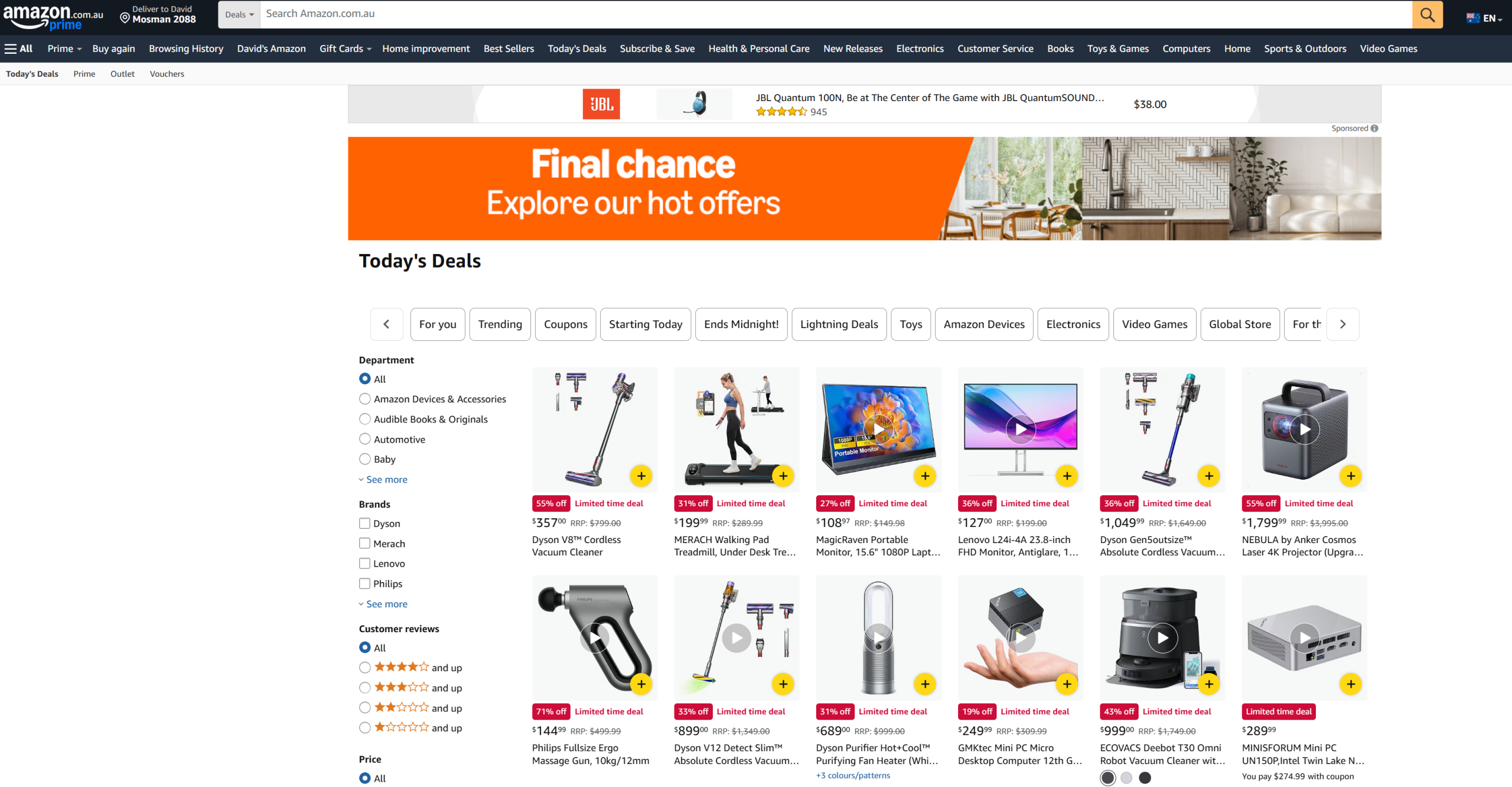
The result is that legacy retailers are increasingly being used as giant national showrooms, providing the physical touchpoint that Amazon currently cannot, while the sale itself migrates online.
Amazon is no longer just a website.
It is investing in new distribution centres capable of delivering large goods including washing machines and oversized televisions, with overnight delivery now a reality in major Australian markets.
That logistics build-out strikes directly at the one meaningful advantage traditional retailers have held over ecommerce.
The warning signs are etched into the histories of every major market Amazon has entered aggressively, including the United States, the United Kingdom and Germany.
The pattern is consistent. Retailers that compete only on range, convenience or price get squeezed hard.
The so-called retail apocalypse that swept through American high streets left behind bankruptcies, collapsing shopping centre traffic, shrinking margins and the consolidation of weaker players.
The businesses most severely damaged were undifferentiated mid-market chains, retailers with poor digital capability, and those dependent on high margins while selling products consumers could easily compare online.The survivors were those who built strong private-label ranges, invested in fulfilment speed, created genuine loyalty ecosystems, locked in exclusive products and turned their stores into experience hubs rather than just transaction points.
Britain’s retail sector offers a closer parallel to Australia.
Amazon forced brutal price competition and same-day delivery standards on UK retailers, triggering massive investment in logistics and the collapse of several traditional chains. Those that endured did so by integrating online and physical retail seamlessly and by ranging products Amazon historically could not deliver efficiently.
Australia faces those same forces, compounded by geography. Servicing a continent-sized country with a comparatively small population makes logistics investment far more costly and complex than in the UK.
Yet Amazon is making that investment anyway, and local retailers will be forced to respond in kind.
Research shows more than 80% of Australian retailers are already pouring money into delivery and fulfilment upgrades, a direct acknowledgment that consumer expectations have shifted. JB Hi-Fi and Bunnings are among those fighting back online, but the sector as a whole still lacks the strong national digital leaders that have helped blunt Amazon’s advance in other markets.
The longer-term structural threat is arguably more damaging than any single lost sale. Amazon is positioning itself to become the default product search engine for Australian consumers, displacing Google and the websites of individual retailers in the discovery phase of the purchase journey. Brands gain access to Amazon’s owned customer data and controlled search visibility in exchange for listing on the platform, creating an incentive to bypass traditional retail relationships entirely. That dynamic has already hollowed out retailer power in the US and UK.
Australian retail has historically operated on high margins, partly because landlords in key locations have extracted excessive rents and partly because consumers have long paid more for goods than their overseas counterparts. Amazon thrives in exactly that environment. The company’s pitch to Australian shoppers is straightforward: you have been overcharged, and here is the alternative.
Observers who spoke to ChannelNews are in broad agreement that Australia remains in the early-to-middle phase of the Amazon Effect, which means the window to adapt is still open, but it is closing. The likely outcome over the next five to ten years is fewer mid-tier retailers, greater consolidation, sharply higher logistics expectations across the board, and a marketplace in which Amazon controls an increasing share of the customer relationship.
The greatest long-term danger is not that Amazon captures all retail sales. It is that Amazon permanently compresses profitability across the entire sector while owning the consumer data and discovery infrastructure that retailers once took for granted.
For Australian retailers, the lesson from every other market is the same: adapt aggressively and early, or wait to become a case study in what not to do.