Amazon Ramps Up Deployment Of Robotics In Warehouses
 Varun Godinho
12 Mar 2025
Varun Godinho
12 Mar 2025
As Amazon prepares to open its second robotics fulfilment centre in Melbourne this year, after having opened a similar facility in Kemps Creek, Western Sydney, three years ago, is now rapidly increasing the use of robotics at its warehouses globally.
Amazon says that 75% of Amazon customer orders globally are now handled in part by robotics, revealing the scale that the use of its robotics is now reaching across its operations.
In its warehouse on the outskirts of Tracy, central California, flat rectangular robots incorporating AI technologies are handed packages by robotic arms.
“Each one is their own beast,” Jonathan Ramey, who maintains the robots, told the Financial Times. “They work through thousands of packages an hour and they don’t let up.”
The company has already confirmed capital expenditures of A$158.96 billion in 2025, with a focus on artificial intelligence and investments in robotics.
“Our robotics touch billions and billions of packages that we ship each year,” says Tye Brady, chief technologist at Amazon Robotics. It is a “great flywheel” that increases productivity while reducing the strain and monotony for human workers, he adds.
Amazon’s Proteus unit uses “computer vision”, using AI to enable robotic systems to process their field of vision in real time. Investments alongside chipmaker Nvidia have helped create “digital twins” — simulated warehouses — that allow it to train autonomous robots.
Amazon’s robotics operation has expanded dramatically since it acquired startup Kiva systems in 2012.
Rebranded as Amazon Robotics, the division has reportedly rolled out more than 750,000 mobile devices and several tens of thousands more robotic arms and autonomous systems.
Its so-called Hercules and Titan robots can lift over a tonne. Robotic arms such as Cardinal pair suction cups with sensors and cameras to lift items safely without damaging them.
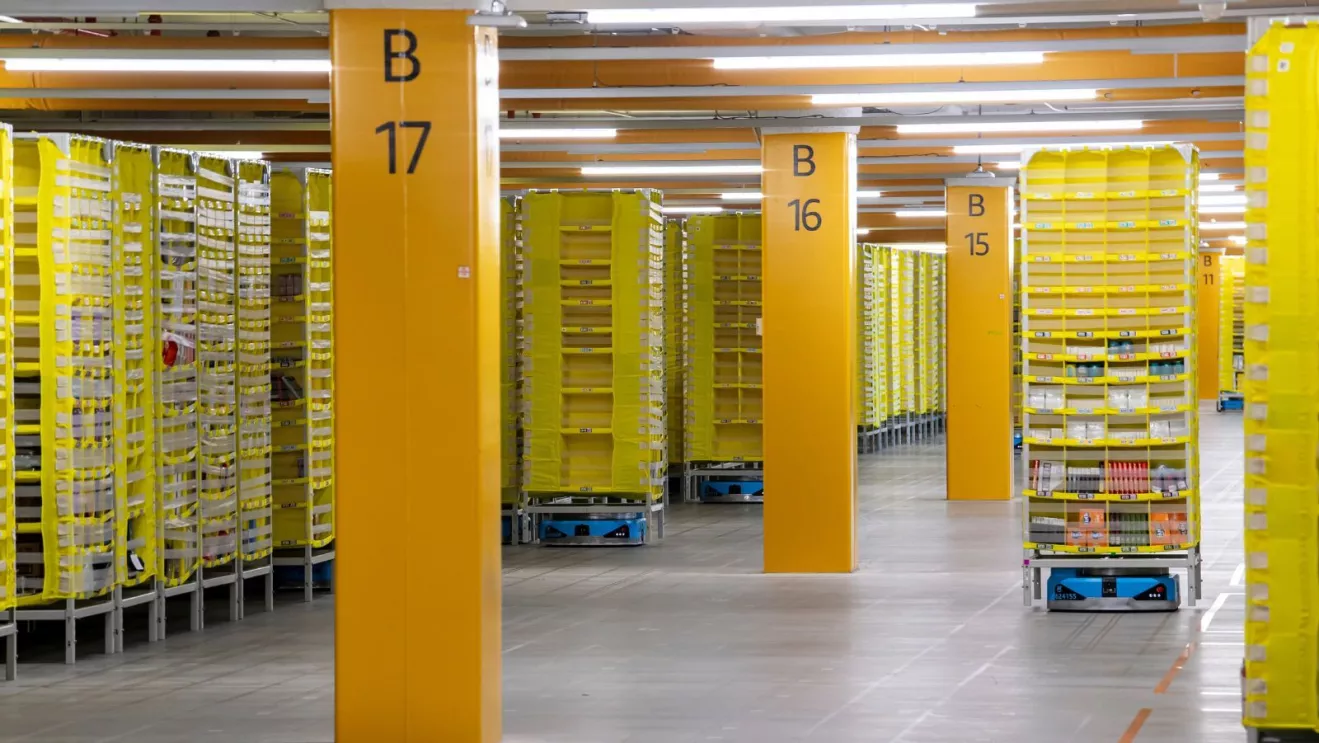
At the Western Sydney robotics fulfilment centre, for example, one of the three robotics floors store approximately 13,000 yellow storage pods. These pods glide across the floor by robotic drives guided by QR codes, delivering them to Amazon’s workers who are ready to store products or pick customer orders.
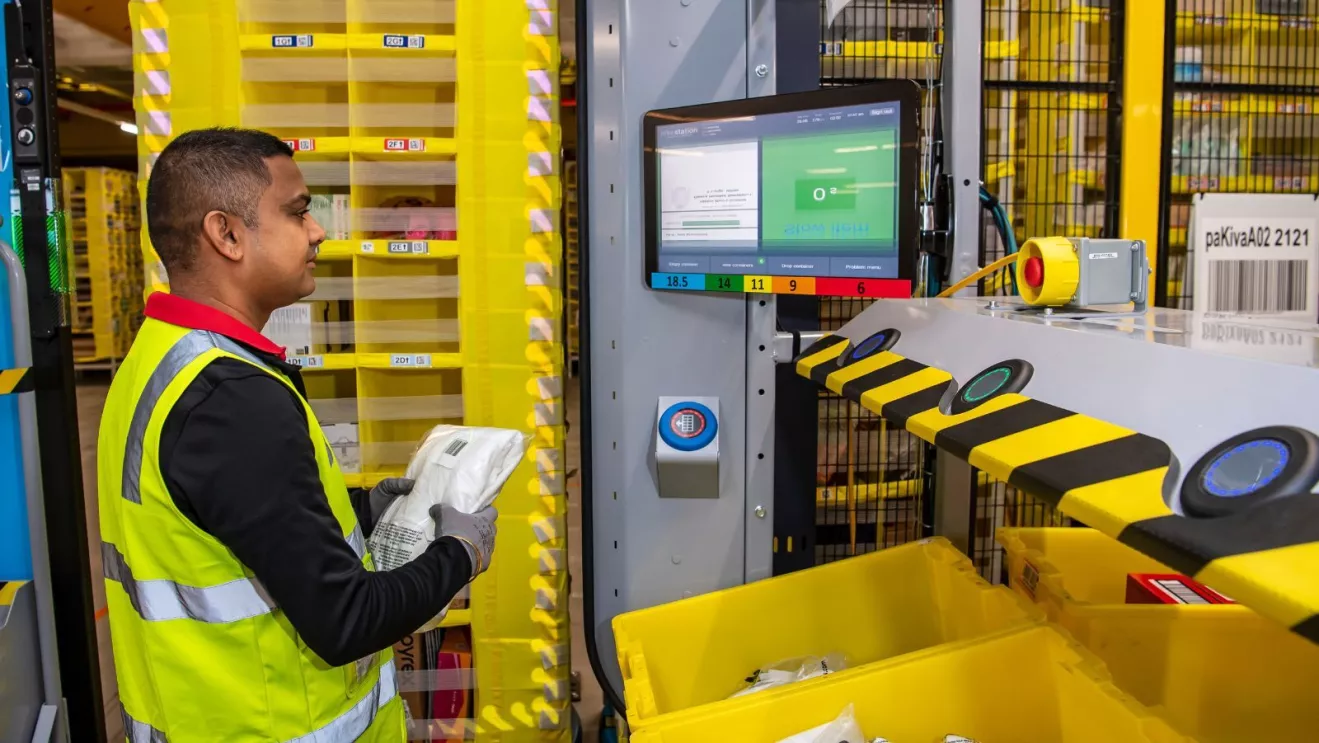
To ensure a safe environment as these robots work alongside humans, approximately 2.5 kilometres of Amazon Robotics safety fencing has been deployed at the Sydney centre to create dedicated robotics fields. It allows the robots to operate within defined boundaries.

The upcoming robotics fulfilment centre in Melbourne will span around 209,000 square metres across four levels – that’s equivalent to 11 Melbourne Cricket Grounds – making it the largest warehouse ever built in Australia and surpassing the Western Sydney robotics site by 9,000sqm.
Bespoke software and tools developed by Amazon are built on top of hardware manufactured by companies including ABB in Switzerland and Japan-based Fanuc.
Pushing back on suggestions that the use of robotics is going to kill jobs, Amazon said that it launched the Mechatronics and Robotics Apprenticeship Program in 2020 to re-train people in fields like robotics and software engineering.
The company has also reportedly created 700 new categories of jobs since introducing robotics in its fulfillment network.
Amazon says that using robots leads to up to 25 per cent reduction in the cost of fulfilling orders at some warehouses. Analysts at Morgan Stanley suggest that more investment in this type of warehousing automation operations will generate around A$15.9 billion in annual savings for Amazon by 2030.