TCL Takes Samsung To Court Over What Really Counts As A Mini-LED TV
 Dominic Bayley
07 Oct 2026
Dominic Bayley
07 Oct 2026
Buying a new TV increasingly means navigating a confusing array of display technologies, from LED and QLED to Mini-LED, OLED, RGB Mini-LED and plenty more.
Even the familiar term “LED TV” can be misleading. Most TVs sold as LED models are actually LCD televisions. The LEDs simply provide the backlight that illuminates the LCD panel and makes the picture visible. OLED and MicroLED displays work differently because their pixels produce their own light.
Things become even more complicated within the LCD category, where manufacturers use terms including LED, QLED, Mini-LED, SQD Mini-LED and RGB Mini-LED. The differences can have a significant impact on picture quality, but there is not always a clear industry-wide definition governing how those labels should be used.
That ambiguity is now at the centre of a legal fight between TCL and Samsung.
TCL is challenging Samsung over the way several of its televisions are marketed as “Mini-LED” models, raising a bigger question for TV buyers: what exactly makes a television Mini-LED, and how different does it need to be from a conventional LED/LCD TV to justify the name?
What is an LED TV?
A conventional LED TV is an LCD television that uses light-emitting diodes to illuminate the LCD panel. The term became popular as manufacturers moved away from older fluorescent LCD backlights.
But not all LED backlights are created equal.
The number, size and placement of the LEDs can vary considerably, as can the way those LEDs are controlled. Some TVs use LEDs positioned around the edges of the display, while more sophisticated models place an array of LEDs directly behind the LCD panel.
Those differences can have a major effect on brightness, contrast, black levels and screen uniformity.
What makes Mini-LED different?
Mini-LED TVs are also LCD televisions, but their backlights use much smaller LEDs. That allows manufacturers to fit potentially thousands of lighting elements behind the screen.
Those LEDs can then be divided into local dimming zones, allowing different sections of the backlight to brighten or darken independently. The result can be significantly better contrast and deeper blacks, while reducing blooming or haloing around bright objects against dark backgrounds.
Mini-LED is commonly associated with submillimetre LEDs, with technical definitions often placing individual LEDs somewhere around 50 to 200 micrometres in size.
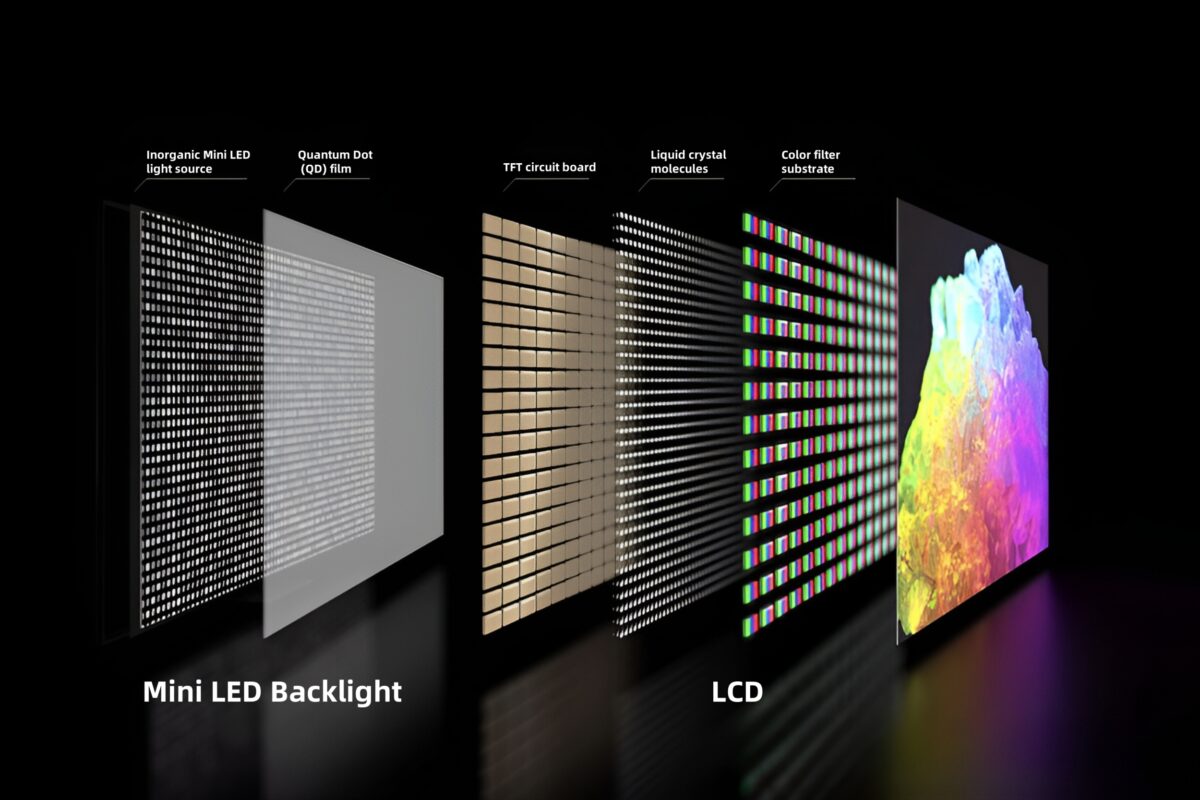
The problem is that there is no universally accepted consumer TV standard defining exactly how small an LED needs to be before a manufacturer can call its television “Mini-LED.”
That lack of a firm definition is central to TCL’s argument against Samsung.
And what about QLED?
QLED is another variation of LCD television. It combines an LED backlight with a layer of quantum dots designed to improve colour reproduction and brightness.
Despite the name, QLED is not a self-emissive display technology like OLED or MicroLED. It is still an LCD panel that requires a separate backlight.
That distinction has already resulted in legal action between Samsung and TCL.
In April 2025, Samsung sued TCL in Germany over allegedly misleading use of the QLED name on some televisions, including TCL’s QLED870 Series.
Samsung argued that TCL used only a small amount of quantum dot material on a diffusion plate and that it did not meaningfully improve colour reproduction or meet consumer expectations of a “true QLED” television.
The German court ultimately sided with Samsung.
Now TCL is challenging Samsung over another increasingly popular TV label.
TCL takes Samsung to court over Mini-LED
TCL filed a lawsuit against Samsung in the US on August 31, 2026, alleging that Samsung falsely marketed its M70H, M80H and M90H 2026 TV series as Mini-LED models.
TCL argues that the marketing creates unfair competition between Samsung’s relatively affordable M Series televisions and TCL’s own Mini-LED products.
But the dispute goes beyond whether Samsung’s LEDs technically meet a particular size requirement.
TCL argues that consumers have come to understand Mini-LED as meaning more than simply tiny LEDs. According to its complaint, the term implies a full-array backlight containing large numbers of LEDs combined with hardware-based local dimming.
That distinction matters.
Traditional edge-lit LCD TVs can use only a relatively small number of LEDs positioned along the sides of the screen. A light guide and diffuser then spread that light across the panel.
The approach is inexpensive and can work well with bright content, but it has limitations when displaying dark scenes or bright objects against black backgrounds.
Full-array Mini-LED TVs instead place many more LEDs directly behind the LCD panel. Those LEDs can be grouped into independently controlled dimming zones, allowing one part of the screen to become bright while another remains dark.
Generally, the greater the number of LEDs and independently controlled zones, the more precisely the television can manage its backlight.
That can improve contrast, black levels, brightness and uniformity and help high-end LCD TVs get closer to some of the contrast advantages offered by self-emissive OLED displays.
Simply making the LEDs smaller does not automatically deliver those benefits.
TCL questions Samsung’s Mini-LED hardware
According to TCL’s complaint, Samsung’s M Series televisions use just 52 LEDs positioned along the top and bottom edges of the screen.
TCL also alleges those LEDs are larger than what is typically associated with Mini-LED technology.
More importantly, because Samsung’s TVs allegedly use an edge-lit design rather than a full array of LEDs positioned behind the LCD panel, TCL says they lack true hardware-based local dimming.
Samsung’s own marketing describes the M Series as using “software-based dimming.”
TCL argues that this is fundamentally different from full-array local dimming, where physical groups of LEDs behind the panel can be controlled independently.
The company further alleges that Samsung’s M Series Mini-LED televisions are effectively reworked versions of its entry-level 2025 Crystal UHD U800F models, which use conventional edge-lit LED/LCD backlighting.
So is Samsung really selling Mini-LED TVs?
That is ultimately what the court will have to decide.
If Mini-LED is defined purely according to the physical size of the LEDs, Samsung could potentially argue that its televisions qualify as long as their lighting elements are sufficiently small.
Samsung has said it will defend against the lawsuit and stands behind the quality and accuracy of its product descriptions, issuing the following statement: “Samsung Electronics is aware of the lawsuit filed by TCL. We intend to vigorously defend against it. We stand fully behind the quality and accuracy of our product descriptions. As the number one TV brand for 20 years, our products, track record, and loyal customers speak for themselves. As this is an active legal matter, we will not be commenting further at this time.”
TCL’s argument is broader. It claims consumers reasonably expect a Mini-LED television to combine smaller LEDs with a full-array backlight and hardware-based local dimming – the features that normally deliver the picture-quality improvements associated with the technology.
The lack of an agreed industry definition makes the issue particularly complicated.
There is also a broader competitive battle playing out between the two companies. TCL has been aggressively expanding its position in the global TV market, while its upcoming partnership with Sony could further strengthen its standing against established leaders including Samsung.
The lawsuit is separate from that partnership, but it illustrates just how fiercely manufacturers are competing in the premium TV market.
For consumers, the dispute also highlights the limitations of relying on technology labels alone.
Terms such as QLED and Mini-LED can provide useful information about how a television works, but they do not necessarily tell you how well it performs. A Mini-LED label, for example, does not reveal how many LEDs are inside the TV, how many local dimming zones it has or how effectively its processing controls the backlight.
Ultimately, picture quality matters more than the acronym printed on the box.
Brightness, contrast, black levels, viewing angles, glare handling, screen size, smart TV features, sound quality, usability and price should all play a role in choosing a television.
If TCL’s lawsuit ultimately produces a clearer definition of what manufacturers can legitimately call a Mini-LED TV, however, consumers may have an easier time understanding exactly what they are paying for.