Is The Communication Minister Shifting Blame Over Triple Zero Failures To Carriers & Samsung Because Of ACMA’s Failure To Regulate Mobile Phones?
 David Richards
29 Oct 2025
David Richards
29 Oct 2025
OPINION: Australian Communications Minister Anika Wells has spent days criticising Optus over the recent Triple Zero outage — and yes, it was a serious failure. But the reality is that much of the problem stems from her own department’s regulatory shortcomings, not just the carriers or Samsung.
The real question is: Is this an attempt by an ill-informed minister to deflect blame, when it was actually the poor performance of the Australian Communications and Media Authority (ACMA) — the very body tasked with regulating and certifying mobile devices — that helped create the problem?
The Self-Regulation Problem
Under current rules, the Labor Government allows smartphone manufacturers to self-regulate — with no active, mandatory policing of devices entering the Australian market.
At the centre of this issue lies ACMA’s CO2 form — the official declaration of conformity for devices sold in Australia. Manufacturers, including lesser-known and questionable brands from China, are effectively told they can “create their own declaration” and simply retain the document for inspection if ever requested by ACMA.
In bold type, the form itself states:
“You do not need to return this form to ACMA.”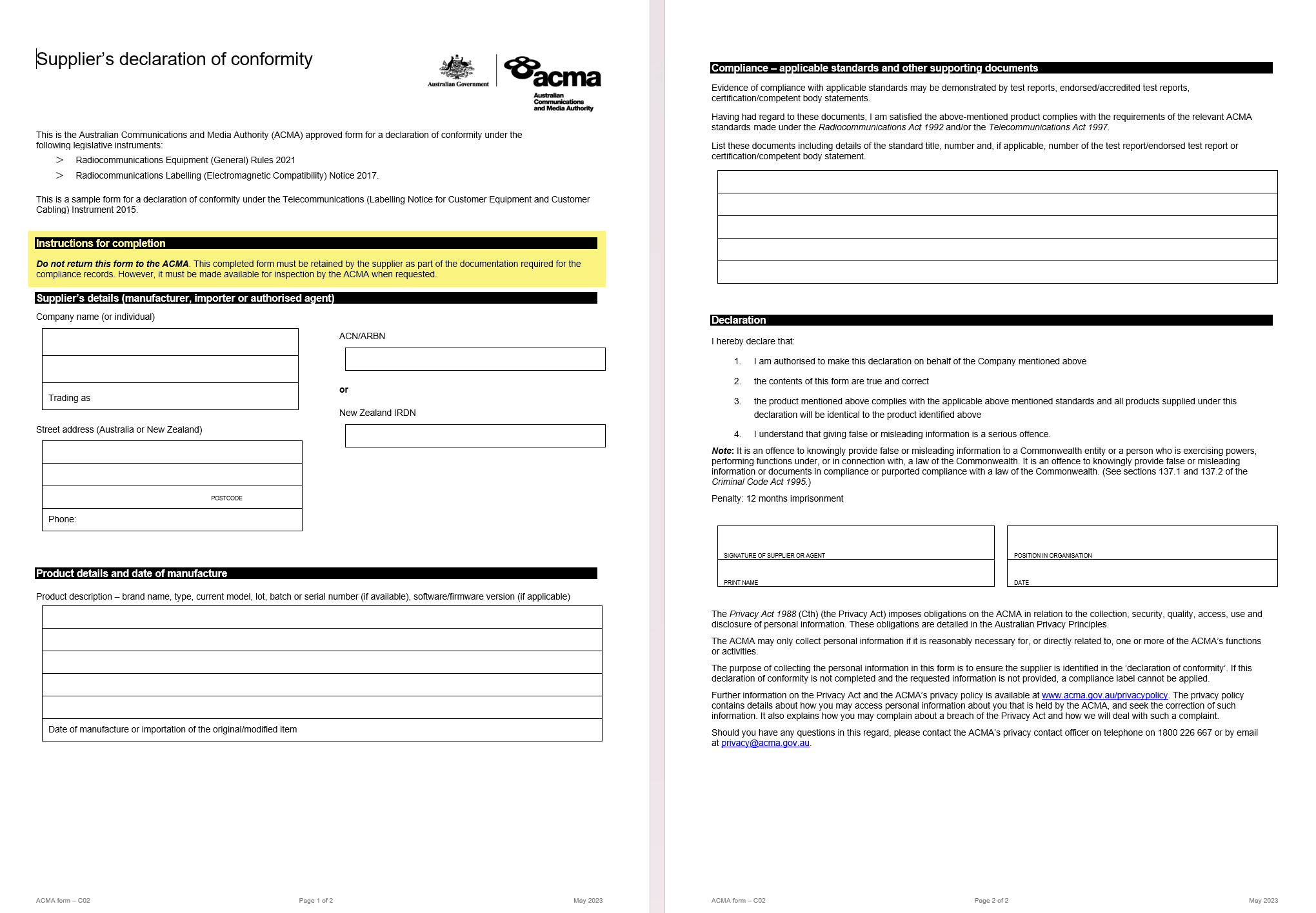
This self-attestation process is authorised under legislation overseen by Wells’ own department — specifically:
Radiocommunications Equipment (General) Rules 2021
Radiocommunications Labelling (Electromagnetic Compatibility) Notice 2017
As one major manufacturer told ChannelNews, “Forget about prevention — ACMA’s process is designed to protect itself, not consumers, if something goes wrong. A Chinese factory can fill this form in with Chinese only certificates and using questionable labs to certify their devices.”
Lack of Oversight
A ChannelNews investigation found that several brands selling mobile phones in Australia have never been challenged by ACMA regarding their certification status.

Australian Communications Minister Anika Wells
What has now become a political sideshow — with both major parties posturing for headlines — should instead become a formal investigation into ACMA’s regulatory and certification processes.
Political Grandstanding
Opposition communications spokeswoman Melissa McIntosh has jumped into the debate, claiming the Samsung issue is “potentially huge.” In truth, it’s an operational problem that can be fixed — not a national scandal.
Unlike her predecessor, Paul Fletcher, a former Optus executive who understood the industry, McIntosh appears to be seeking airtime rather than offering technical insight. Having spent her early career as a political aide, she lacks the communications expertise needed to engage constructively on the issue.

Opposition communications spokeswoman Melissa McIntosh
Both Wells and McIntosh should focus on the real problems, rather than using a tragic incident and technical failures as political footballs.
The Real Questions
There are far more pressing questions the public deserves answered:
Why were devices involved in the Triple Zero failures locked to foreign carriers?
Why isn’t ACMA policing uncertified device imports?
Why are grey imports — many locked to foreign networks — being openly sold in Australia?
It’s worth noting that the Samsung models under scrutiny were originally certified for Australian networks. The problems only emerged after the closure of 3G networks, when it became clear some devices failed to properly route emergency calls via 4G or 5G.
Why didn’t ACMA re-verify these certifications once 3G was phased out, to ensure all devices could make emergency calls across the newer networks?
Samsung has admitted the issue was an oversight, but the failure of oversight by regulators is just as significant.
Cosmetic Fixes Won’t Solve Structural Failures
In what appears to be a knee-jerk political reaction, the Communications Minister has directed Optus and Telstra to report Triple Zero outages in real-time — a move designed more for optics than outcomes.
Wells has written to ACMA instructing them to “improve transparency” around network failures. But perhaps she should start by improving ACMA’s performance — ensuring the agency properly vets which handsets enter Australia and whether they actually comply with Australian standards.
Under new directives, telcos will soon be required to maintain a public, real-time register of network outages. Yet this doesn’t address the root cause: the flood of non-compliant, grey-imported phones — many with inadequate emergency call compatibility — that continue to slip into Australia unchecked.
The Bottom Line
This is not a Samsung problem or an Optus problem — it’s a systemic regulatory failure.
Until ACMA enforces proper compliance and the government stops relying on self-certification, Australia will remain vulnerable to the same operational failures — and politicians will keep playing the blame game.