Consumer Wearables Set To Generate More Than US$1 Trillion By 2032
 April Ossington
20 Aug 2026
April Ossington
20 Aug 2026

The global consumer wearables industry is entering a major growth phase, with cumulative revenue forecast to exceed US$1 trillion between 2026 and 2032 as buyers embrace more advanced health features, artificial intelligence and new wearable form factors.
According to Counterpoint Research’s Global Consumer IoT Wearables Tracker 2024-2032F, worldwide consumer wearables revenue is expected to increase at a compound annual growth rate of 12 per cent between 2026 and 2032.
That is considerably faster than unit shipments, which are forecast to grow at 6 per cent. Counterpoint believes the difference reflects consumers moving towards more capable and higher-priced products rather than growth being driven purely by greater shipment volumes.
Smartwatches and smart hearables will continue to form the backbone of the industry thanks to their large existing user bases. However, newer products including smart glasses, smart rings and AI-powered pendants are expected to become increasingly important.
Health technology is one factor driving that change. Wearable devices are moving beyond conventional fitness tracking towards continuous monitoring and potentially preventive healthcare applications, where devices can alert users to changes before they would otherwise become apparent.
Counterpoint Principal Analyst Anshika Jain said this transition is helping transform wearables from optional accessories into products consumers may consider replacing regularly.
Artificial intelligence is expected to accelerate the trend by enabling hands-free assistance and more continuous monitoring across different types of wearable hardware.
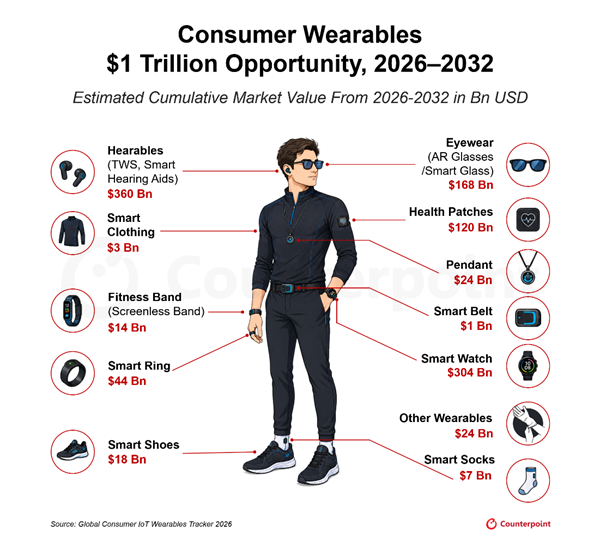
Smart eyewear could be one of the biggest beneficiaries. Counterpoint forecasts the category will generate US$44 billion in annual revenue by 2032 and represent close to one-fifth of the total consumer wearables market.
The category covers products ranging from display-less smart glasses to more advanced augmented reality eyewear. Cameras, microphones, speakers and displays can potentially provide communication, translation, navigation and real-time assistance while reducing the need to repeatedly reach for a smartphone.
Display-less AI glasses are expected to attract buyers through familiar eyewear designs, comparatively affordable pricing and camera-and-audio functionality.
AR glasses, meanwhile, could command higher prices by providing digital information directly within the user’s field of view. Potential applications include navigation, productivity, professional training and entertainment.
Smart pendants and smart rings are also forecast to be among the industry’s fastest-growing categories, although AI pendants will be expanding from a relatively small starting point.
Their appeal is expected to centre on discreet designs, continuous sensing and always-available digital assistance. Smart rings in particular can provide health monitoring without requiring users to wear a conventional smartwatch.
Despite the arrival of these newer products, smartwatches and true wireless stereo earbuds, commonly known as TWS devices, are expected to remain the industry’s largest categories.
Counterpoint forecasts smartwatches and TWS products will generate a combined US$558 billion in cumulative revenue between 2026 and 2032, accounting for more than half of the industry’s projected US$1 trillion-plus total.
Their continued dominance will be supported by large installed user bases, regular replacement cycles and close integration with smartphone ecosystems.
Smartwatches could also move further into health monitoring and personal computing as manufacturers introduce premium hardware, cellular connectivity, increasingly sophisticated sensors and on-device AI.
TWS products face a somewhat different outlook. Although the category will remain enormous, Counterpoint expects revenue growth to face pressure as features become increasingly standardised and manufacturers compete aggressively on price.
On-device AI presents its own technical challenges for wearable manufacturers and semiconductor companies. Unlike smartphones and computers, wearables frequently operate directly against the body while continuously collecting information and relying on relatively small batteries.
Counterpoint Research Director Mohit Agrawal said heat and battery efficiency will therefore be critical considerations for companies developing chips capable of handling AI directly on wearable devices.
As wearable hardware becomes more sophisticated, Counterpoint expects competition to increasingly move beyond individual specifications.
Manufacturers that can combine devices with interoperable software, secure data management, developer support and broader industry partnerships could be better positioned to keep users within their ecosystems.
The forecast suggests the next stage of the wearables market will not simply be about selling more smartwatches and wireless earbuds. Smart eyewear, rings, pendants and other emerging products could reshape how consumers interact with AI and monitor their health, while helping turn wearables into an industry generating more than US$1 trillion over the next seven years.