Apple Unveils M6 And M5 Ultra Chips With Major AI Performance Gains
 April Ossington
26 Aug 2026
April Ossington
26 Aug 2026
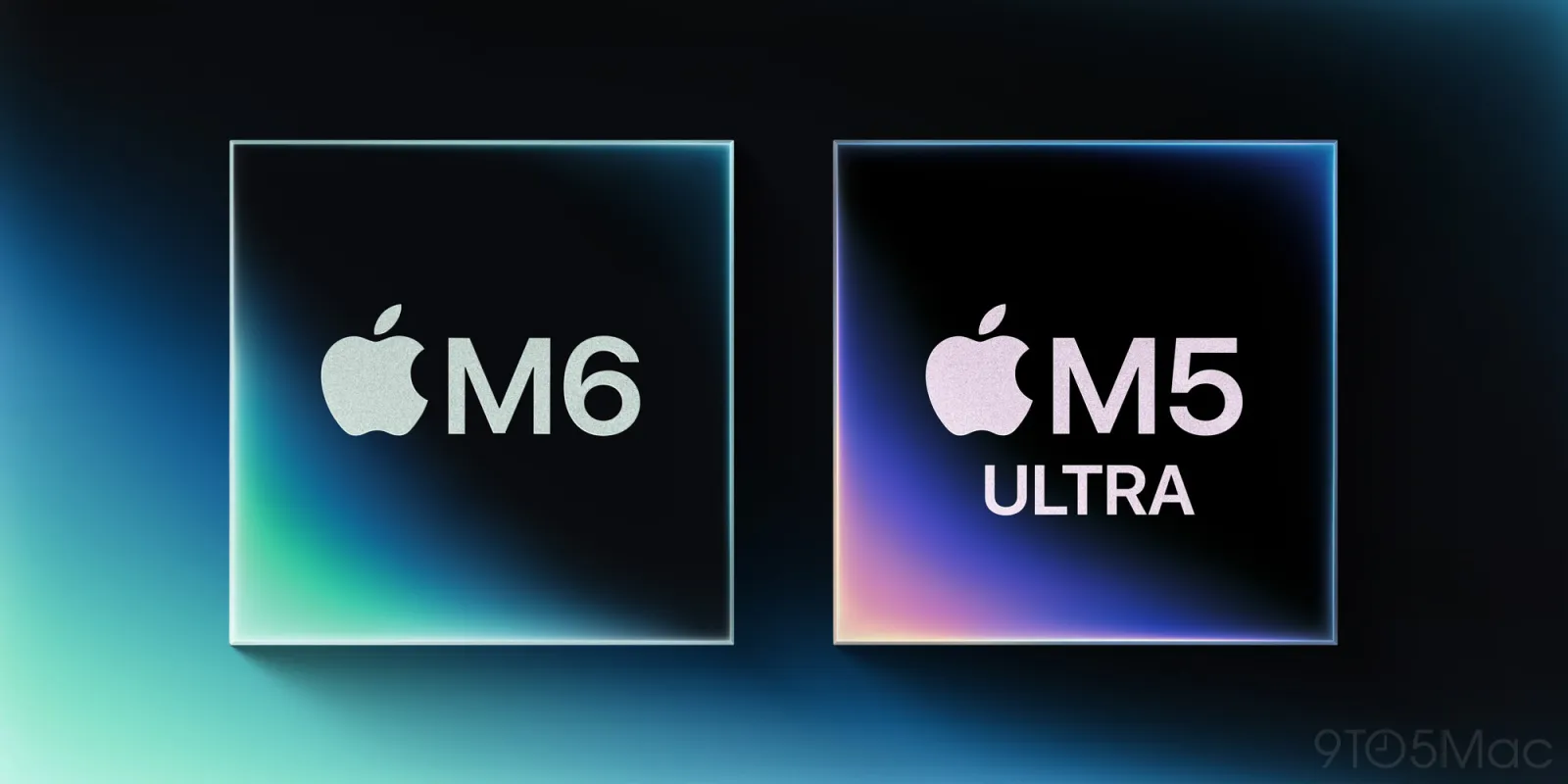
Apple has introduced its latest generation of Mac processors, unveiling the M6 alongside the more powerful M5 Ultra as it targets demanding artificial intelligence, video production and 3D workloads.
The M6 represents the next step for Apple silicon and is manufactured using a 2nm process, allowing Apple to increase transistor density while improving power efficiency. The chip makes its debut in the newly announced Mac mini.
Apple has equipped the M6 with a 12-core CPU, up from 10 cores on the M5. Its configuration includes two super cores, four performance cores and six efficiency cores, with Apple claiming the processor delivers the world’s fastest single-threaded performance.
Compared with the M5, Apple says the M6 delivers up to 1.2 times faster multi-threaded CPU performance. Against the original M1, the improvement increases to as much as 2.4 times.
Graphics performance has also received an upgrade. The M6 incorporates a 12-core GPU, with a Neural Accelerator built into every GPU core. Apple claims peak GPU compute performance for AI workloads is 30 per cent faster than the M5 and eight times faster than the M1.
Hardware-accelerated ray tracing and Dynamic Caching are also supported, strengthening the chip’s capabilities for graphics-intensive applications including 3D rendering and professional creative work.
On-device AI is another major focus. The M6 incorporates an updated neural processing architecture featuring dual 16-core Neural Engines. Apple says this provides twice the peak compute performance of the M5 for on-device AI workloads.
The M6 can be configured with up to 32GB of unified memory and offers memory bandwidth of up to 170GB/s.
For users requiring considerably more processing power, Apple has also introduced the M5 Ultra, which will initially be available in the new Mac Studio.
Rather than following a conventional dual-die Ultra configuration, the M5 Ultra connects two dual-die M5 Max chips through Apple’s UltraFusion technology. This creates a four-die design, making it the first M-series processor to use a quad-die architecture.
Apple describes the M5 Ultra as its most powerful chip yet.
At its highest configuration, the processor features a 36-core CPU comprising 12 super cores and 24 performance cores. Apple claims single-threaded performance is up to 1.25 times higher than the M3 Ultra, while multi-threaded performance improves by up to 1.3 times.
The M5 Ultra can also be configured with an 80-core GPU and up to 32 Neural Engine cores. Apple says peak AI compute performance can reach 4.3 times that of the M3 Ultra.

Professional video production is another area receiving considerable attention. The M5 Ultra includes twice as many video encode and decode blocks, enabling a Mac equipped with the processor to handle as many as 33 simultaneous streams of 8K ProRes video at 30fps.
Memory capacity also moves well beyond the M6. The M5 Ultra supports configurations with as much as 512GB of unified memory and memory bandwidth reaching 1.2TB/s.
The two processors demonstrate Apple’s increasingly different approach to different sections of the Mac market. The M6 brings the company’s latest CPU, GPU and AI architecture to a more mainstream Mac, while the M5 Ultra is aimed squarely at professionals dealing with extremely demanding workloads.
Apple has not provided pricing for the chips separately, as both are integrated into Mac hardware. Australian pricing will therefore depend on the configurations of the new Mac mini and Mac Studio in which they are offered.