Asus Launches ProArt P16 And P14 Laptops With Powerful Nvidia RTX Spark AI Platform
 Dominic Bayley
09 Oct 2026
Dominic Bayley
09 Oct 2026
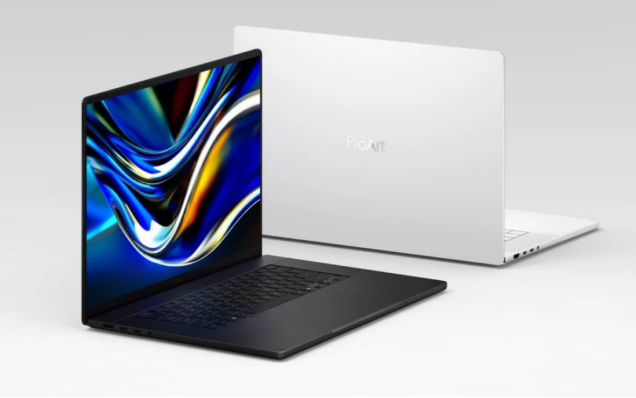
Asus has officially launched its new ProArt P16 and ProArt P14 laptops, bringing Nvidia’s RTX Spark AI platform to portable workstations designed for content creators, developers and AI professionals.
First unveiled at Computex 2026, the new laptops combine Nvidia’s Arm-based Grace CPU with a Blackwell RTX GPU, allowing users to run demanding AI models directly on their devices without relying on cloud-based processing.
At the heart of the RTX Spark platform is a unified memory architecture that allows the CPU and GPU to access the same pool of memory. With up to 128GB of unified memory, a 20-core Grace CPU and a Blackwell GPU featuring up to 6,144 CUDA cores, the system is designed to overcome the memory limitations typically associated with conventional Windows laptops.
Asus claims the architecture can deliver up to one petaflop of FP4 AI performance, with enough processing power to run large language models containing up to 120 billion parameters and supporting context windows of up to one million tokens.
The technology is aimed at professionals working with demanding applications, including complex 3D rendering, 12K video editing and generative AI development.
Running these workloads locally could also reduce dependence on expensive cloud computing services while allowing users to keep sensitive projects and data on their own machines.
Despite their powerful hardware, Asus has managed to keep both laptops relatively slim and lightweight.
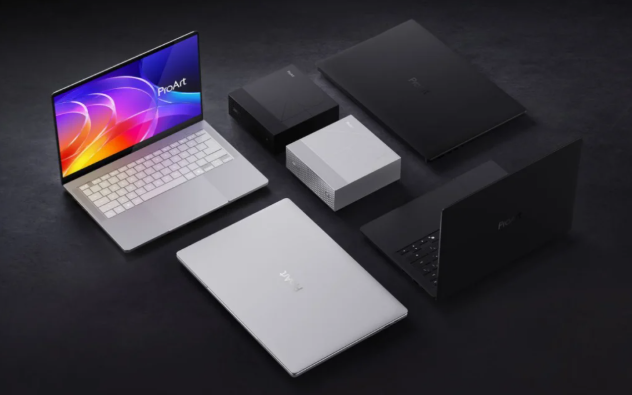
The larger 16-inch ProArt P16 measures just 12.9mm thick and weighs 1.77kg, while the more compact 14-inch ProArt P14 is 13.9mm thick and weighs 1.48kg.
Both models feature Asus Lumina Pro OLED displays with variable refresh rates of up to 120Hz, 100% coverage of the DCI-P3 colour gamut and peak HDR brightness reaching 1,600 nits.
The ProArt P16 comes equipped with a 4K OLED display and Nvidia G-Sync support, while the P14 features a 3K OLED panel.
Asus has also included anti-reflection coatings to improve visibility, along with Wi-Fi 7 connectivity, USB4 ports and a range of additional connections aimed at professional users.
Battery capacities are equally substantial, with the P16 housing a 99.9Wh battery and the smaller P14 featuring a 90Wh unit.
On the software front, Asus is introducing several AI-powered applications designed to take advantage of the laptops’ processing capabilities.
These include MuseTree, which supports local image generation using FLUX and WAN models, and StoryCube, an AI-powered media management application designed to help creators organise their content.
Asus has also partnered with Nous Research to integrate Hermes Agent, an open-source autonomous AI assistant capable of carrying out tasks across local applications and files.
Both laptops also support ComfyUI, giving developers and creators access to a node-based interface for building and managing advanced generative AI workflows.
The emphasis on local AI processing is a major selling point, particularly for professionals who want greater control over their workflows without depending on an internet connection or ongoing cloud subscription costs.
The Asus ProArt P16 and P14 are available to pre-order now in Australia through the Asus Store and participating retailers, with general availability commencing on October 17. Pricing starts at $5,999 for the ProArt P16 and $6,499 for the ProArt P14, positioning the new models firmly in the premium workstation category.