Active Speakers Challenge Traditional Hi-Fi As Audio Giants Tackle Distortion
 Dominic Bayley
27 Nov 2026
High-end audio manufacturers are challenging the long-held belief that passive speakers paired with separate amplifiers deliver superior sound quality, with advances in amplification, digital processing and driver control strengthening the case for active speaker systems.
Engineering reports published by the Japan Audio Society (JAS), the organisation responsible for Hi-Res Audio certification, highlight how KEF, Yamaha and Avantgarde Acoustic are exploiting integrated amplification to reduce distortion and improve acoustic performance.
While active speakers have traditionally been associated with professional recording studios and desktop audio, they are increasingly finding their way into premium home entertainment systems.
The rise of music streaming has helped accelerate adoption, with consumers seeking simpler setups without necessarily compromising sound quality.
However, manufacturers are now demonstrating that the benefits extend well beyond convenience.
Unlike conventional passive speakers, which use internal crossover networks to distribute amplified signals between drivers, fully active designs separate frequencies before amplification, allowing individual amplifiers to power each driver directly.
This gives engineers greater control over speaker performance while reducing unwanted interactions between bass and treble frequencies.
Manufacturers can also deploy different amplification technologies within the same speaker, using high-powered Class D amplification for bass reproduction and Class AB amplification for higher frequencies.
“From a technical perspective, active speakers have huge advantages, which allow us to make active speaker systems that can outperform a traditional hi-fi system of the same total price,” KEF Chief Technology Officer Jack Oclee-Brown said in July.
Digital signal processing (DSP) is another significant advantage, allowing manufacturers to fine-tune frequency response, crossover slopes, driver timing, phase alignment and overload protection.
KEF discovered during development of its original LS50 Wireless that adjusting frequency response alone was insufficient to achieve its desired sound quality.
Engineers subsequently revised the speaker’s digital filters to improve spatial depth and reduce unwanted sonic artefacts.
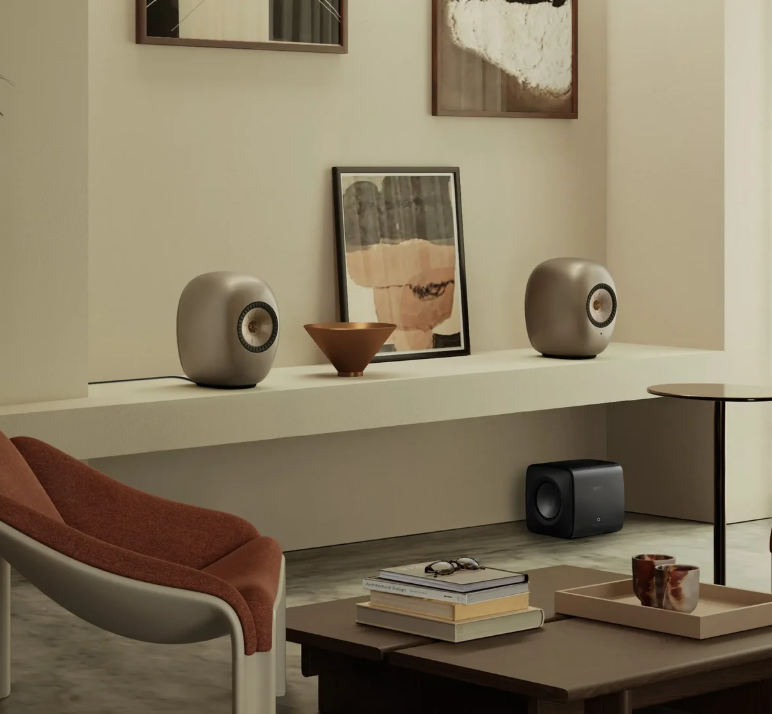
The British audio manufacturer’s more recent LS LUXE speakers, launched in August, take the technology further by incorporating current-drive amplification and Velocity Control Technology (VECO).
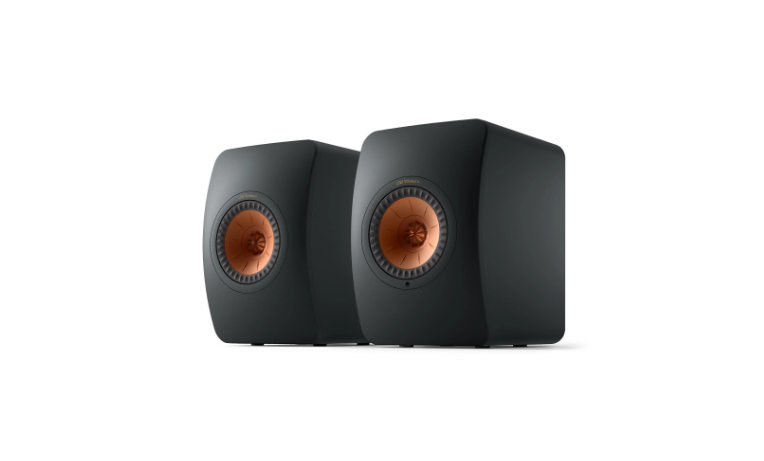
An internal sensing coil monitors the movement of the low/mid-frequency driver, feeding information back to the amplifier to correct unwanted motion and reduce distortion.
The LS LUXE also features a larger driver and an enclosure approximately 50% bigger than that of the LS50 Wireless II.
Meanwhile, Yamaha has reported significant reductions in distortion through its new Synergistic Drive technology, introduced in the NX-70A speaker.
The system uses current feedback to compensate for electrical and magnetic interactions within the driver that can compromise sound reproduction.
Yamaha recorded reductions of up to 15dB in third-harmonic woofer distortion at 800Hz, with improvements across a broader frequency range between 200Hz and 2kHz.
The NX-70A also incorporates linear-phase digital equalisation to improve timing across a wide frequency range.
German premium audio manufacturer Avantgarde Acoustic has adopted a different approach with its OPUS 1 speaker, retaining elements of traditional passive speaker engineering alongside integrated amplification.
Its 10-inch woofer is powered by a 250W Class D amplifier with DSP, while a dedicated amplifier incorporating technology from the company’s patented iTRON current-drive design powers the mid/high-frequency horn through a passive crossover.
Despite these advances, active speakers present several challenges for manufacturers and consumers.
Housing amplifiers, power supplies, digital processors and drivers within a single enclosure creates engineering challenges involving heat, vibration and electrical interference.
Consumers also sacrifice some of the flexibility associated with traditional hi-fi systems, particularly the ability to independently upgrade amplifiers and other components.
Software longevity, repair costs and replacement amplifier availability are additional considerations, particularly for premium connected speakers expected to remain in service for decades.
Buyers are being encouraged to investigate warranty coverage, servicing arrangements and whether speakers can continue operating independently of integrated streaming platforms.
Nevertheless, the engineering advances suggest active speakers are increasingly becoming a sound-quality-driven alternative to traditional high-end audio systems rather than simply a more convenient option.
“The sonic drawbacks of building the amplifier into the speaker have now turned into advantages,” JAS contributor Hijikata concluded.
“Going forward, we will see more models chosen not for convenience, but because putting sound quality first led straight to them.”