Under New Leadership JB Hi Fi Is Being Reengineered, What Is Coming As Share Value Falls?
 David Richards
26 May 2026
David Richards
26 May 2026

JB Hi, Fi’s sharp share price slide in 2026 has triggered fresh debate about whether Australia’s biggest consumer electronics retailer is finally becoming vulnerable to Amazon. But ChannelNews investigations reveal the real issue runs far deeper than competitive pressure from the US giant with new CEO Nick Wells now reenineering the popular retailer for future growth.
Despite continued sales growth across both JB Hi, Fi and The Good Guys in FY26, investors dumped the stock after management signalled a tougher road ahead.
The sell off reflects growing concerns that the retailer’s rapid earnings expansion may have peaked as Australian consumers come under mounting economic pressure.
Analysts say the market is not questioning whether JB Hi, Fi is a good business. Instead, investors are reassessing how much they are willing to pay for a retailer entering a slower growth phase.
The company now finds itself caught between rising supplier costs, weakening consumer confidence, elevated interest rates and intensifying margin pressure as discounting increases across the retail sector.
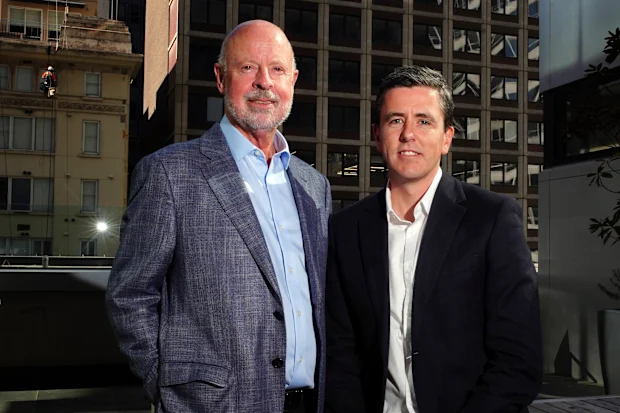
Nick Wells JB Hi Fi Group CEO right, seen with e&s managing director Rob Sinclair.
Harvey Norman, which has yet to report since February 2026, is facing similar headwinds.
One of the biggest concerns remains inventory and supply chain stress in electronics categories heavily dependent on memory components, particularly AI enabled devices, PCs and smartphones.
Memory shortages are pushing up hardware prices at the same time consumers are becoming more cautious with discretionary spending.
Analysts increasingly believe the consumer electronics sector is now normalising after several years of unusually strong demand driven by pandemic spending and replacement cycles.
The consensus view emerging across the market is that JB Hi, Fi remains operationally strong, but future growth is likely to be slower and more cyclical.
Even so, the retailer continues to be regarded as one of Australia’s best run retail businesses.
Its low cost operating model, disciplined inventory management and high sales throughput continue to outperform many rivals.
Combined with the scale of JB Hi, Fi, The Good Guys and e&s, the group retains enormous buying power with suppliers, allowing it to maintain aggressive pricing while protecting profitability.
That operating efficiency remains central to the company’s long term competitiveness.
But the competitive landscape is changing rapidly.
Amazon’s expanding presence in Australia is forcing JB Hi, Fi to accelerate investment in logistics, ecommerce infrastructure, automation and omnichannel retail technology.
The retailer is now aggressively upgrading fulfilment capabilities, warehouse automation and delivery systems as it benchmarks itself directly against Amazon’s delivery performance.
At the same time, JB Hi, Fi is leveraging something Amazon still lacks locally, a vast national store footprint integrated tightly with online operations.
The company is investing heavily in click and collect, ship from store capabilities, real time inventory visibility and faster fulfilment systems designed to turn physical stores into strategic distribution assets.
The Good Guys is also understood to be preparing a major marketplace expansion that could introduce new brands and categories in an effort to broaden its digital reach.
Suppliers are already seeing significant investment in upgraded commerce platforms, customer data systems, recommendation engines and mobile shopping experiences as online retail growth continues to outpace traditional store traffic.
Management is also betting heavily on AI driven hardware demand becoming the next major consumer electronics upgrade cycle.
Executives recently highlighted strong customer interest in AI enabled PCs, smartphones and connected devices despite rising prices linked to memory shortages.
Unlike Amazon, JB Hi, Fi is not attempting to build AI ecosystems or platforms. Instead, it is positioning itself as Australia’s leading retail destination for AI powered consumer hardware.
Strategically, analysts say JB Hi, Fi’s defence against Amazon is built around combining trusted local branding, aggressive pricing, rapid fulfilment, physical store convenience and an increasingly sophisticated digital shopping experience.
That strategy appears to be resonating with consumers.
The retailer currently attracts more than 20 million monthly visits to its online platforms, compared with roughly 5.5 million for Harvey Norman.
Industry observers increasingly describe JB Hi, Fi as operating a “hybrid retail” model, combining ecommerce scale with physical store advantages that pure online rivals struggle to replicate.
The problem for investors is valuation.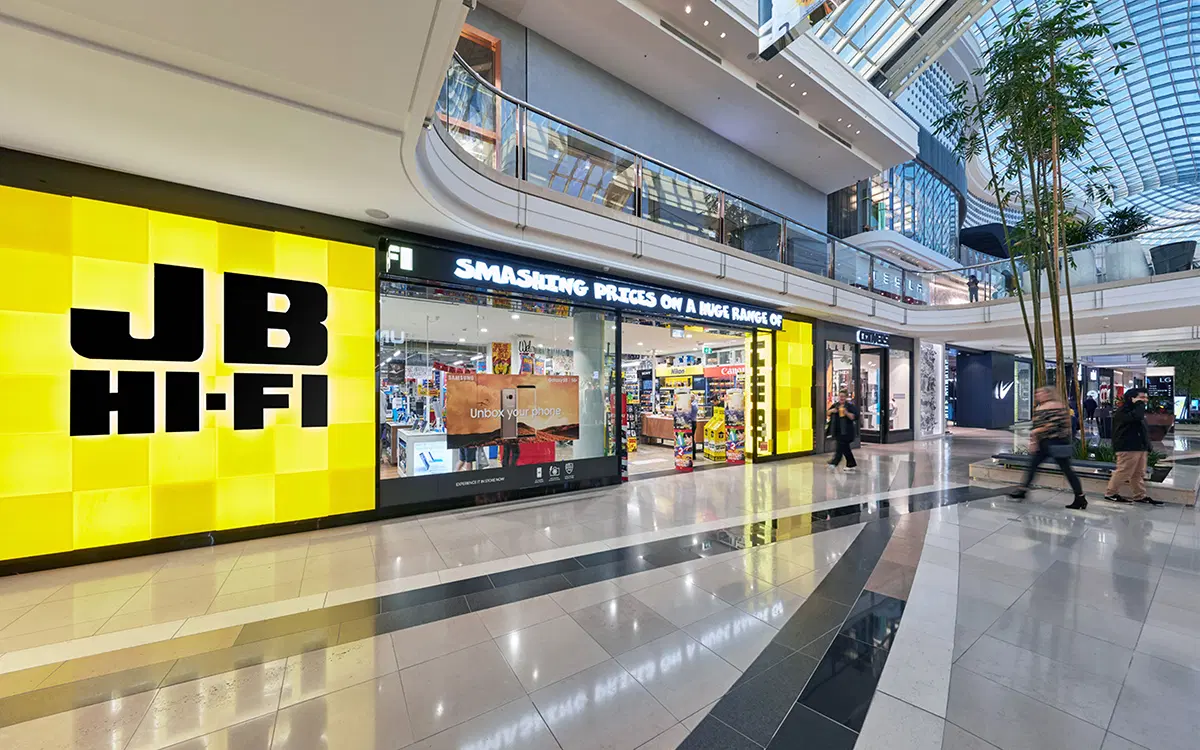
The market now appears to be repricing JB Hi, Fi from a premium high growth retailer into what analysts describe as a “high quality mature retailer with slower earnings growth.”
That shift does not imply the business is in trouble. Far from it.
Most analysts still view the company as financially strong, operationally disciplined and strategically well positioned. Consensus price targets remain above the current share price.
What investors are now watching closely is whether discretionary spending weakens further through late 2026, particularly during the crucial Black Friday and Christmas trading periods.
Management’s immediate focus is maintaining gross margins during promotional cycles while driving stronger sales momentum across The Good Guys, appliances and emerging AI device categories.
Ultimately, JB Hi, Fi’s fortunes remain tied to two critical factors, consumer confidence and replacement cycles.
Electronics retailers thrive when consumers feel financially secure and devices reach the point where upgrades become unavoidable. Phones, PCs and appliances all move through predictable replacement patterns, and when economic conditions improve, sales volumes can rebound quickly.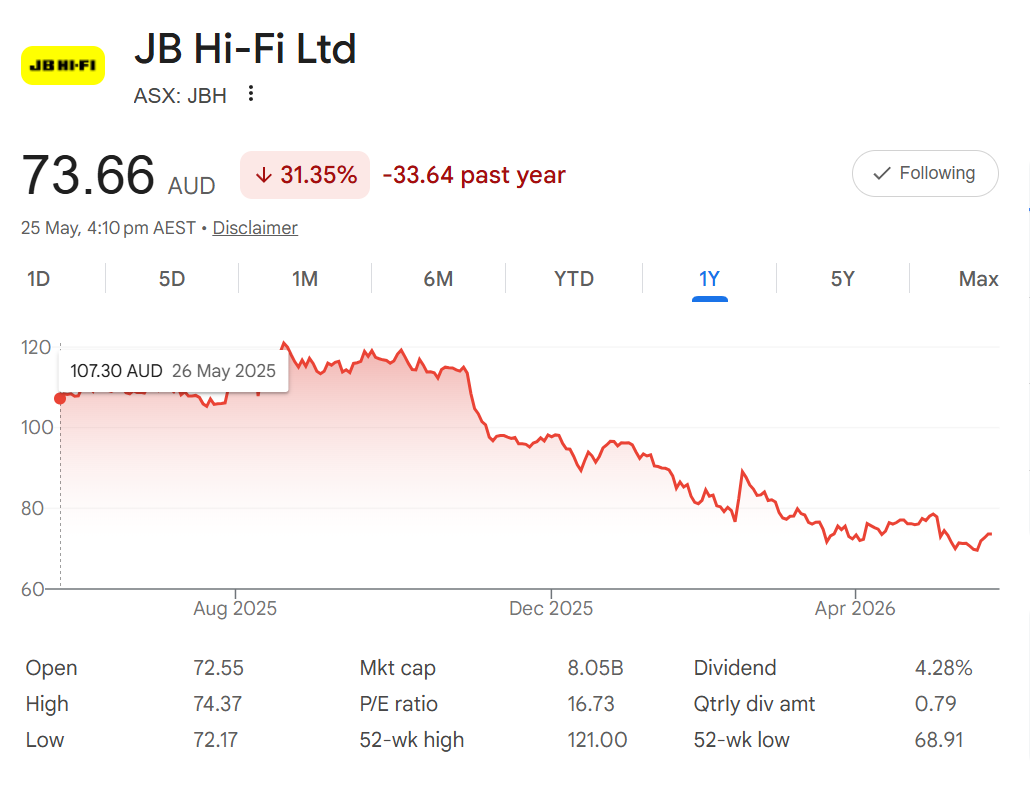
The reverse is also true.
If cost of living pressures persist and interest rates remain elevated, consumers are likely to delay purchases of discretionary electronics, keeping sales subdued and increasing competitive pricing pressure across the market.
Research firm Simply Wall Street recently argued that JB Hi, Fi’s positioning as a price focused, youth oriented and operationally efficient retailer gives it a structural advantage over more traditional appliance chains during periods of market recovery.
The firm noted that while competitors operate more conventional big box retail formats, JB Hi, Fi behaves more like a high value electronics chain capable of capturing returning consumer demand faster than rivals.
But analysts also warned that the business remains highly exposed to the broader consumer spending cycle.
In the long term, JB Hi, Fi is not viewed as a high growth technology company. It is a mature retailer whose performance rises and falls with discretionary spending trends.
For now, the market is not questioning whether JB Hi, Fi can survive Amazon.
The real question is whether Australia’s most efficient electronics retailer can continue delivering the growth investors once expected in a far tougher retail environment.