Smartwatch Market Slumps as Huawei Hits Record 22% Share
 Emma Wheaton
08 Sep 2026
Emma Wheaton
08 Sep 2026

Global smartwatch shipments fell 4% year-on-year in the second quarter of 2026, marking the market’s first decline in a year as consumers held onto existing devices and basic smartwatch demand weakened.
According to Counterpoint Research’s Global Smartwatch Shipments Tracker, the decline reflects an increasingly mature market as longer replacement cycles emerge, creating a major challenge for manufacturers.
Huawei was the standout performer, increasing its global shipment share to a record 22% during the quarter and taking the number one position in the global market. China was the key driver of Huawei’s performance, accounting for approximately 80% of the company’s worldwide shipments.
Counterpoint Principal Analyst Anshika Jain said Apple recorded the fastest year-on-year growth among the market’s five largest brands. Apple increased shipments across all regions, helped by continued demand for its refreshed product range launched in late 2025.
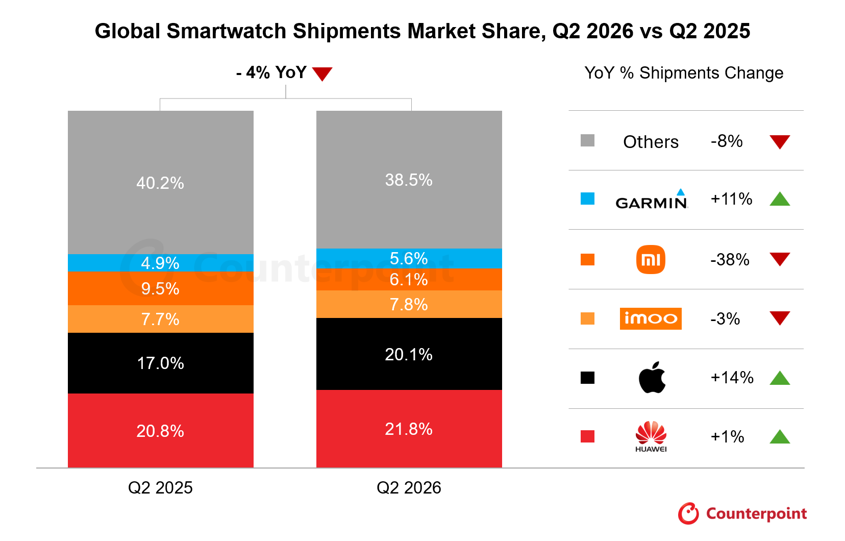
Source: Counterpoint Research Global Smartwatch Shipments Tracker by Model, Q2 2026
The Apple Watch Series 11 and Watch SE 3 accounted for more than 80% of Apple’s global smartwatch shipments during the quarter, according to Counterpoint.
China is the world’s largest smartwatch market with a record 38% share of global shipments in Q2. Shipments in the country increased 7% year-on-year, with strong demand for domestic brands including Huawei and Imoo.
China’s government consumer electronics subsidy program also contributed to sales growth, giving a boost to the local smartwatch market.
While North America recorded slightly stronger growth than China, the Chinese market’s increasing share shows the growing influence of domestic brands in the global wearable technology sector.
Counterpoint expects global smartwatch shipments to increase by just 1% for the full year in 2026. However, the research firm says it predicts the market will regain some momentum over the longer term, forecasting a 3% compound annual growth rate through 2030.
Counterpoint Research Director Mohit Agrawal said emerging technologies could incentivise customers to replace their existing watches. These technologies include artificial intelligence, blood pressure monitoring and the ongoing development of non-invasive blood glucose monitoring.
The findings show a smartwatch market that is divided between low-cost devices that struggle to compel users to upgrade and premium models competing through more advanced health and AI capabilities.