Microsoft Takes Aim At MacBook Pro With Powerful New Surface Laptop Ultra
 Dominic Bayley
08 Oct 2026
Dominic Bayley
08 Oct 2026
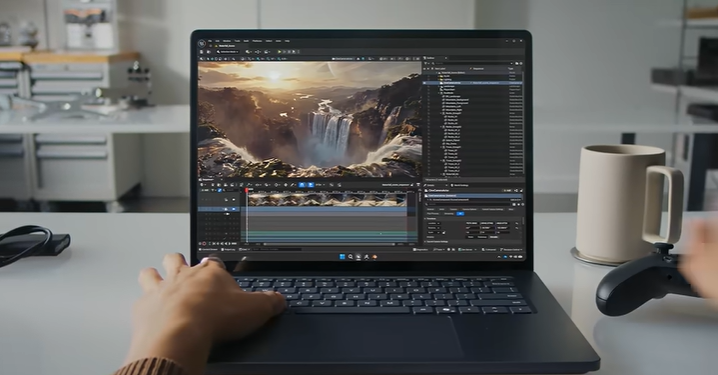
Microsoft has outlined its next big push for Windows, putting locally running AI agents at the centre of its vision while also fully unveiling its most powerful Surface laptop yet.
At its Windows and Surface event in San Francisco, Microsoft detailed new Copilot and agentic AI features designed to run across both PCs and the cloud. It also revealed more about the Surface Laptop Ultra, a high-end machine powered by NVIDIA’s new RTX Spark system-on-a-chip.
Microsoft CEO Satya Nadella was joined on stage by NVIDIA CEO Jensen Huang as the companies highlighted their growing collaboration around AI and personal computing.
A major focus of the event was Microsoft’s plan to turn Windows into a platform where AI agents can perform more tasks on a user’s behalf. With permission, Copilot will be able to work with files stored locally on a PC and carry out actions using a combination of on-device AI models and cloud computing.
Microsoft is also adding the ability to generate apps and widgets using AI, while Windows Search is becoming considerably more capable.
Starting in Spring, users will be able to perform thousands of quick actions directly through Search on the Windows taskbar. These range from enabling dark mode and adjusting the volume to taking screenshots, answering questions and sending text messages.
Microsoft is effectively transforming Windows Search into a more conversational, Copilot-style interface rather than simply a tool for finding apps and files.
A new Get Started experience will also make it easier to install and configure AI agents in Windows. Microsoft says third-party agents will be supported, including Portable Computer, which can operate locally without consuming Perplexity cloud credits. Meta’s Muse will also be available as a native Windows app.
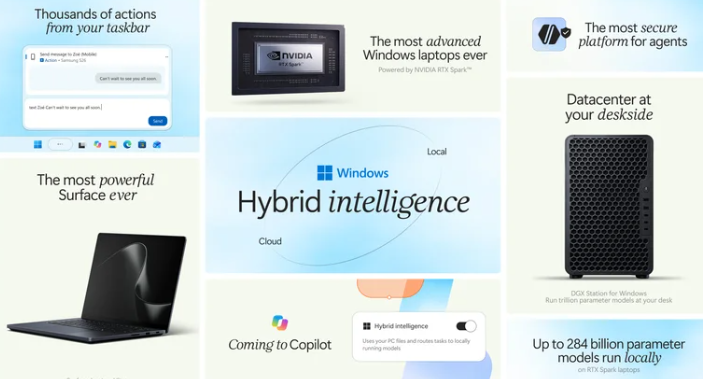
Microsoft is putting a strong emphasis on security and user permission as it expands these capabilities, describing Windows as a secure platform for running AI agents. That will be particularly important given the privacy concerns and criticism that surrounded previous features such as Recall and some of Microsoft’s earlier Copilot integrations.
The other major announcement was the Surface Laptop Ultra, which Microsoft first teased earlier this year.
Designed primarily for developers and creators, the 15-inch laptop is being positioned as Microsoft’s answer to high-end machines such as Apple’s MacBook Pro.
It features a 3:2 mini-LED display capable of reaching up to 2,000 nits of brightness, along with a trackpad that is 30 per cent larger than the one found on the seventh-generation Surface Laptop.
Despite its performance ambitions, Microsoft says the Laptop Ultra weighs less than 4.5 pounds (around 2kg) and measures less than 18mm thick. It is also claimed to offer 2.5 times the thermal capacity of the 15-inch seventh-generation Surface Laptop while maintaining all-day battery life.
Connectivity includes USB-A, USB-C, HDMI, a 3.5mm headphone jack and a full-size SD card reader. Microsoft has also developed a magnetic charging accessory that connects through a standard USB-C port, offering an alternative similar in concept to Apple’s MagSafe.
Inside is NVIDIA’s Arm-based RTX Spark SoC, which Microsoft says delivers GPU performance comparable to a GeForce RTX 5070. The laptop supports technologies including ray tracing, DLSS and NVIDIA Reflex.
Microsoft demonstrated Gears of War: E-Day running on the machine and confirmed Call of Duty support is planned for later this year.
The RTX Spark includes a neural processing unit powerful enough to meet Microsoft’s Copilot+ PC requirements, while its 20-core CPU can be paired with as much as 128GB of unified memory. The chip is also designed to keep power consumption relatively restrained, with a maximum draw of 80W.
Microsoft has also paid attention to repairability, including a replaceable SSD that should make storage upgrades and repairs easier.
All of that hardware comes at a considerable price. The Surface Laptop Ultra starts at A$4,399, with pre-orders now open.
Microsoft also announced US pricing for the Surface RTX Spark Dev Box, a compact desktop aimed at developers running more demanding AI workloads. It starts at US$5,999, with US pre-orders now available. Australian pricing and availability have yet to be announced.