Labor Tips Billions More Into NBN, But Will It Stop The Starlink Stampede?
 Peter Holmes
28 Jan 2025
Peter Holmes
28 Jan 2025

Labor is digging in behind the National Broadband Network (NBN), despite the woeful service being offered to many customers in rural and regional Australia, and the increased demand for Elon Musk’s Starlink satellite service.
A recent telecoms review by former Labor minister Alannah MacTiernan concluded that Australia’s growing reliance on Starlink “does obviously raise issues of sovereign risk when the proprietor is a person that is seeking to have major political power around the world”, as she put it during an ABC interview on January 14.
Earlier this month Prime Minister Albanese announced that the ALP would tip another $3.8 billion into the NBN, providing full fibre connections to 620,000 additional homes and businesses.
The NBN owes about $42.5 billion, and has assets of around $39 billion. The interest bill on its debt is nearly $900 million a year.
The Coalition backed the ALP investment, although there is talk that if elected at the forthcoming federal poll the Coalition would look at selling off the NBN.
Shadow Communications Minister David Coleman slammed the NBN’s service to those outside metro areas, in a recent ABC interview.

“If you talk to pretty much anyone in regional Australia, they will tell you that the NBN is a joke. People are getting rid of the NBN every day and they’re signing up for other products because those other products are providing a much better service for them.”
Customers who have signed up to NBN fibre-to-the-premises (FTTP) in regional and rural areas report erratic services that regularly drop out, or have speeds so slow that people are forced to use hotspot.
In an interview with The Sydney Morning Herald, Communications Minister Michelle Rowland said “there is no way that Starlink would be able to deliver the speeds, capability and low latency that is delivered by fibre”.
Retailers Telstra and Optus are exploring options with Low Earth Orbiting (LEO) satellites, and Amazon is hiring highly skilled Australians to work on its LEO project. Industry consultant Paul Budde told the Herald: “My guess is that NBN will do a deal with Starlink if geopolicy allows. In that way they could potentially get some customers back – if their pricing is competitive.”
The Starlink website shows a map of Australia with two shades of blue. The light blue is where Starlink’s LEO satellite service is available. The dark blue is where the service is “sold out”.
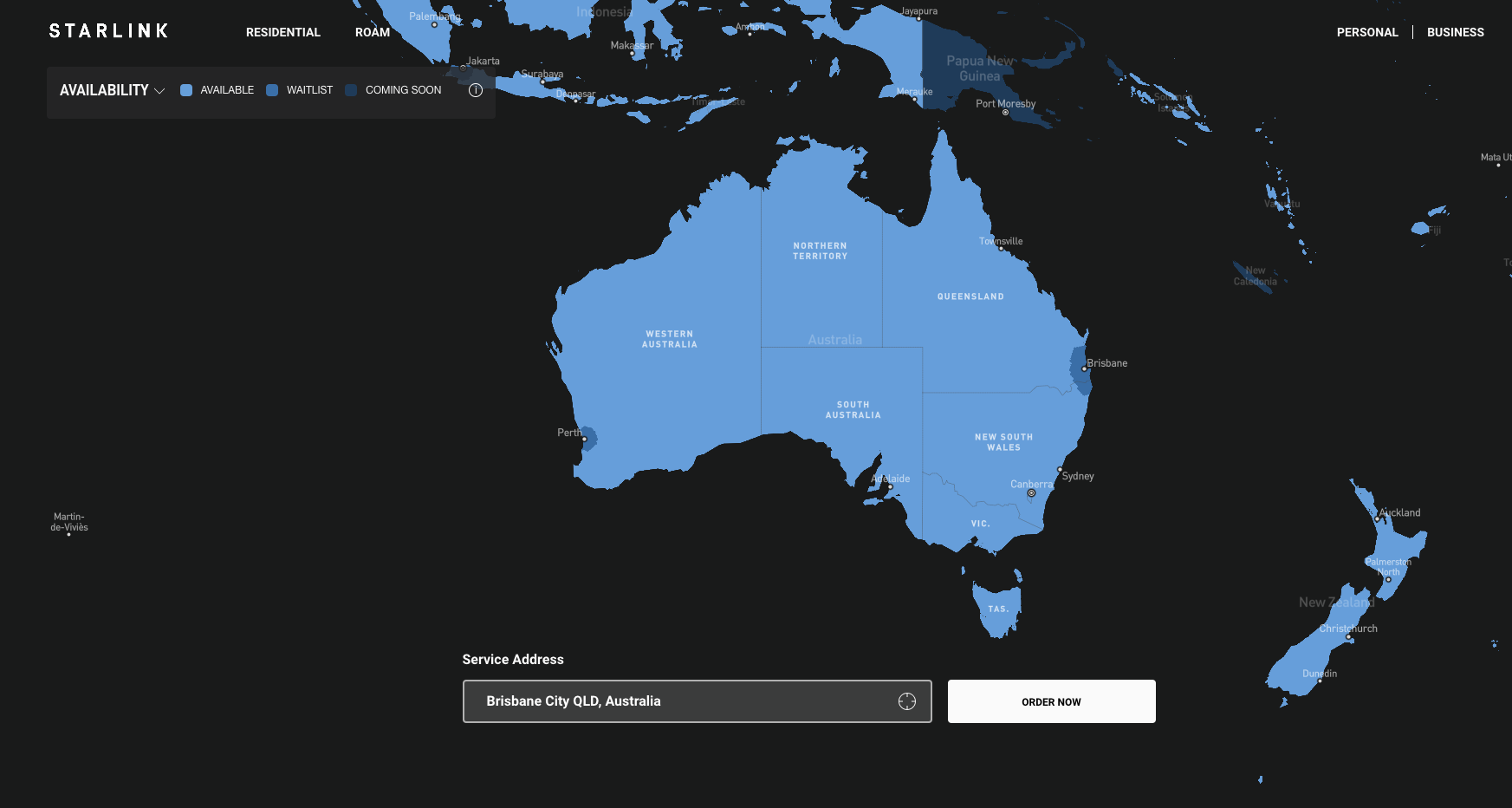
Starlink Map.
Across the whole continent two areas are shades in dark blue.
The first is on the East Coast, roughly from Ballina in Northern NSW, through Tweed Heads, the Gold Coast, Brisbane and the Sunshine Coast, and west to Toowoomba.
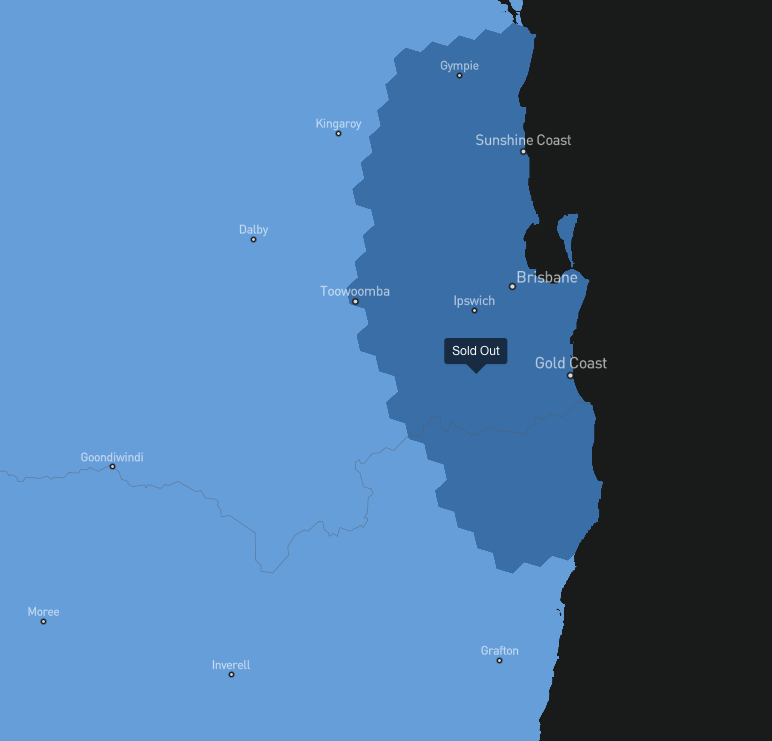
Starlink Sold Out.
On the West Coast it centres on Perth and runs about 80km north, 80km and 100km inland.
Rowland said more than half of 622,000 premises to be connected to the NBN were in rural and regional Australia.
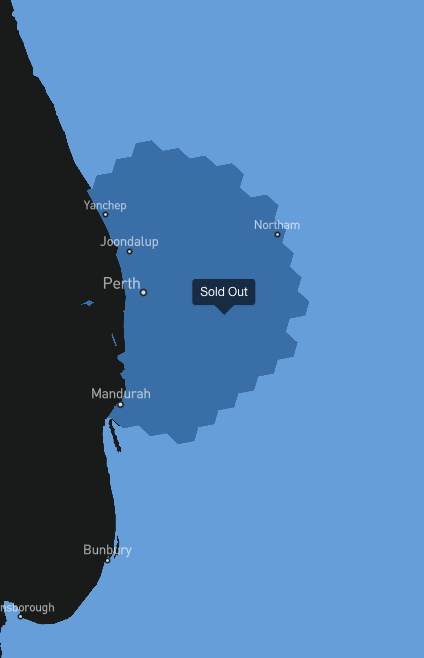
Starlink Sold Out.
In an ABC interview earlier this month Rowland was asked whether 5G and LEO satellites were making the NBN “redundant”.
“Well, to the contrary … fibre continues to be the standard when it comes to capability to speeds, but also in terms of long-term reliability. The laws of physics are set. Fibre is clearly recognised as the standard.
“It’s why Labor set out – when we conceived the NBN – to ensure that this was the technology that we invested in because it lasts some 50 years. It is impervious compared to, for example, copper. When it comes to natural disasters, it is far more resilient.
“Now, of course, there is a place for other technologies, and NBN itself uses a mix of technologies ranging from satellite to fixed wireless to fibre. And that will continue to be the case, particularly in some areas where it will be unfortunately uneconomic to roll out fibre to some premises.”