Cirlcle Shaped Jony Ive Puck, Will It Be The Injection CE Retailers Will Need In 2027
 David Richards
10 Aug 2026
David Richards
10 Aug 2026

Australian retailers are tipped to benefit from a conflict between Apple and Open AI and the launch of a unique range of product, developed by the man who helped make Apple a key force in the consumer electronics market.
I am in Shenzhen China at the moment, and one of the big buzzes is the fact that Open AI has been talking to Chinese component manufacturers about a multiple range of consumer electronic products, including a smart speaker and a mobile device.
Currently OpenAI is developing a new line of consumer electronic hardware in partnership with legendary former Apple chief designer Jony Ive, signaling an aggressive expansion into a hardware market long dominated by legacy tech giants.
According to sources familiar with Chinese manufacturing supply chains in Shenzhen, OpenAI has engaged regional component suppliers to produce an initial suite of devices, led by a screenless, high-end AI smart speaker expected to launch globally in 2027 with an estimated local retail price around $499.
The upcoming hardware represents the first physical product collaboration between OpenAI and Ive, whose design collective was integrated into the AI firm following a major acquisition.
Ive, who spent decades driving industrial design at Apple for foundational products including the iPhone, iPad, Mac, and early iOS interfaces, has reportedly crafted a portable, premium-metal companion device that departs significantly from conventional countertop devices.
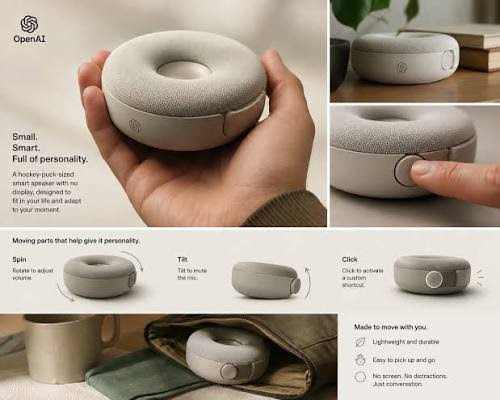
Some are suggesting this is what it could look like. (Concept Only).
Described by sources as a puck-sized, ring-shaped device, the speaker relies on OpenAI’s native GPT generative models and advanced real-time voice interface.
Unlike traditional smart speakers that remain anchored to a wall outlet, the battery-powered unit is designed to be handheld, carried throughout the home, or used during travel with the device capable of being wireless charged according to Chinese sources.
Key specifications and physical features include an array of onboard sensing cameras, environmental sensors, light indicators, array microphones, and specialized speaker grilles allow the device to continuously process surrounding conditions.
The metal casing reportedly includes subtle moving mechanical components that animate during speech and processing, giving the hardware a tactile, human-like responsiveness.
The good news is that system bypasses mandatory wake-words such as “Hey Siri,” “Hello Google,” or “Alexa” in favor of continuous, ambient conversational interaction.
Missing is a display screen, with users having to rely instead on spatial awareness and superior audio hardware designed to outperform existing market competitors.
As for the product strategy the devices places OpenAI into direct competition with Google, Amazon, and Apple in the voice-assistant sector.
Industry analysts note that Australian consumer electronics retailers are positioned to benefit from the launch, as the device will be distributed through traditional retail channels alongside OpenAI’s direct-to-consumer online platform.
What’s not known is whether the Company will appoint a distributor to handle their products in Australia.
The move comes at a strategic inflection point as traditional consumer electronics companies struggle to seamlessly integrate generative AI conversational models into legacy voice interfaces. Industry insiders suggest prototypes may be previewed as early as CES 2027 ahead of a formal retail rollout.
OpenAI has not officially confirmed final retail pricing or specific global shipping dates.