Chinese TV Challengers Target Australia as Market Slumps and Logistics Headaches Grow
 David Richards
06 Mar 2026
David Richards
06 Mar 2026
Australia’s television market is bracing for a new wave of Chinese challengers just as the sector faces one of its toughest periods in years.
Dreame, best known globally for its robotic vacuum cleaners, is preparing to enter the Australian TV category, according to industry sources. The company is expected to join a growing list of Chinese manufacturers seeking market share in Australia despite a double-digit collapse in TV sales during 2025 and the imminent launch of 2026 model ranges from established brands.
Retailers say the timing is risky. The Australian TV market is grappling not only with weakening demand but also with a surprisingly practical problem: television size.
The 100-inch problem
Large-screen televisions remain one of the few growth areas in the category, yet retailers say logistics issues are becoming a growing headache.
Several retailers told industry observers that they have begun pushing back deliveries of ultra-large TVs — particularly 100-inch models and above — because of difficulties getting the products into apartment buildings.
Boxes often won’t fit into lifts or through doorways, forcing retailers to return stock to brands or refuse delivery altogether.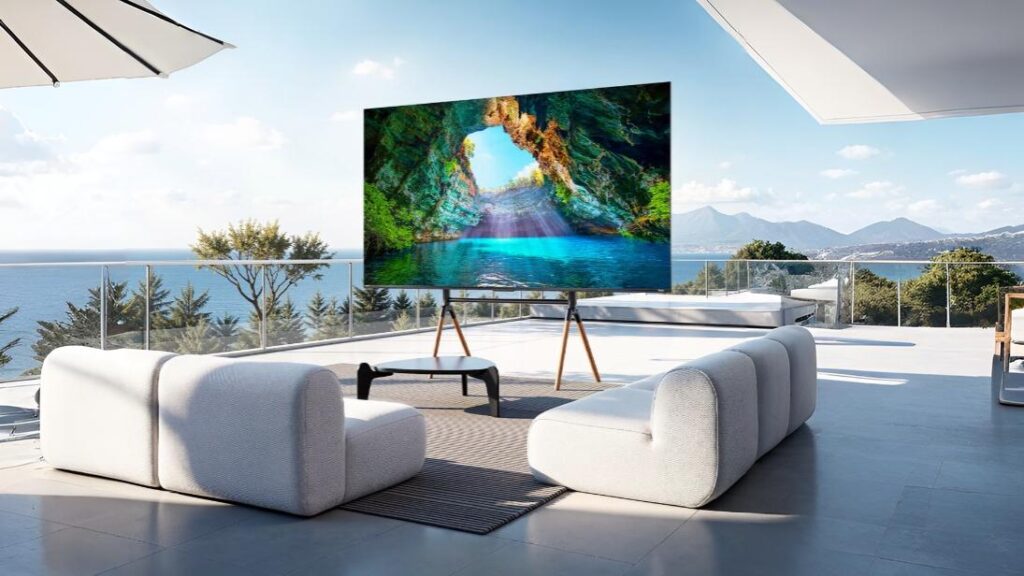
“It’s become a real issue,” one retailer said. “Customers want the big screens, but in many cases you simply can’t get them into apartments.”
The problem comes at a time when manufacturers are aggressively promoting oversized displays as the next upgrade cycle driver.
Demand weakens globally
The push into larger screens is unfolding against a backdrop of weak global demand.
Global TV shipments were effectively flat year-on-year in the fourth quarter of 2025 at around 61.5 million units, according to Omdia’s TV Sets Market Tracker — a disappointing result for what is traditionally the strongest sales period of the year.
The Asia Pacific region, which includes Australia, saw shipments fall more than 18%, while China’s domestic market collapsed by 25.3% during the quarter.
Despite the decline, Asia Pacific remains the largest TV market globally, accounting for roughly 40% of worldwide demand and an estimated $30–40 billion in value, with smart TVs and premium display technologies driving most sales.
Chinese brands reshape the market
The industry is also undergoing a dramatic shift in competitive power.
Chinese manufacturers are steadily eroding the dominance of traditional leaders Samsung and LG.
Several research firms reported that TCL briefly became the world’s largest TV shipper in December 2025, capturing around 16% global market share, compared with Samsung’s 13%.
TCL’s shipments grew roughly 10% year-on-year, although analysts say that momentum did not extend across the entire quarter. Samsung ultimately retained the number one position for Q4 2025 shipments overall, with volumes rising about 2% year-on-year.
Growth in mature markets remains limited. North America recorded 4.7% year-on-year growth, while Western Europe expanded 3.2% — respectable numbers in a category that has struggled for years to generate meaningful demand.
The real momentum is coming from developing markets.
Western Europe moved into second place globally for TV shipments, while Asia and Oceania ranked third, both overtaking China for the first time in years.
Hisense surges in premium TVs
Hisense has emerged as one of the most aggressive challengers in the premium segment.
The company significantly expanded its presence in large-screen and MiniLED TVs during 2025.
Hisense’s premium TV unit share rose from 14% in Q1 2024 to 20% in Q1 2025
Premium revenue share increased from 13% to around 17%
Much of the growth has been driven by its push into MiniLED technology, which offers higher brightness and lower costs than OLED.
Hisense now dominates some fast-growing categories:
57% global share of 100-inch-plus TVs
70% share of the global Laser TV market
Meanwhile, LG’s OLED TV sales have declined, highlighting the mounting competitive pressure on the once-dominant premium technology.
Inventory build-up ahead of 2026 launches
In markets like Australia and the United States, the sales picture has become more volatile.
Shipments fluctuated throughout 2025, and sell-through during the crucial holiday season fell short of expectations. As a result, retailers are entering Q1 2026 with elevated inventory levels, which typically leads to aggressive discounting and squeezed margins.
Despite China’s domestic downturn, TCL and Hisense still managed to grow their combined global shipments by 2.2% year-on-year.
In the United States — where Samsung and LG are struggling to maintain share — the two Chinese brands expanded their combined market share from 28.6% to 30.7%.
Supply chain costs rising
Matthew Rubin, Principal Analyst for TV Set Research at Omdia, says Chinese manufacturers have had to rapidly adjust their global supply chains.
“Chinese brands have shown strong agility in their growth strategies over the past year,” Rubin said.
“Accessing markets is more challenging now, but both TCL and Hisense have adjusted supply chains to meet new requirements. That flexibility comes with added cost, and profitability is becoming a bigger priority, particularly as component costs such as memory rise.”
The shift has forced manufacturers to balance expansion with profitability as rising component costs and regulatory hurdles tighten margins.
Technology battle intensifies
At the heart of the industry’s next phase is a technology battle for the premium TV market.
OLED shipments grew 8.6% globally in Q4 2025, with Western Europe — the world’s largest OLED market — rising 11.5% year-on-year as affluent consumers continue to favour the technology.
OLED’s precise pixel-level light control and strong brand positioning still make it the benchmark for premium TVs.
However, pressure from MiniLED technology is rapidly intensifying.
At CES 2026, TCL positioned MiniLED combined with enhanced Quantum Dot technology as the centerpiece of its upcoming TV lineup. Both TCL and Hisense are now promoting MiniLED not as a budget alternative to OLED, but as a true premium competitor, highlighting its superior brightness and colour performance.
A pivotal 18 months ahead
The next 18 months could determine which display technology dominates the premium market.
Manufacturers are betting that advances in RGB MiniLED will narrow the image-quality gap with OLED enough to sway buyers — particularly in the booming market for ultra-large screens.
Panel costs, retail showroom space and streaming content optimisation will all play a role in shaping the outcome.
For now, the battle lines are drawn — just as new entrants prepare to shake up markets like Australia that are already under pressure.
And with TV demand weakening globally, the fight for market share is only getting more intense.