Chinese Lenovo Profit Slides as Security Scrutiny and Component Pressures Mount
 David Richards
17 Feb 2026
David Richards
17 Feb 2026
Chinese technology giant Lenovo has reported a 21% fall in quarterly net profit, despite an 18% rise in revenue to US$22.2 billion, as the company grapples with surging memory costs, softening consumer PC demand, and renewed scrutiny over its ties to Beijing, they are also investing in AI Servers despite the security risks.
The world’s largest PC maker warned that rising DRAM and NAND prices are expected to pressure PC unit sales, with Chief Executive Yang Yuanqing conceding that constrained RAM supply could limit shipments even as underlying demand remains steady.
The company has already begun lifting prices to offset soaring component costs, reflecting broader industry strain as Samsung Electronics and SK Hynix — which together control roughly 70% of the global DRAM market and more than half of NAND flash supply — reportedly double memory pricing for major hardware vendors.
However, beyond margin pressure and supply shortages, Lenovo faces another challenge: escalating political and security concerns in the United States over its Chinese ownership structure and alleged national security risks.
U.S. Government Security Concerns Persist
Lenovo is headquartered in Bejing and is partly owned through state-linked Chinese entities, including the Chinese Academy of Sciences. Its ownership structure has long drawn attention in Washington amid broader tensions between the United States and China over technology supply chains and cyber security.
While Lenovo did not reference the issue in its latest earnings release, calls within the U.S. Federal Government to restrict or ban Lenovo equipment continue.
Over the past two decades, several U.S. agencies have either investigated or restricted Lenovo products, including the State Department, Department of Homeland Security, and elements within the Department of Defense. Lawmakers in Congress have, as recently as late 2023 and into 2026, urged stronger action to remove Chinese-made hardware from federal procurement channels, citing potential cyber espionage risks and supply-chain vulnerabilities.
Security concerns raised in Washington have included fears of compromised supply chains, potential firmware-level vulnerabilities, and the broader geopolitical risk posed by reliance on Chinese technology providers in sensitive government environments.
Lenovo has consistently denied that its products pose any security risk and maintains that it operates as a global company with transparent governance and compliance frameworks.
Nevertheless, the political pressure underscores a growing divide between Lenovo’s global expansion ambitions and rising Western scrutiny of Chinese technology firms.
AI Push Raises Further Questions
Lenovo is now aggressively pivoting toward artificial intelligence infrastructure in a bid to offset pressure in its traditional PC and smartphone business, which still accounts for roughly 70% of revenue.
Its Digital Infrastructure Group posted an operating loss of US$11 million as it expanded AI server capabilities, including rack-scale systems based on Nvidia’s GB200 NVL72 platform.
Management says the global AI infrastructure market could triple by 2028, with demand shifting from large language model training toward inference workloads.
However, the expansion into AI servers — potentially deployed in data centres housing sensitive corporate and government information — may intensify scrutiny in jurisdictions already wary of Chinese hardware vendors.
The company has also indicated it is working more closely with Chinese memory suppliers as global supply tightens, further reinforcing its supply chain alignment with mainland China at a time when Western governments are actively seeking diversification away from Chinese technology ecosystems.
CES Controversy and Local Market Gaps
Lenovo’s January 2026 Tech World event at CES showcased a string of AI-enabled devices, including the Lenovo Aura Edition PC lineup, ThinkBook Plus Gen 7 Auto Twist, Legion Go powered by SteamOS, and new Motorola foldables.
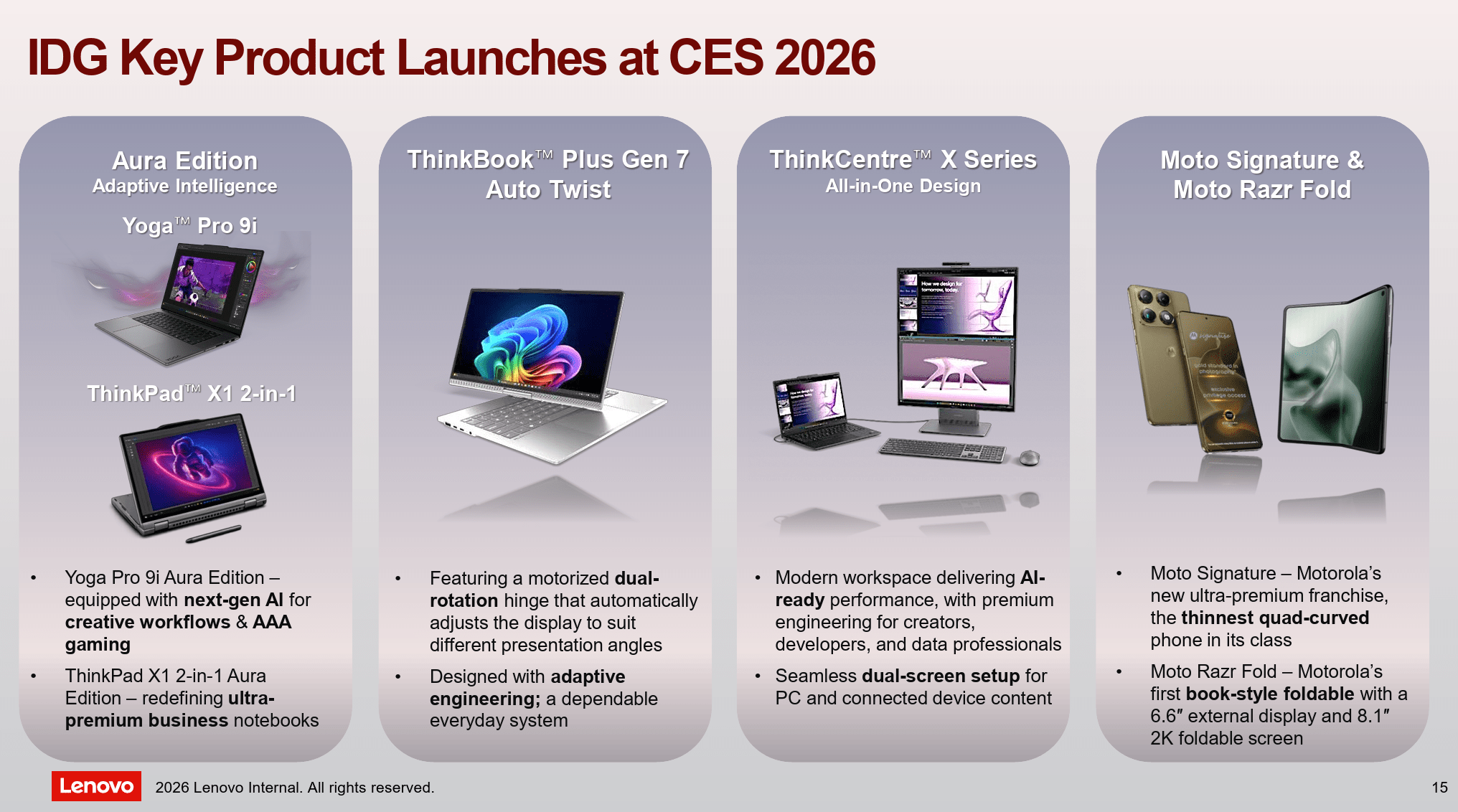
Yet none of those flagship products have been released locally in Australia, and the company has declined to explain why Australian journalists were blocked from attending its CES Tech World event — despite international media being given full access.
Motorola smartphone shipments hit record volumes during the quarter, according to management, though analysts note that rising memory costs could soon affect pricing across both PC and smartphone categories.
Industry-Wide Memory Shock
The current memory shortage is being driven in part by the rapid allocation of high-bandwidth memory to AI data centre infrastructure, where hyperscale deployments are absorbing supply that would otherwise flow into consumer devices.
As AI infrastructure spending surges, consumer hardware makers like Lenovo face rising costs and tighter availability — a squeeze that may weigh on shipments throughout 2026.
Balancing Growth and Geopolitics
Lenovo’s strategy is clear: lean into AI servers, raise prices to protect margins, and ride enterprise demand while consumer PC growth moderates.
What remains less certain is how geopolitical risk may shape its future in Western markets.
With U.S. lawmakers continuing to push for restrictions on Chinese-made hardware in federal systems — and with supply chains increasingly politicised — Lenovo’s growth ambitions may hinge not just on component availability and AI demand, but on whether it can navigate intensifying national security scrutiny in its most strategically sensitive markets.
CGS International’s Analyst Summer Wang claim that Lenovo’s margins could remain resilient despite higher component costs.
The analyst expects Lenovo’s 2026 PC shipments to fall 5% as consumer demand weakens on rising PC prices amid component cost pressures.
The Windows 10 end-of-support upgrade cycle may provide some support to shipments.
Lenovo’s PC pretax income margin could remain stable at 6.8%-7% in fiscal 2027 and 2028, supported by higher selling prices as AI PC shipments make up a bigger share of the product mix, the analyst claims.