Australian Government & Carriers Head To Japan For High-Level Summit on AI, 6G and China’s Expanding Security Attacks On Networks
 David Richards
08 Dec 2025
David Richards
08 Dec 2025

Australia’s major carriers—Telstra, Optus and TPG Vodafone, are set to travel to Japan for a closed-door meeting with counterparts from Canada, the U.K., the U.S. and Japan, alongside selected government officials.
The aim is to coordinate next steps on artificial intelligence, emerging 6G standards, and strategies to counter China’s growing dominance in global telecommunications and preventing China from getting access to ‘Five Eyes’ networks such as those operating in Australia.
The gathering, held under the Global Coalition on Telecommunications (GCOT), marks the first in-person meeting of what has been dubbed the “telecom Five Eyes”.
Governments within the group are increasingly focused on preventing Chinese access to sensitive intelligence and to devices operating on Western networks, including consumer products such as TP-Link and Eufy routers which it’s alleged could be used to access Western networks.
A central part of discussions will be how Australia approaches AI integration and 6G rollout, with an emphasis on cybersecurity, quantum technologies, and the risks posed by Chinese networking hardware sold domestically. Open RAN—an approach that mixes equipment from multiple vendors to reduce reliance on Chinese systems and mitigate security vulnerabilities—will also feature prominently.
Participants include Japan’s Ministry of Internal Affairs and Communications; the U.K. Department for Science, Innovation and Technology; Australia’s Department of Infrastructure, Transport, Regional Development, Communications, Sport and the Arts; Innovation, Science and Economic Development Canada; and the U.S. National Telecommunications and Information Administration.

Tapo is a smart home brand owned by TP-Link Corporation, a major global networking and smart device manufacturer based in China who is set to be banned in the USA.
The talks come as China accelerates efforts to dominate the global telecom equipment sector, raising questions about whether Australia will eventually restrict or ban products from certain Chinese manufacturers. In the U.S., TP-Link is already under heavy scrutiny: multiple federal agencies opened investigations in 2024 over alleged links to cyberattacks, with several departments now supporting a looming nationwide ban. The U.S. Department of Justice is also probing whether TP-Link engaged in predatory pricing to undercut competitors.
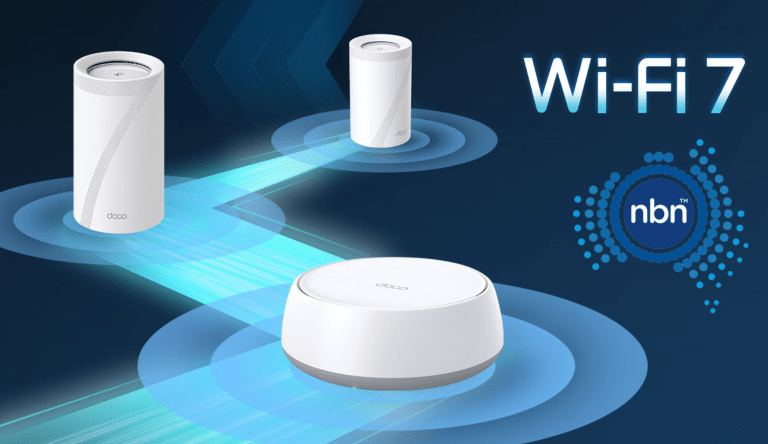
TP-Link, also owns Deco mesh Wi-Fi gear. Deco is one of TP-Link’s key brands alongside Tapo, Kasa, and Omada,
Huawei remains another focal point. Although barred from supplying network equipment in Australia, it still commands 34% of the global 5G base-station market—well ahead of Ericsson (26%) and Nokia (18%). Huawei’s single-vendor model is at odds with the Open RAN approach that democratic nations are increasingly championing to strengthen the security and economic resilience of telecom networks. Meanwhile, smartphone brand Honor—linked through ownership structures to a Chinese Communist Party-controlled entity—has recently begun selling devices in Australia.
The Japan meeting coincides with a U.S.-hosted Open RAN symposium in Tokyo, drawing around 160 representatives from more than 20 countries, including Finland, Germany, Taiwan, India and Brazil. Holding the event in Japan is intended to encourage broader participation from nations that prefer some distance from the U.S. This is the first time the symposium has been held in Japan, as GCOT looks to build cooperation beyond its core five members.
Established in 2023, GCOT serves as a platform for governments, industry and academia to collaborate on telecom policy and innovation. It meets in person roughly once per year, with previous sessions in Barcelona in February 2024 and March 2025.
In January, GCOT members issued a joint statement on AI and Open RAN, outlining six principles for AI adoption across the telecom sector: innovation and competition, transparency and human oversight, privacy, fairness, security and resilience, and environmental sustainability. The statement also stressed the need for formal Open RAN certification systems to improve interoperability across diverse telecom equipment.