ASUS Moves Early on Wi-Fi 8 With New High-End Gaming Router for Australia
 David Richards
02 Sep 2026
David Richards
02 Sep 2026

ASUS is moving quickly to establish a position in Australia’s emerging Wi-Fi 8 market, unveiling a new quad-band gaming router built around reliability, lower latency and improved performance in congested wireless environments.
The Taiwanese hardware manufacturer, which has been expanding its presence in the premium networking market against rivals including Netgear, has revealed its ROG Rapture GT-BN98, a quad-band Wi-Fi 8 router capable of combined wireless throughput of up to 25,000Mbps.
The arrival of Wi-Fi 8, technically known as IEEE 802.11bn, represents a significant change in direction for wireless networking.
Unlike previous Wi-Fi generations, the primary objective is not another dramatic increase in theoretical maximum speed.
Wi-Fi 8 retains many of the headline specifications introduced with Wi-Fi 7, including operation across the 2.4GHz, 5GHz and 6GHz bands, support for 320MHz channels and 4096-QAM modulation.
Instead, the new standard is being developed around what the industry calls Ultra High Reliability, with a particular focus on maintaining performance when signals are weak, networks are congested or users move between wireless access points.
That could prove particularly important for gaming, video conferencing and other applications where latency and connection stability can be as important as raw bandwidth.
Among the major technologies being developed for Wi-Fi 8 is Multi-AP Coordination, which allows multiple access points to work more closely together rather than operating largely independently.
The IEEE 802.11bn development targets include a 25 per cent improvement in throughput under challenging signal conditions, a 25 per cent reduction in worst-case latency and a 25 per cent reduction in packet loss during roaming compared with Wi-Fi 7.
ASUS is positioning the GT-BN98 to take advantage of those capabilities.
The router, unveiled at Gamescom, is based on the draft 802.11bn specification and is powered by a 2.6GHz quad-core processor with 2GB of RAM.
ASUS claims combined quad-band wireless speeds of up to 25,000Mbps, including up to 11,529Mbps over the 6GHz band using 320MHz channels.
The GT-BN98 also has two 10Gb Ethernet ports and four 2.5Gb ports, giving users high-speed wired connections for gaming PCs, network storage and other bandwidth-intensive equipment.
Australian pricing and a firm retail availability date have yet to be announced.
ASUS Building Out Wi-Fi 8 Range
The GT-BN98 is one of two Wi-Fi 8 gaming routers ASUS has revealed during 2026 as manufacturers begin positioning themselves for the next generation of wireless networking.
Its more powerful stablemate, the ROG Rapture GT-BN98 Pro, surfaced ahead of Computex 2026 after receiving a category award in the Gaming & Immersive Tech section of the Computex Best Choice Awards.
ASUS subsequently unveiled the device at Computex, describing it as the world’s first Wi-Fi 8 gaming router.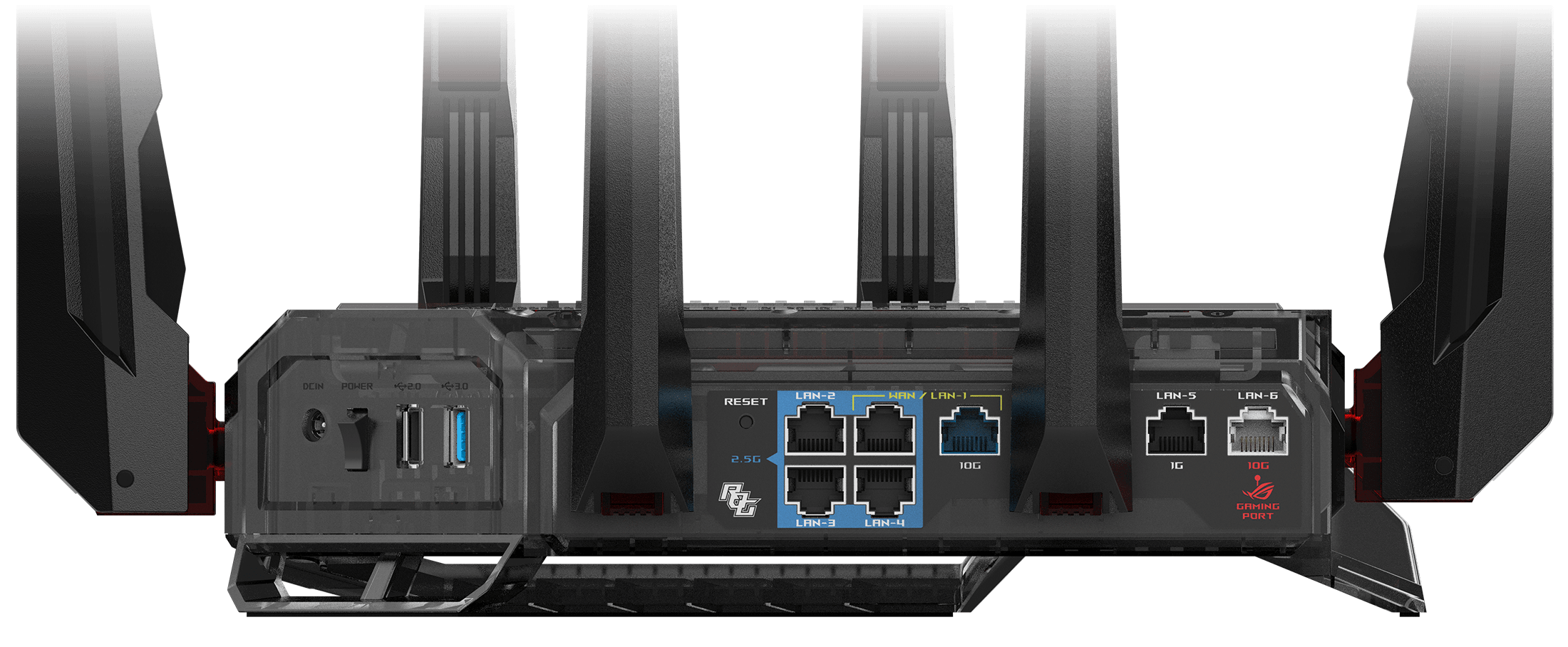
The GT-BN98 Pro is rated for combined wireless throughput of up to 30Gbps and includes dual 10Gb Ethernet connectivity. ASUS has also equipped it with an aluminium heat-dissipation plate using a nanocarbon coating as it targets the premium gaming and high-performance networking market.
Beyond faster hardware, ASUS is putting considerable emphasis on software designed to manage increasingly crowded home and business networks.
Adaptive QoE is designed to dynamically allocate bandwidth according to network conditions and application demands, while WiFi Insight monitors wireless network conditions across multiple bands and continually checks for interference.
A bundled third-party GTNet service is designed to analyse network conditions and route gaming traffic over what it determines is the most reliable path to game servers.
ASUS is also including network security features designed to block malicious websites, trackers and compromised devices.
Guest Network Pro allows users to create up to five SSIDs, providing separate networks for IoT devices, guests and other equipment while supporting VPN connections and parental controls.
The push into Wi-Fi 8 comes as networking manufacturers increasingly compete at the premium end of the Australian router market, where gaming, multi-gigabit broadband, connected devices and increasingly demanding home networks are creating demand for more reliable wireless connections.
For consumers, however, the significance of Wi-Fi 8 is unlikely to be measured simply by another jump in the number printed on the router box.
If the technology performs as intended, its biggest advantage over Wi-Fi 7 will be maintaining fast, low-latency connections in the difficult real-world conditions where wireless networks traditionally struggle.