Mysterious Sonos S59 Soundbar Points To Long-Awaited Beam Upgrade
 April Ossington
19 Aug 2026
April Ossington
19 Aug 2026
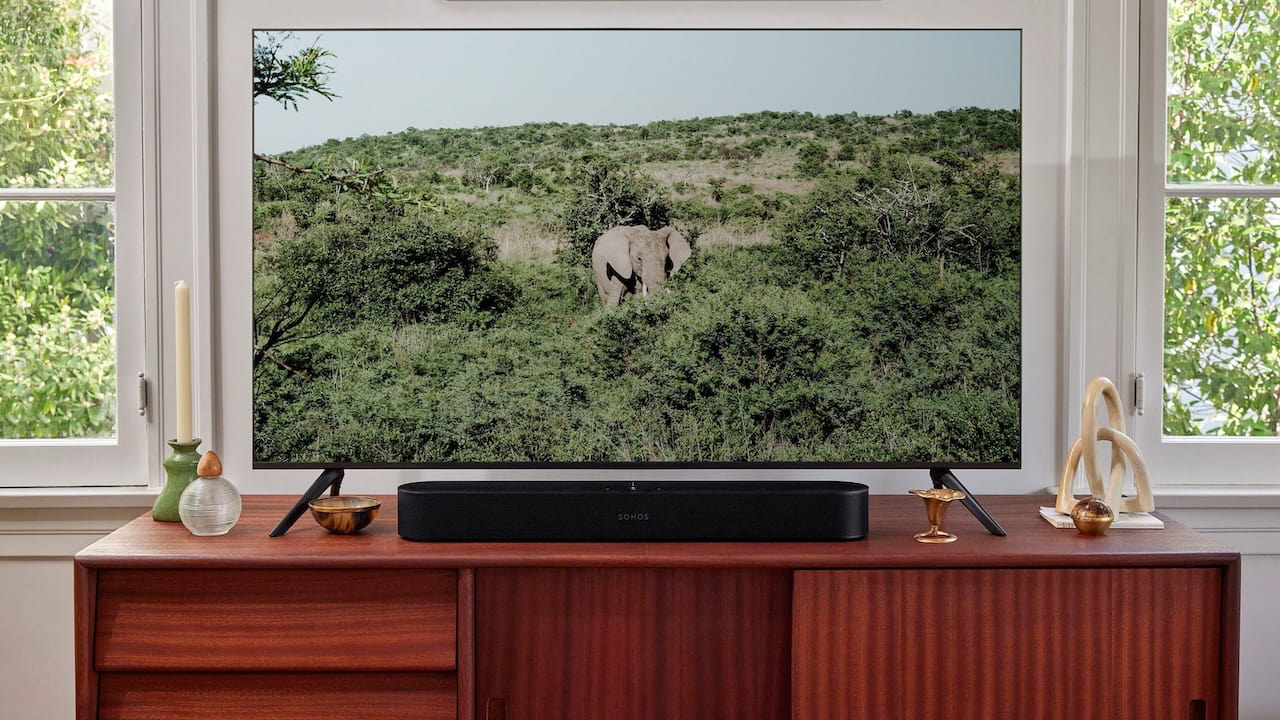
Sonos appears to be preparing a new compact soundbar, with regulatory documents revealing upgraded wireless technology that could point to the first major replacement for the Beam Gen 2 since its 2021 debut.
A Sonos device identified as the S59, with product code RM059 and the internal name “Gambit”, received US Federal Communications Commission approval on August 14. While the filing describes it simply as a wireless smart speaker, reports suggest the product resembles the Beam Gen 2 and could be unveiled as part of a Sonos hardware announcement in September.
Sonos has not confirmed the product’s retail name, specifications, price or launch timing, so details beyond the regulatory documentation remain unconfirmed.
The FCC information does reveal Bluetooth connectivity and Wi-Fi across the 2.4GHz, 5GHz and 6GHz bands, together with 2×2 MIMO support.
That would represent a considerable connectivity improvement over the Beam Gen 2, which uses Wi-Fi 4 and does not offer conventional Bluetooth playback. Sonos’ more expensive Arc Ultra already supports Wi-Fi 6 and Bluetooth.
Many of the details that would reveal how the S59 actually performs remain confidential. External and internal photographs, the user manual and other documentation are being withheld until January 27, 2027.
There is consequently no confirmation of its speaker configuration, driver count or whether Sonos will introduce dedicated upward-firing speakers for Dolby Atmos.

Sonos Beam 2 Soundbar
The existing Beam Gen 2 produces Atmos height effects through audio processing rather than physical upward-firing drivers. This differs from the larger Arc Ultra, which incorporates two upward-firing tweeters to provide more direct height information.
A new Beam-class model would give Sonos an opportunity to improve this area while retaining the compact dimensions that have made the Beam suitable for smaller televisions and living spaces.
Other unanswered questions include whether the S59 will inherit Sound Motion technology from the Arc Ultra. That system uses a four-motor, dual-membrane woofer to produce greater bass output from a relatively compact enclosure.
It is also unclear whether features such as enhanced Speech Enhancement and expanded Trueplay room optimisation will be included.
Competition has become considerably stronger since the Beam Gen 2 arrived five years ago. Bose, Samsung, Sony and WiiM now offer compact soundbars with combinations of Dolby Atmos, advanced dialogue processing, Bluetooth and expanded wireless connectivity.
WiiM, in particular, has moved into this segment with the Bar, which uses a 3.0.2-channel configuration with physical top-firing height channels and supports both Dolby Atmos and DTS.
Sonos’ established multi-room ecosystem remains an important advantage. A compatible soundbar can form the starting point for a larger system incorporating wireless surrounds, a Sonos Sub or Sub Mini, multi-room speakers and Sonos Ace headphones.
Current Beam Gen 2 owners may have little reason to upgrade until the S59’s acoustic hardware becomes clear. The existing model already provides Dolby Atmos, HDMI eARC, Trueplay and integration with other Sonos products.
For anyone considering buying a Beam Gen 2 now, however, the FCC appearance provides a good reason to see what Sonos announces next. The current Beam Gen 2 is priced at US$499, approximately A$765 by direct conversion, while the Arc Ultra’s US$1,099 price converts to approximately A$1,685.
If the S59 does become the next Beam, its success may depend less on its newly confirmed wireless capabilities and more on whether Sonos can deliver a meaningful improvement in bass, dialogue and Dolby Atmos performance without sacrificing the compact design.