Australian Solar Farms Losing Up to 65% of Power Due to Grid Bottlenecks
 Isabella Alexiou
11 Jul 2025
Isabella Alexiou
11 Jul 2025

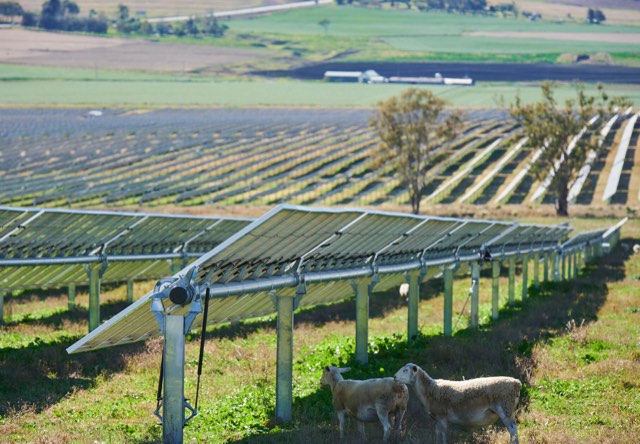
Almost every large solar farm in Australia’s southeastern states will be forced to curtail at least one-third of their power generation by 2027 due to critical delays in energy transition infrastructure projects, according to new analysis from the Australian Energy Market Operator.
The bottlenecks threaten to severely hamper Australia’s renewable energy transition as coal plants prepare for shutdown.
AEMO’s analysis reveals that no major solar farms in Victoria or South Australia are forecast to have curtailment rates below 35 percent by 2027, while several projects may be forced to shed more than 65 percent of their generated power.
The unprecedented curtailment levels result from mismatched growth between new renewable energy projects and the transmission infrastructure required to connect them to the grid.
“While some locations have not seen heavy congestion historically, they are nearing their current network limits and additional capacity may result in new areas of congestion,” the AEMO report stated.
The market operator noted that Victorian and South Australian curtailment rates are forecast to be “particularly high” as transmission capacity fails to keep pace with renewable energy development.
The infrastructure delays pose significant challenges to Australia’s energy transition timeline, with the federal government targeting 82 percent renewable energy generation by 2030 and a 43 percent reduction in carbon emissions.
AEMO has outlined a $122 billion blueprint for Australia’s future electricity grid, but many critical transmission projects have encountered delays and cost overruns.
Last week, AEMO announced a two-year extension for the $3.3 billion VNI West cable project connecting NSW and Victoria, highlighting the systemic delays affecting major infrastructure.
Other crucial projects awaiting completion include the $2.3 billion EnergyConnect line between South Australia and NSW, the 365km Humelink cable, and Victoria’s Western Renewables Link.
The transmission bottlenecks become particularly pressing as coal-fired power stations prepare for closure.
Coal plants generated approximately 53 percent of Australia’s electricity in the last financial year, with EnergyAustralia’s Yallourn plant scheduled to close in 2028 and Origin’s Eraring facility due for shutdown in 2027.
The Clean Energy Council, representing large-scale solar investors including Iberdrola, Neoen, Acciona, and Tilt Renewables, warned that slow transmission rollouts are materially impacting investment decisions.
“Large-scale solar is fast and cost-effective to build, but it’s also the most exposed to curtailment, especially when system security limits or negative prices hit in the middle of a sunny day,” said CEC spokesman Chris O’Keefe.
Energy systems researcher Dylan McConnell from the University of NSW acknowledged that some curtailment is normal in high-renewables grids but emphasised that current projections exceed efficient levels.
“There is an efficient amount of curtailment – but it’s not 60 percent,” he explained, comparing the situation to highway congestion, where infrastructure must balance capacity with cost-effectiveness.
According to AEMO data, most grid-scale wind and solar farms experienced less than 1 percent curtailment due to network constraints in 2024, though individual solar farms faced higher rates.
The dramatic increase projected through 2027 reflects the accelerating mismatch between renewable generation capacity and transmission infrastructure development timelines.