Australian Retail Sales To Hit $40 Billion As Household Goods Lead Growth
 April Ossington
19 Aug 2026
April Ossington
19 Aug 2026
Australian retail sales are forecast to reach A$40 billion in a single month for the first time in August, with household goods expected to record the strongest growth of any major retail category. However, relatively subdued inflation across appliances and consumer electronics suggests the increase is being driven by more than simply higher hardware prices.
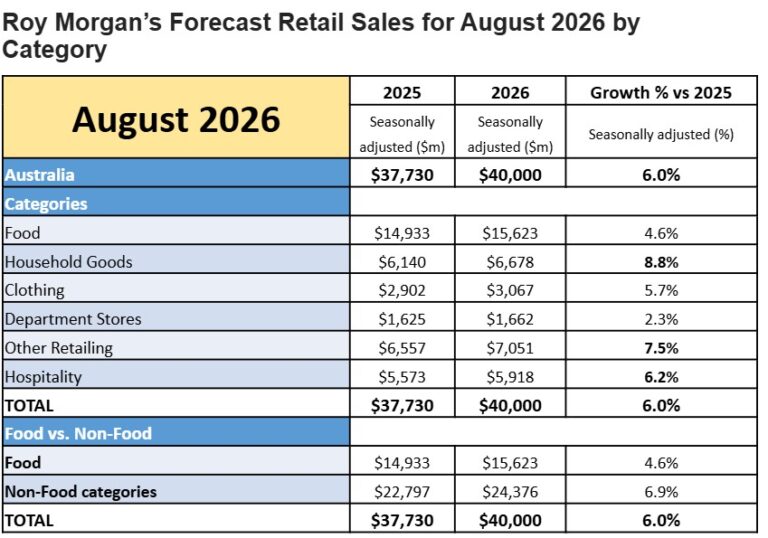
New forecasts from Roy Morgan predict total retail sales will reach A$40 billion in August 2026, an increase of 6 per cent from A$37.73 billion a year earlier.
Household Goods is expected to outperform the broader market, with sales forecast to climb 8.8 per cent from A$6.14 billion to almost A$6.68 billion.
Other Retailing is expected to increase 7.5 per cent to A$7.05 billion, while Hospitality is forecast to rise 6.2 per cent to A$5.92 billion. Clothing sales are projected to increase 5.7 per cent to A$3.07 billion, while Department Stores are expected to record the weakest growth at 2.3 per cent.
Overall non-food retail sales are forecast to increase 6.9 per cent to A$24.38 billion.
For the consumer electronics and appliance sector, the strength of the Household Goods forecast raises an important question about how much of the additional spending can be attributed to inflation.
The latest Australian Bureau of Statistics monthly Consumer Price Index provides some indication that higher hardware prices are unlikely to explain the bulk of the increase.
Headline inflation reached 3.8 per cent in the 12 months to June 2026, easing from 4 per cent in May.
Prices across the broader Furnishings, household equipment and services category increased just 1.6 per cent over the year, substantially below headline inflation.
Importantly, much of that increase came from services rather than household hardware. Childcare prices increased 7.6 per cent, while hairdressing and personal grooming services rose 4.2 per cent.
The category also recorded a 1.2 per cent monthly decline in June, coinciding with end-of-financial-year discounting.
A similar situation is evident in consumer electronics. Recreation and culture prices increased 3.3 per cent annually, but international holiday travel, up 4.2 per cent, and domestic holiday travel, up 3.8 per cent, were significant contributors.
Digital services are experiencing considerably stronger inflation than the devices used to access them. Audio, visual and computing media and services prices were up 10.5 per cent in the 12 months to May.
The distinction is significant for electronics and appliance retailers. If hardware prices are broadly flat while Household Goods sales dollars increase 8.8 per cent, price rises alone cannot account for the forecast growth.
Instead, the figures could point towards stronger sales volumes, consumers purchasing higher-value products, changes in the mix of goods being sold, or a combination of these factors.
Promotional activity also remains an important part of the equation. Consumer electronics have historically faced significant price competition, while major sales periods and discounting can restrict retailers’ ability to pass higher operating and supply-chain costs directly to consumers.
Across the wider economy, goods prices increased 3.5 per cent over the year to June, compared with a 4 per cent increase for services.
The contrast between relatively restrained hardware inflation and rapidly rising digital service costs could become increasingly important for retailers such as JB Hi-Fi and The Good Guys. Stronger sales revenue does not automatically translate into stronger margins if retailers are moving more products while maintaining aggressive prices.
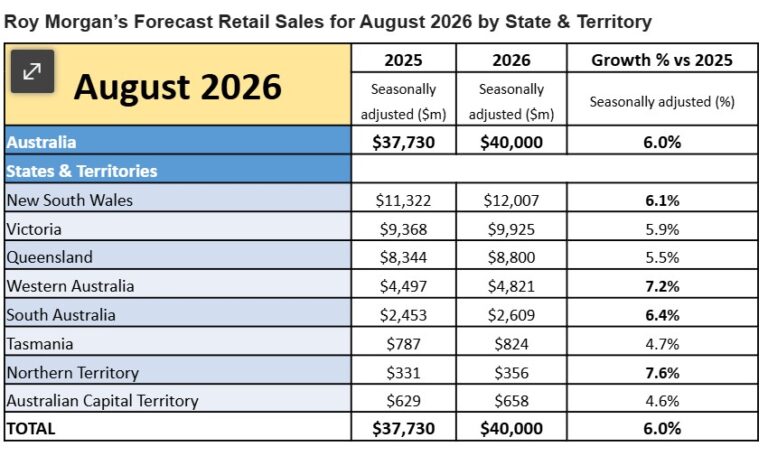
Geographically, Western Australia is forecast to record retail growth of 7.2 per cent to A$4.82 billion, while South Australia is expected to increase 6.4 per cent to A$2.61 billion.
New South Wales retail sales are forecast to exceed A$12 billion for the first time in August, increasing 6.1 per cent year-on-year. Victoria is expected to reach A$9.93 billion, up 5.9 per cent, while Queensland is forecast to increase 5.5 per cent to A$8.8 billion.
The Northern Territory is forecast to record the strongest percentage increase at 7.6 per cent, although from a considerably smaller base.
For Australia’s consumer electronics and appliance industry, however, the headline figure is Household Goods’ 8.8 per cent expected increase. With appliance and electronics hardware prices showing relatively little inflation compared with other parts of household spending, the August figures could provide a clearer indication that Australians are spending more on the category rather than simply paying more for the same products.